Abraham
Father of monotheism, model of submission, origin of religious duties
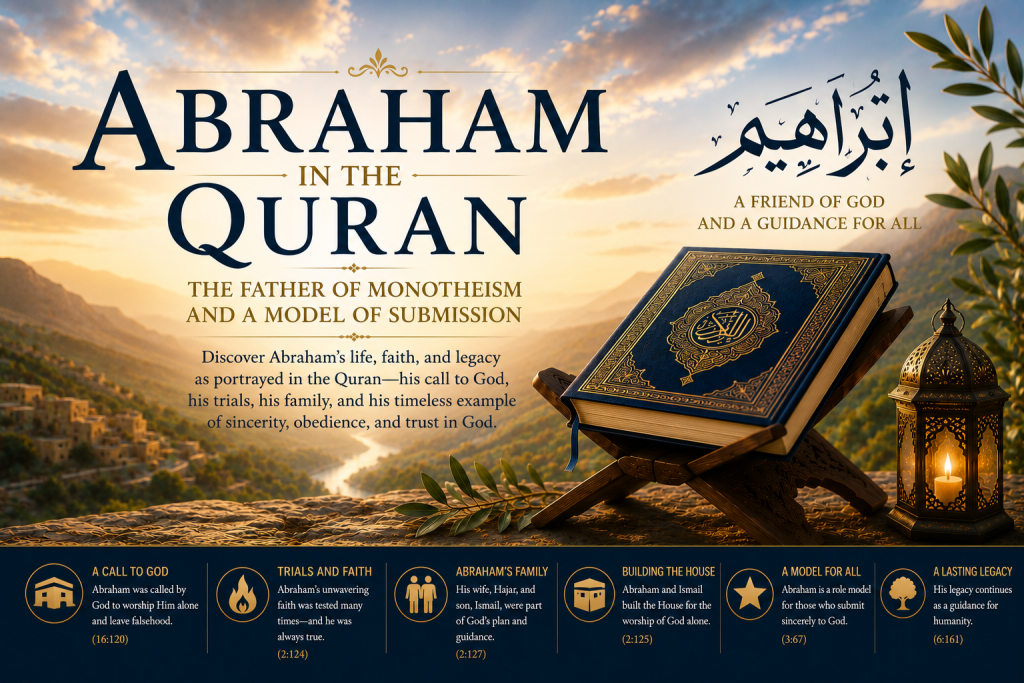
Abraham (Ibrāhīm) is presented in the Qur’an as the model of pure monotheism, a man who reasoned against idolatry, fulfilled divine tests, established religious duties, and built the Sacred House. The Qur’an commands believers to follow his religion, not sects or inherited tradition.
Abraham in the Quran is a pivotal figure, illustrating the essence of monotheism and divine submission.
INTRODUCTION
Abraham appears throughout the Qur’an as a central figure of divine guidance. He is neither the founder of a sect nor the icon of later religious groups, but a submitter to God alone, who established the religious and ethical foundations that define worship in Islam today.
This pillar collects the major themes of Abraham’s life and the Qur’anic lessons derived from them.
The teachings of Abraham in the Quran highlight his unparalleled commitment to God and his role as a model for future generations.
IDENTITY OF ABRAHAM
Abraham in the Quran: A Model of Faith
The Qur’an emphasizes Abraham’s identity as a monotheist submitter, not as a Jewish or Christian figure, nor as a symbolic abstraction. His defining traits are belief, reason, and direct devotion to God.
Pages in this section:
Key Qur’anic Points
- Challenged ancestral religion
-
Rejected idolatry publicly
-
Survived persecution
-
Migrated for God
-
Received leadership after tests
In understanding Abraham in the Quran, we see the foundations of faith that emphasize worship without intermediaries.
RELIGION OF ABRAHAM
The Qur’an calls believers to follow the religion of Abraham (millat Ibrāhīm). This religion is non-sectarian, scripturally grounded, and defined by concrete worship rather than symbolic reinterpretation.
Pages in this section:
Key Qur’anic Points:
- Monotheism without shirk
-
Religious duties rooted in Abraham
-
Leadership based on righteousness
-
Direct prayer without intermediaries
By adhering to the religion of Abraham in the Quran, believers embrace a path of true monotheism.
CORRECTIONS & CLARIFICATIONS
Abraham in the Quran is not merely a historical figure but a continuous source of guidance for all believers.
The Qur’an corrects later historical claims and re-centers religion upon Abraham’s submission, not post-Abrahamic religious structures.
Pages in this section:
Key Quranic Points:
WHY ABRAHAM MATTERS
Abraham matters because the Qur’an presents him as:
The origin of religious duties (salat, zakat, hajj…)
The recipient of covenant and leadership
The purifier of the Sacred House
The model for believers across time
The standard against sectarian claims
The Qur’an commands believers to follow his religion, not inherited divisions, cultural accretions, or re-engineered reinterpretations.
The legacy of Abraham in the Quran serves as a cornerstone for understanding Submission (Islam).
To learn how Abraham defines Qur’anic submission, explore the sections above. Each page draws from the Quran alone, without external doctrine, commentary, or sectarian interpretation.