Salat in the Quran
INTRODUCTION — WHY SALAT REQUIRES CLARIFICATION
Salat occupies a central place among religious duties, yet it is also the most frequently misunderstood. It is often reduced to ritual motion, dismissed as symbolic language, or redefined as a general state of awareness. At the same time, it is sometimes inflated into a system of human enforcement or technical perfectionism. Both approaches miss how the Quran itself presents Salat.
The Quran treats Salat as a defined religious duty that is continuous, inherited, and binding. Because it is practiced regularly and publicly, Salat becomes especially vulnerable to distortion. Meaning can be emptied while form remains, or form can be overemphasized while purpose is forgotten. For this reason, the Quran returns to Salat repeatedly, not to introduce it as something new, but to preserve its role and correct its misuse.
This page does not attempt to teach how Salat is performed. Instead, it clarifies what Salat is in the Quran, why it receives particular attention, and how the Quran governs it. Only when Salat is understood within this framework can later discussions of correction, structure, or practice remain grounded and coherent.
SALAT AS AN INHERITED ABRAHAMIC DUTY
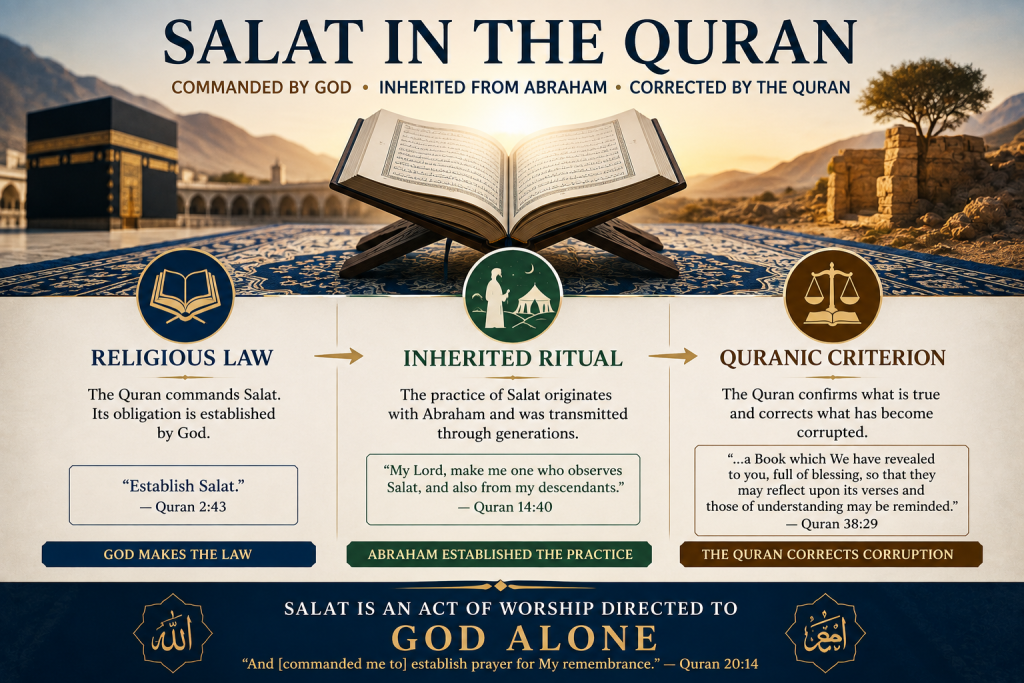
The Quran does not present Salat as an innovation introduced with its revelation. It belongs to the religious path traced back to Abraham and upheld by successive messengers. Muhammad is instructed to follow this established religion, not to create a new form of devotion. Salat therefore enters the Quranic discourse as a known and recognizable duty.
This inheritance explains the Quran’s tone. Salat is addressed as something already practiced, already visible, and already understood in its outward form. The Quran does not pause to define it from the beginning, because it speaks to people who know what Salat is. Its concern is not introduction, but alignment.
By anchoring Salat in Abrahamic continuity, the Quran establishes both permanence and restraint. Salat is not open to invention, symbolic redefinition, or personal reinterpretation. At the same time, it is not treated as a cultural artifact tied to one community or era. It is a duty that transcends generations while remaining subject to divine judgment.
This inherited character also clarifies why Salat requires careful correction rather than replacement. Because the duty persists across time, deviation does not eliminate it. Instead, revelation intervenes to restore meaning, discipline, and accountability. Salat continues as a living obligation, preserved through inheritance and governed by God’s guidance rather than by human authority. (Quran 16:123, 21:73, 22:78)
RELIGIOUS LAW AND INHERITED RITUAL
Salat must be distinguished in two related respects: its obligation as religious law and its ritual as an inherited religious practice.
The obligation to observe Salat is established by the Quran. God commands Salat; therefore its status as a religious duty does not depend upon tradition, custom, or another source of religious law.
The ritual through which Salat is performed, however, did not originate with Muhammad or with the revelation of the Quran. It was inherited through the religion of Abraham and practiced before the Quran was revealed.
WHY SALAT IS ADDRESSED MORE FREQUENTLY IN THE QURAN
Salat is the most continuous of religious duties. It is performed regularly, publicly, and repeatedly throughout a believer’s life. Because of this frequency, Salat is uniquely vulnerable to distortion. Habit can replace awareness, routine can eclipse purpose, and form can persist even when meaning has eroded.
The Quran’s repeated engagement with Salat reflects this vulnerability. It does not indicate novelty, nor does it suggest uncertainty about how Salat is performed. Rather, the repetition serves as protection. By returning to Salat across diverse contexts, the Quran reinforces its role as a living obligation tied to consciousness, discipline, and accountability.
Salat also functions as a daily anchor for submission. Unlike duties that arise periodically or conditionally, Salat intersects with ordinary life in a constant way. It therefore becomes a primary site where neglect, excess, or misalignment can emerge. The Quran addresses Salat to preserve its orientation toward God, not to multiply its form.
This frequent reference also establishes priority without hierarchy. Salat is not elevated above other duties in importance, but it is emphasized because of its centrality in shaping daily conduct. The Quran’s attention ensures that Salat remains a means of alignment rather than a hollow ritual or a tool of display.
Understanding this pattern prevents misreading. The Quran’s focus on Salat is not instructional repetition, nor is it an invitation to redefine the duty. It is a sustained reminder that a continuous obligation requires continuous correction to remain faithful to its purpose. (Quran 4:103, 29:45)
WHAT SALAT IS (AND IS NOT)
In the Quran, Salat is a defined religious duty. It is not presented as a metaphor, a psychological state, or a symbolic gesture. Nor is it described as a general form of remembrance detached from structure. Salat is an ordained act of devotion that carries form, discipline, and accountability.
At the same time, the Quran does not reduce Salat to physical motion. Performance alone does not fulfill its purpose. Salat is meant to cultivate awareness, restraint, and alignment with God. When outward form continues while awareness is absent, Salat loses its function even if its motions remain intact.
This balance is essential. Salat cannot be dissolved into abstraction, nor can it be reduced to ritualism. Attempts to redefine Salat as a purely internal experience strip it of obligation. Attempts to treat it as a performance to be perfected strip it of meaning. The Quran rejects both extremes by maintaining Salat as a structured duty oriented toward conscious submission.
Understanding what Salat is also clarifies what it is not. It is not a wellness technique, a cultural marker, or a display of piety. It is not a substitute for moral responsibility, nor does it compensate for injustice or neglect elsewhere in life. Salat functions within a broader framework of accountability, not as an isolated act.
By defining Salat in this way, the Quran preserves its integrity. Salat remains recognizable, binding, and purposeful without becoming mechanical or symbolic. This clarity allows later discussion of correction, structure, and practice to proceed without confusion or distortion.
SALAT AS A DISTINCT QURANIC DUTY
The Quran treats Salat as a distinct and defined religious duty, not as a generic expression drawn loosely from language or culture. This distinction is reflected consistently in how the Quran refers to Salat and how it differentiates it from other uses of the same root.
When the Quran speaks of Salat as an obligation upon believers, it does so in a fixed and recognizable manner. This usage signals that Salat occupies a specific category within religious life. It is not interchangeable with general invocations, blessings, or forms of remembrance that may share linguistic roots but differ in function and authority.
This distinction is important because it prevents redefinition. Salat cannot be reduced to an abstract concept such as mindfulness or moral awareness, nor can it be expanded into unrelated acts under the same label. The Quran preserves Salat’s identity by consistently treating it as an ordained duty with defined purpose and boundaries.
At the same time, the Quran does not elevate Salat through technical exposition. Its distinct status is established through usage rather than explanation. Readers are not required to analyze language or form to recognize Salat’s role. The Quran’s consistent treatment is sufficient to establish that Salat is neither symbolic nor optional, but a prescribed act of devotion.
By maintaining this distinction, the Quran protects Salat from both dilution and inflation. Salat remains what it was intended to be: a specific duty within submission to God, governed by revelation rather than by interpretation or abstraction. (Quran 2:43, 11:114)
THE QURAN’S CORRECTIVE ROLE IN SALAT
The Quran does not introduce Salat as a new practice, nor does it document it as a procedure. Instead, it addresses Salat where distortion, neglect, or excess has entered. This selective engagement reflects the Quran’s role as a criterion that judges practice rather than as a manual that reproduces it.
Correction occurs where meaning has shifted or limits have been altered. The Quran intervenes to restore orientation, discipline, and awareness without dismantling the duty itself. It clarifies when Salat is to be observed, how it should function within life, and what attitudes undermine its purpose. Where practice remains intact, the Quran remains silent.
This approach preserves continuity while asserting authority. Salat continues as an inherited obligation, but its legitimacy depends on alignment with divine guidance rather than on habit or consensus. Correction removes deviations without opening the door to reinvention or expansion.
By correcting rather than re-teaching, the Quran also prevents ritual inflation. It does not multiply requirements or introduce new layers of complexity. Instead, it restrains Salat within its intended bounds, ensuring that form serves purpose and that discipline supports accountability.
Understanding this corrective role is essential for reading the details that follow. When the Quran addresses Salat, it is not redefining the duty. It is restoring it, preserving its role as a living act of submission governed by God alone. (Quran 5:6, 17:110)
FORM, STRUCTURE, AND DISCIPLINE
Salat includes form and structure, but these elements do not exist for their own sake. In the Quran, structure serves discipline, and discipline supports awareness. Form is therefore a means, not an end.
The presence of structure does not imply rigidity or human legislation. It reflects the nature of Salat as a repeated obligation that orders time and attention. Without structure, continuity would dissolve into spontaneity and the duty itself would lose coherence. At the same time, structure is restrained. It is not expanded into exhaustive regulation or technical obsession.
This balance prevents two distortions. One reduces Salat to free expression, detached from obligation. The other turns Salat into a system of precision and enforcement. The Quran avoids both by affirming form while refusing to codify it as human law.
Discipline in Salat also protects accountability. Regularity creates consistency, and consistency reveals sincerity. Form provides a framework within which intention and awareness can be exercised repeatedly over time. Without discipline, Salat would become episodic and lose its role as a continuous anchor for submission.
By preserving form without inflating it, the Quran ensures that Salat remains recognizable, binding, and meaningful. Structure supports submission, but submission remains directed to God rather than to rules, appearances, or human authority.
SALAT AND ACCOUNTABILITY
Salat is not performed for an audience, nor is it validated by human oversight. In the Quran, Salat is an act of responsibility carried out directly before God. Its value is measured by sincerity, consistency, and alignment, not by observation or approval from others.
This direct accountability removes intermediaries. No individual performs Salat on behalf of another, and no authority evaluates its validity. Each person bears responsibility for their own observance, and judgment belongs to God alone. This preserves Salat as an expression of submission rather than as a marker of status or conformity.
Because Salat is tied to accountability, it cannot substitute for ethical conduct. It does not compensate for injustice, neglect, or wrongdoing elsewhere in life. The Quran consistently situates Salat within a broader moral framework, where devotion and responsibility are inseparable.
This connection also explains why Salat cannot be enforced. Coerced performance undermines accountability by shifting responsibility away from the individual. Salat fulfills its purpose only when it is chosen in awareness and carried out as an act of submission, not as compliance with external pressure.
By grounding Salat in accountability, the Quran preserves both obligation and integrity. Salat remains binding, but its fulfillment remains personal. It disciplines life without creating hierarchy, surveillance, or substitution, ensuring that responsibility remains where it belongs.
HOW TO READ SALAT-RELATED PAGES THAT FOLLOW
The pages that follow this hub address Salat from different angles, but they do not all serve the same purpose. Some clarify meaning and correction, while others address structure or practice. Reading them without orientation can lead to confusion, especially if mechanics are mistaken for authority.
Conceptual pages explain why Salat exists, how the Quran governs it, and where correction is required. These pages establish boundaries and principles. Practical references, where they appear, assume this framework and do not replace it. Mechanics support duty, but they do not define it.
This distinction matters because Salat has often been reduced either to technical precision or to personal interpretation. Both approaches detach practice from guidance. The Quran maintains coherence by preserving form while anchoring authority in revelation rather than in procedure.
Readers are therefore encouraged to approach Salat in sequence. Meaning comes before mechanics, and accountability comes before performance. Practical guidance exists to support observance, not to legislate it. When this order is respected, Salat remains a living obligation rather than a contested ritual.
With this orientation in place, the pages that follow can be read without confusion. Each contributes to understanding Salat as a continuous, inherited duty governed by the Quran and fulfilled in awareness before God alone.
CONCLUSION — SALAT AS CONTINUOUS SUBMISSION
In the Quran, Salat is neither an abstract concept nor a mechanical performance. It is a continuous religious duty inherited from Abraham, upheld by successive messengers, and governed by divine guidance rather than human authority. Its purpose is not display or perfection, but alignment, discipline, and accountability.
The Quran addresses Salat repeatedly to preserve its meaning and correct its misuse. Where distortion enters, revelation intervenes. Where form remains sound, the Quran remains silent. In this way, Salat continues without reinvention, and obligation remains intact without expansion.
Salat’s structure supports awareness, and its discipline supports responsibility. It cannot be reduced to symbolism, nor can it substitute for ethical conduct. It is fulfilled individually, answered for personally, and judged by God alone.
When approached within this framework, Salat remains what it was intended to be: a living act of submission that orders life, prepares for accountability, and preserves devotion without coercion or excess.
This page belongs within the broader framework governing religious duties and their Abrahamic origin.
For the conceptual foundation of obligation, accountability, and limits, see What the Quran Means by Religious Duties.
For the Abrahamic origin and continuity of religious practice, see Religious Duties Inherited from Abraham.
To examine how the Quran restores Salat where inherited practice was distorted, continue with How the Quran Corrects Inherited Salat.
A complete, Quran-aligned reference for individual, congregational, and Friday Salat, see How to Perform Salat.
How many daily Salats does the Quran establish? Five Daily Salats or Three?
For why inherited ritual does not constitute an additional source of religious law, see The Quran: Fully Detailed for Religious Guidance.