
If We Accept God’s Messenger, We Must Also Accept His Method
Introduction Many believers accept that Rashad Khalifa was the messenger spoken of in God’s covenant with the prophets: “GOD
Common Characteristics of Modern Claimants
Introduction Throughout history, individuals have claimed divine appointment, special revelation, messengership, spiritual authority, or a unique status before God.

Rashad Khalifa on Upholding the Quran Alone
Rashad Khalifa repeatedly instructed believers to follow God’s word rather than his personal words. These verified quotations from his translation, books, sermons, conferences, and Quran studies establish the Quran as the sole criterion for religious guidance and law.
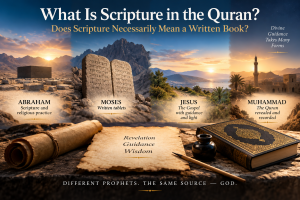
What Is Scripture in the Quran?
What does the Quran mean by scripture? The Quran refers to the scriptures of Abraham and the Gospel given to Jesus without describing either as a physical written book, while Moses explicitly received written tablets. This Quran-alone study compares Abraham, Moses, Jesus and Muhammad to examine whether divine scripture is defined by its physical form—or by its source: God.
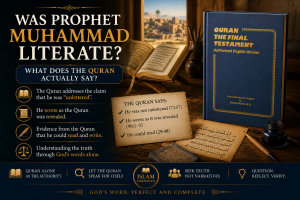
Was Prophet Muhammad Literate? A Quran-Based Reassessment
Was Prophet Muhammad illiterate? The Quran does not explicitly say so. Instead, it emphasizes that the Prophet had no prior exposure to scripture and that the Quran itself is a self-contained proof (74:30–35).
Riba in the Quran: Usury, Interest, Charity, and Trade
What does the Quran actually prohibit as riba? The Quran permits commerce while prohibiting riba, but it also discusses charity, loans, debt, capital, hardship, and justice. This Quran-alone study examines the verses on riba and asks whether every form of modern interest can automatically be equated with the riba prohibited by God.