The Proof Is Contained Within the Quran
Introduction
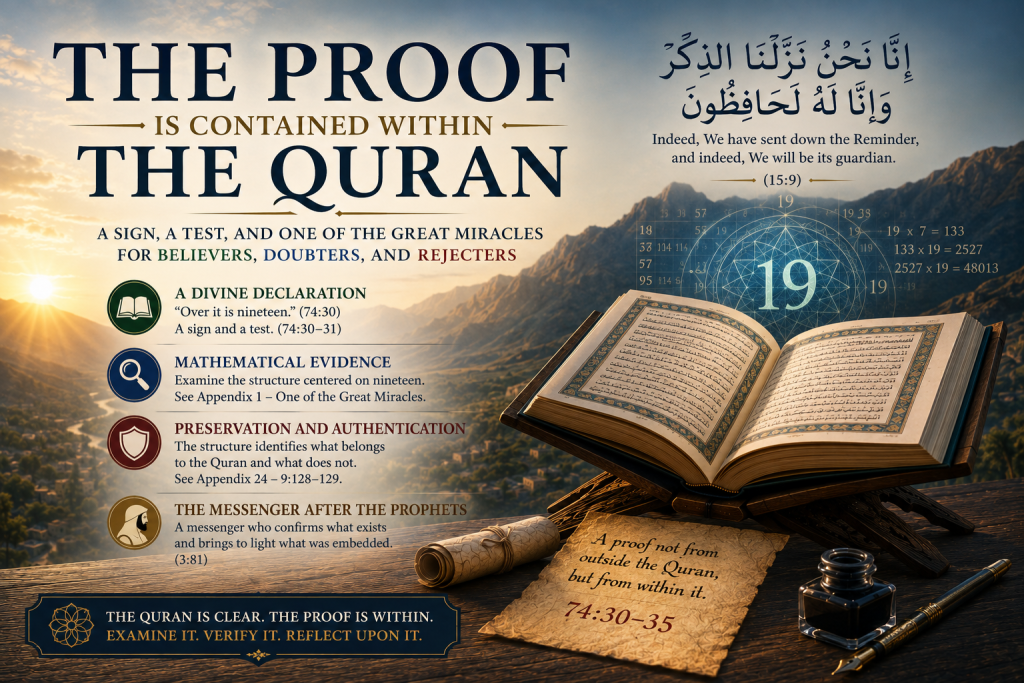
The Quran describes itself not only as guidance and reminder, but as clear proof. It declares divine preservation (15:9) and repeatedly refers to its signs.
Within the Quran appears a direct statement:
“Over it is nineteen.” (74:30)
The verses that follow describe this number as a deliberate sign and test (74:30–35). The proof is therefore not presented as something external that must be added to the Quran. The claim examined in this study is that its authentication is embedded within the Quran itself.
The Explicit Declaration
After stating “Over it is nineteen,” the Quran explains the purpose of this number (74:31):
To disturb the disbelievers.
To convince the People of the Scripture.
To strengthen the faith of the believers.
To remove doubt from the hearts of believers and the People of the Scripture.
To expose those who harbor doubt and disbelief.
The verse concludes by affirming that none knows the forces of the Lord except Him and that this is a reminder for humanity.
These are explicit textual statements. Nineteen is not presented as incidental; it is presented as intentional.
The Quran as Clear Proof
The Quran describes itself as clear proof (98:1). It also declares:
“Indeed, We have sent down the Reminder, and indeed, We will preserve it.” (15:9)
The Quran declares its preservation. A preserved text can therefore be examined for internal consistency and for the structural relationships claimed to exist within it.
The Quran also opens multiple chapters with isolated initials (10:1, 38:1), immediately connecting them to the Book and its signs. These initials form part of the textual structure.
Structural Coherence Centered on Nineteen
Examination of the Quran’s Arabic text reveals recurring structural relationships centered on the number nineteen.
These include:
Letter counts.
Word counts.
Chapter structures.
Relationships involving the Quranic initials.
Large-scale numerical coherence across the text.
Some patterns are simple and verifiable manually. Others require computational analysis due to the scope of the text.
The Quran does not spell out the mechanics of this structure. What it declares explicitly is the number nineteen and its role as a sign and test.
The structural system emerges through analysis of the preserved text.
Text and Analysis
It is essential to distinguish between what the Quran explicitly declares and what analysis demonstrates.
The Quran explicitly declares:
Nineteen.
Its function as a test.
Its role as a sign.
Its effect on belief and doubt.
Its preservation.
The mathematical interconnections associated with nineteen are derived through examination of the text.
The existence of structural coherence is demonstrable.
Its mechanics are analytical.
The Proof Belongs to the Quran
The mathematical structure associated with nineteen does not derive its authority from the person who brought it to light.
If the structure is genuine, its evidence resides in the Quran itself.
This distinction is fundamental.
A messenger may point to a sign. A researcher may demonstrate a pattern. A computer may make large-scale examination possible. But none of these creates the proof.
The claim presented here is that the proof was already embedded within the Quran and was subsequently brought to light through examination of its text.
The evidence must therefore be examined on its own terms.
This is consistent with the Quranic principle of verification:
“You shall not accept any information, unless you verify it for yourself. I have given you the hearing, the eyesight, and the brain, and you are responsible for using them.”
— Quran 17:36
The important question is therefore not simply:
Who discovered the structure?
It is:
Is the claimed structure actually present in the Quran?
For readers who wish to examine that evidence directly, the detailed mathematical analysis is presented in Appendix 1, while Appendix 24 examines the specific case of Quran 9:128–129.
The Role of the Messenger After the Prophets
The Quran describes a covenant involving a messenger who would confirm what already exists (3:81).
Confirmation does not introduce new scripture. It confirms and brings to light what is already present.
The structural system centered on nineteen was brought to light and demonstrated by the messenger after the prophets. The claim is not that the messenger created the system, but that he revealed a structure already embedded within the Quran.
This distinction preserves both:
The finality of prophethood.
The completeness of the Quran.
Rashad Khalifa — Messenger of the Covenant
Explore his identification as the Messenger of the Covenant, the mathematical proof, the purpose of life, the Quran-alone message, religious practices, and other information brought to light from within the Quran.
A Test by Design
74:30–35 describes nineteen as a test that produces different responses:
Increased certainty.
Removal of doubt.
Exposure of skepticism.
The Proof functions within this declared framework. It is measurable and open to scrutiny. It does not compel belief; it presents structural consistency.
Conclusion
The Proof is not an addition to the Quran.
It is not a parallel authority.
It is not a substitute for guidance.
It is a structural signature embedded within the preserved text — declared through the number nineteen and observable through analysis.
The Quran contains its own authentication.
Explore the Proof
The following studies allow the reader to move from the Quranic declaration of nineteen to the mathematical evidence, preservation, and the Quranic framework concerning the messenger who brings the proof to light.
Begin With the Quranic Declaration
Over It Is Nineteen (74:30–35)
Begin with the Quranic passage itself and examine what the Quran explicitly states about nineteen and its purpose.
A Sign for Believers, Doubters, and Rejecters
Explore the different responses to the sign anticipated within Quran 74:31.
Proof Does Not Compel Belief
Consider why evidence can increase certainty and remove doubt without eliminating human choice or accountability.
Examine the Mathematical Evidence
Appendix 1 — One of the Great Miracles
Examine the principal mathematical evidence associated with nineteen, including structural relationships involving letters, words, Quranic initials, suras, verses, and other features of the Quranic text.
Appendix 24 — Two False Verses Removed from the Quran
Examine the evidence concerning 9:128–129 and the claim that the mathematical structure identifies these two verses as later additions to the Quran.
Proof and Preservation
Preservation of the Quran
Explore the Quran’s declaration concerning preservation and the integrity of the transmitted text.
Modern Scholarship and the Quranic Proof
Consider the relationship between internally claimed Quranic evidence and questions approached through modern historical and textual scholarship.
The Messenger and the Proof
The Covenant Taken from the Prophets (3:81)
Examine the Quranic covenant concerning a messenger who comes confirming what already exists.
The Messenger Who Confirms What Exists
Explore why confirmation does not require a new scripture.
The Messenger Who Delivers the Proof
Examine the relationship between the messenger and a proof already contained within the Quran.
Bringing to Light What Was Embedded
Explore the distinction between creating a proof and bringing to light something already present within the scripture.
After the Prophets
Finality of Prophethood
Examine Muhammad as the final prophet and the Quranic distinction between prophethood and messengership.
The Messenger After the Prophets
Examine the Quranic case concerning a messenger following the final prophet.
Quranic Manifestations After the Prophets
Study the manifestations presented in connection with the messenger after the prophets.
The Smoke in Sura 44
Examine the Smoke as one of the manifestations associated with warning, confirmation, and accountability.