Messengers in the Quran
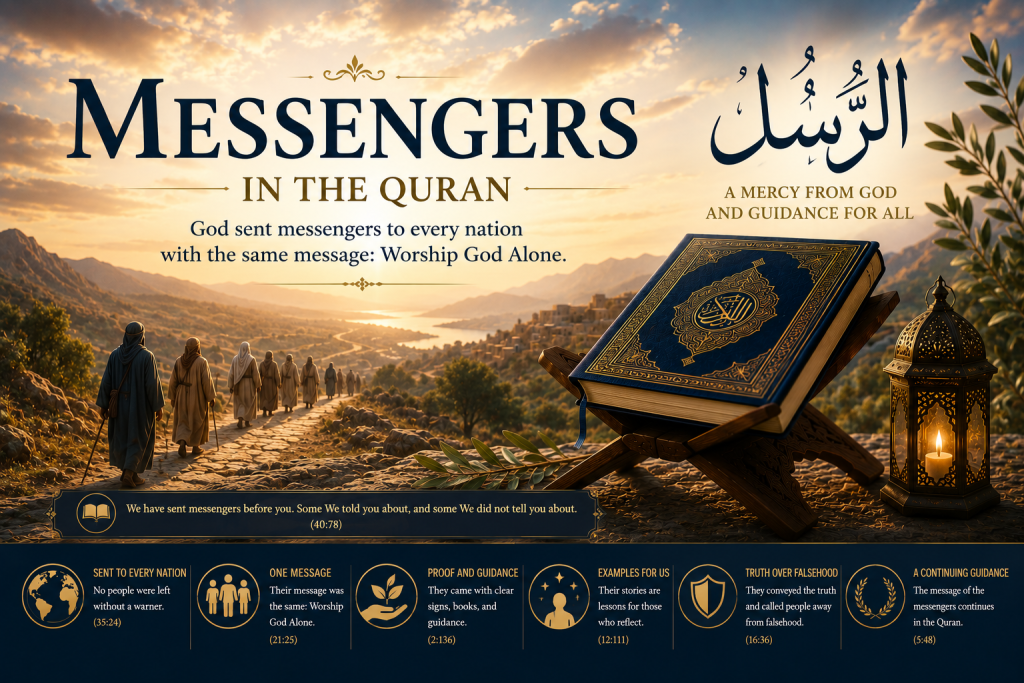
God's Guidance Through His Messengers
The Quran presents messengers as divinely commissioned human beings sent to clarify guidance and establish accountability. Across different generations and communities, the Quran describes a consistent structure of revelation, proclamation, response, and consequence.
Understanding messengership requires distinguishing between prophet (nabi) and messenger (rasul) as described in the Quran itself. While the terms overlap, the Quran’s usage indicates functional differences that shape the structure of revelation.
Prophet and Messenger: Clarifying the Terms
In the Quran, every prophet is a messenger. A prophet receives scripture or revelation and conveys it to his people. By delivering divine revelation, the prophet fulfills the function of a messenger.
However, not every messenger is necessarily described as a prophet.
Verse 3:81 describes a covenant taken from the prophets: when a messenger comes confirming what is already with them, they must believe in him and support him. This verse distinguishes between the prophets who were given scripture and a messenger who confirms what already exists.
Thus:
A prophet brings scripture and is therefore also a messenger.
A messenger confirms existing scripture and clarifies what is already revealed.
The Quran’s terminology allows for both functions within the broader structure of guidance.
The Role of a Prophet
A prophet (nabi) is one who receives revelation in the form of scripture or divine instruction. The Quran identifies several prophets who were given scripture:
Moses (Torah)
David (Psalms)
Jesus (Gospel)
Muhammad (Quran)
Verse 33:40 describes Muhammad as the Seal of the Prophets. The verse establishes the finality of prophethood, indicating that no new scripture-bearing prophet follows him.
The Quran does not describe him as the final messenger in that verse; rather, it specifies finality in relation to prophethood.
By bringing scripture, a prophet necessarily fulfills the role of a messenger, because he conveys revelation to his people.
The Role of a Messenger
A messenger (rasul) is one sent with a clear commission to proclaim, clarify, and warn. The messenger establishes accountability by delivering the message plainly.
Verse 3:81 introduces an important function of messengership: confirmation. A messenger comes confirming what is already with them — that is, confirming existing scripture.
This function of confirmation preserves continuity within revelation. Scripture is not isolated; it is reaffirmed and clarified through successive missions.
Thus:
The prophet introduces scripture.
The messenger confirms and clarifies what exists.
In some cases, these roles coincide in one individual. In other cases, they are distinct functions within the Quranic framework.
The Pattern of Messengers in the Quran
Across the narratives of Noah, Hud, Salih, Lot, Moses, and others, the Quran presents a recurring pattern:
A messenger is sent to a defined people.
The message centers on worship of God alone.
The people resist, reject, or mock.
Clarification or sign follows.
Consequence occurs after persistent rejection.
This structure is presented not merely as history, but as moral instruction. The Quran repeatedly calls readers to reflect on earlier communities and recognize the continuity of divine justice.
The sending of messengers establishes accountability. No community is held responsible without first receiving clarification.
Finality of Prophethood
Verse 33:40 identifies Muhammad as the Seal of the Prophets. With him, the line of scripture-bearing prophethood is completed. The Quran is described as fully detailed and preserved.
The verse specifies finality in prophethood, not in the broader function of messengership as described elsewhere in the Quran. The distinction between prophet and messenger therefore becomes essential for understanding the structure of revelation.
By completing prophethood, the Quran closes the introduction of new scripture.
Covenant and Confirmation (3:81)
Verse 3:81 describes a covenant taken from the prophets:
When a messenger comes confirming what is already with them, they must believe in him and support him.
This verse situates messengership within a framework of continuity and confirmation. The messenger does not bring a competing revelation, but confirms what has already been given.
The covenant underscores accountability across generations. Revelation forms a unified chain rather than isolated texts.
The Covenant Taken from the Prophets (3:81)
The Messenger Who Confirms What Exists
Quranic Manifestations After the Prophets
Major Messengers Mentioned in the Quran
The Quran names several messengers and prophets while indicating that others are not named. The following pages explore their missions as presented in the Quran.
Noah
A prolonged mission marked by patient proclamation and eventual consequence.
Abraham
A central figure in the call to monotheism and rejection of idolatry.
Moses
The most frequently mentioned prophet in the Quran, associated with scripture and confrontation with tyranny.
Joseph
A narrative emphasizing moral integrity, patience, and divine planning.
Jesus
Presented as a messenger and servant of God who confirms prior scripture and calls to pure monotheism.
Muhammad
The final prophet and recipient of the Quran.
The Messenger After the Prophets
Rashad Khalifa — Messenger of the Covenant
Explore the identification as the Messenger of the Covenant, the mathematical proof, the purpose of life, the Quran-alone message, religious practices, and other information brought to light from within the Quran.
Continue Exploring Messengership
The Quran’s discussion of messengers extends beyond the accounts of individual messengers. It also addresses their relationship to scripture, the evidence that confirms God’s messengers, the covenant taken from the prophets, and messengership after the final prophet.
These studies explore those questions in greater depth.
Messengers and Scripture
The Quran distinguishes between prophets and messengers and describes their relationship to revelation and scripture. Understanding these distinctions is important when examining both the role of God’s messengers and the Quranic statement that Muhammad was the final prophet.
Proof and Confirmation
God’s messengers do not ask people to accept unsupported claims. The Quran repeatedly connects messengership with evidence, signs, confirmation, and accountability while also making clear that proof does not compel anyone to believe.
The Proof Is Contained Within the Quran
Over It Is Nineteen (74:30–35)
A Sign for Believers, Doubters, and Rejecters
After the Prophets
The Quran describes a covenant taken from the prophets concerning a messenger who would come after scripture had been given, confirming what already existed. These studies examine 3:81 and related passages, what confirmation means, and the accountability that follows when God’s evidence is made clear.
The Covenant Taken from the Prophets (3:81)
The Messenger Who Confirms What Exists
Bringing to Light What Was Embedded
After Muhammad
The Quran identifies Muhammad as the final prophet. These studies examine the separate question of messengership after Muhammad and the Quranic evidence associated with proof, later manifestations, and the Smoke described in Sura 44.
The Messenger After the Prophets
The Proof in the Quran (74:30–31)
A Text-Centered Study
The Quran’s presentation of messengers is not merely biographical. It establishes a structured theology of revelation, confirmation, and accountability.
By examining the distinction between prophet and messenger, and by tracing the recurring pattern across communities, readers gain clearer insight into the Quran’s unified message: worship God alone, uphold revelation, and recognize responsibility.