Muhammad: Messenger and Final Prophet
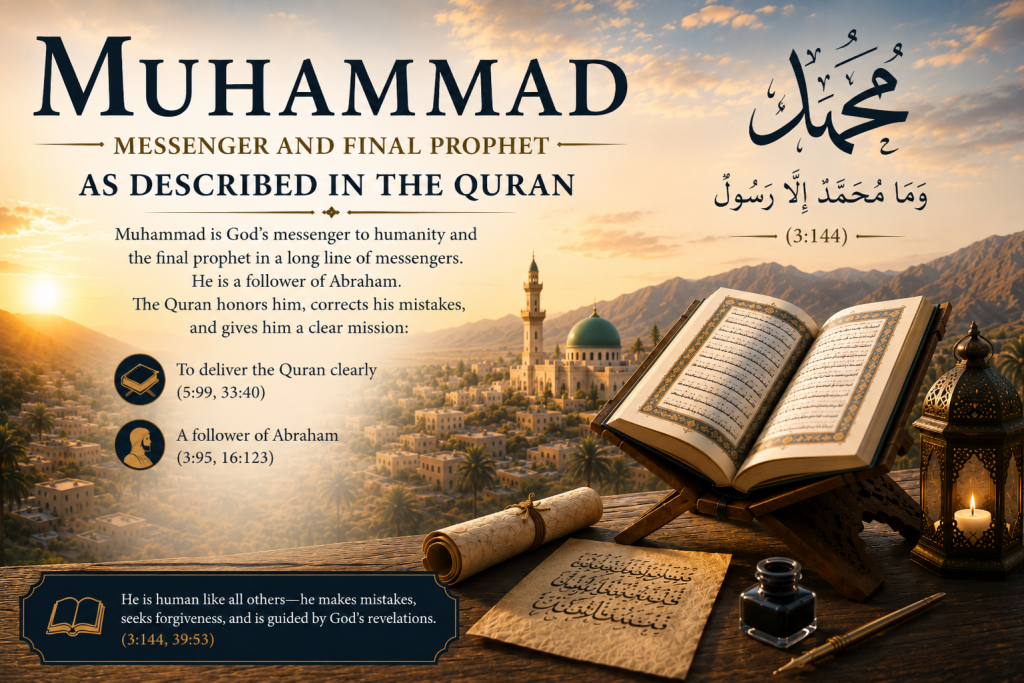
Orientation
Muhammad occupies a central place in the Quran as the recipient of its revelation and as the Seal of the Prophets. The Quran presents him as a human messenger entrusted with receiving and delivering divine scripture and calling his people to worship God alone.
Understanding Muhammad in the Quran requires attention to his humanity, his role in receiving and conveying revelation, the finality of prophethood, and his place within the Abrahamic tradition.
A Human Messenger
The Quran repeatedly emphasizes that Muhammad is a human being.
He eats, walks in markets, faces opposition, and experiences difficulty. He is instructed to declare:
“I am only a human being like you, to whom revelation has been given.”
This emphasis prevents deification and establishes that authority belongs to revelation, not to personality.
The Quran corrects expectations that a messenger must be angelic or superhuman. The sign is the message itself.
Recipient of the Final Scripture
Muhammad is the recipient of the Quran, described as guidance, clarification, and detailed scripture.
By bringing scripture, he fulfills the function of prophet. As he conveys revelation publicly, he fulfills the function of messenger. In him, both roles coincide.
The Quran presents itself as preserved and complete, forming the final scripture in the chain of revelation.
Muhammad and the Question of Literacy
The Quran’s first revealed words are “Read” (96:1), followed by the statement that God “teaches by means of the pen” (96:4). Another early chapter opens with the oath, “The Pen and what they write” (68:1). These verses place reading, writing, and recording at the center of revelation.
The Quran records opponents saying:
“These are tales of the ancients that he wrote down; they are being dictated to him morning and evening.” (25:5)
This accusation assumes writing activity. At the same time, the Quran describes Muhammad as al-ummī (7:157–158). The term appears elsewhere in the Quran (2:78, 3:20, 62:2) referring to those without prior scripture, indicating one not previously given a revealed book rather than explicitly stating illiteracy.
The Quran’s emphasis remains on divine origin and preservation:
“We will collect it and recite it.” (75:17)
“The Holy Spirit has brought it down.” (2:97)
The focus is not on literacy status, but on the certainty that revelation is from God and safeguarded by Him.
Seal of the Prophets (33:40)
Verse 33:40 identifies Muhammad as the Seal of the Prophets.
This establishes the finality of prophethood. No new scripture-bearing prophet follows him.
The verse specifies finality in relation to prophethood. With him, the introduction of new scripture concludes. The Quran is presented as fully detailed and preserved.
This distinction between prophet and messenger becomes important in understanding how revelation is completed while clarification remains anchored in scripture itself.
Muhammad in the Abrahamic Line
Muhammad’s mission is situated within the Abrahamic line of prophets. The Quran repeatedly affirms that true believers follow the religion of Abraham – submission to God alone (2:130–135, 4:125).
God describes Abraham as a model of pure monotheism:
“God took Abraham as a sincere friend.” (4:125)
Muhammad is presented not as introducing a new religion, but as reinforcing and completing the same monotheistic message that Abraham championed.
In this way, the Quran positions Muhammad within the Abrahamic spiritual lineage – one who calls to the same core message: worship God alone and uphold divine guidance.
The Role of the Messenger
The Quran describes Muhammad’s mission as:
- Receiving and delivering God’s revelation
- Reciting God’s revelations to the people
- Warning and giving good news
- Calling people to worship God alone
Muhammad was responsible for faithfully conveying what was revealed to him. He was not an independent source of religious law, nor does the Quran make him the source of its explanation. The Quran states that explanation belongs to God (75:19).
Muhammad’s responsibility was therefore to deliver the message entrusted to him. Belief, rejection, and accountability remained with the individual.
“Your duty is only to deliver.”
Rejection and Opposition
Like earlier messengers, Muhammad faced accusations:
Poet
Sorcerer
Insane
Fabricator
The Quran responds to these charges and reassures him. The pattern mirrors earlier narratives: messenger sent, message delivered, resistance encountered.
Unlike certain earlier communities, however, the Quran does not describe the complete destruction of his people. Accountability extends across generations.
Authority and Limitation
The Quran establishes boundaries around Muhammad’s authority.
He does not control benefit or harm except as God wills.
He does not possess knowledge of the unseen beyond revelation.
He cannot compel belief.
These limitations preserve strict monotheism. The messenger conveys revelation; he does not replace it.
Completion of Revelation
With Muhammad, scripture reaches completion. The Quran describes itself as fully detailed and sufficient.
The finality of prophethood closes the era of new scripture. The Quran stands as preserved guidance.
Muhammad’s mission therefore represents culmination and confirmation within the unified chain of messengers.
Conclusion
Muhammad in the Quran is presented as a human messenger and the Seal of the Prophets. He receives and conveys the final scripture, clarifies its message, and calls humanity to worship God alone.
The Quran situates him within the Abrahamic tradition, affirms the completion of prophethood, and emphasizes that authority belongs to revelation itself.
Through him, the chain of scripture concludes — and the call of monotheism continues.
Continue Your Study
Muhammad, Prophethood, and Messengership
Messengers in the Quran
Explore the broader Quranic framework for prophets, messengers, scripture, confirmation, and accountability.
Finality of Prophethood
Examine Quran 33:40 and the distinction between Muhammad as the final prophet and the broader Quranic concept of messengership.
Was Prophet Muhammad Literate?
Examine the Quranic evidence concerning Muhammad’s literacy and the meaning of ummi.
Did Prophet Muhammad Write the Quran?
Consider the Quranic evidence concerning Muhammad’s relationship to the written revelation.
What is Scripture in the Quran
For a comparison of how the Quran describes the scriptures associated with Abraham, Moses, Jesus, and Muhammad.
Muhammad and Religious Authority
The Quran: Fully Detailed for Religious Guidance
Explore why the completeness of God’s religious law does not require Muhammad to become an independent source of religious legislation.
No Other Source of Law
Examine the Quranic basis for God’s exclusive authority to establish religious law.
Who Explains the Quran?
Examine whether the Quran assigns its explanation to Muhammad or to God.
Obedience to a Human Messenger Is Conditional
Explore what obedience to God’s messenger means and the relationship between the messenger and the revelation he delivers.
Muhammad and the Abrahamic Tradition
Abraham in the Quran
Explore the Quranic foundation of the religious tradition Muhammad was commanded to follow.
Religion of Abraham
Examine why Muhammad and the believers are directed to follow the religion of Abraham.
Final Prophet and What Follows
The Covenant Taken from the Prophets (3:81)
Examine the Quranic covenant concerning a messenger who confirms existing scripture.
The Messenger Who Confirms What Exists
Explore the distinction between the completion of prophethood and a messenger who confirms what already exists.