How to Perform Salat (Contact Prayer)
This page provides complete, practical instructions for performing Salat correctly — individually, in congregation, and in Friday congregational prayer.
ABLUTION (WUDU)
Before starting the Contact Prayer, a person is required to perform ablution (wudu).
Ablution consists of four steps only:
- Wash the face
- Wash the arms to the elbows
- Wipe the head
- Wash the feet to the ankles
Any additional steps are man-made additions and are not authorized.
Certain circumstances, such as sexual orgasm, require bathing.
If water is not available or cannot be used, dry ablution (tayammum) may be performed by touching clean, dry soil and rubbing the face and hands.
INTENTION
Intention is made in the heart
Intention is not spoken aloud
The worshipper intends which Contact Prayer is being observed:
Dawn
Noon
Afternoon
Sunset
Night
THE CALL TO PRAYER (AZAN)
The Calling to the Prayer (Azan) is not part of Salat and is not required.
It is used for congregational prayer to notify others that it is time to observe Salat.
The Azan must be dedicated to God alone and must not include the name of anyone else.
The Azan is spoken as follows:
Arabic
الله أكبر
الله أكبر
الله أكبر
الله أكبر
لا إله إلا الله
Transliteration
Allāhu Akbar
Allāhu Akbar
Allāhu Akbar
Allāhu Akbar
Lā ilāha illā llāh
Meaning
God is the Greatest
God is the Greatest
God is the Greatest
God is the Greatest
There is no god except God
PRAYER LEADER (IMAM)
There is no hierarchical authority or clergy.
One person from the congregation is chosen to lead the Contact Prayer and is designated as the Imam for that prayer only.
Members of the congregation usually share this responsibility
HOW TO PERFORM SALAT (INDIVIDUAL)
First — Direction
Face the direction of the Sacred Masjid in Mecca.
Second — Hands
Raise the hands to the sides of the head, thumbs near the ears, palms facing forward.
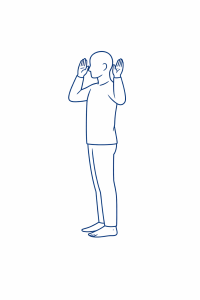
Third — Opening Statement
Say:
Arabic
الله أكبر
Transliteration
Allāhu Akbar
Meaning
God is the Greatest
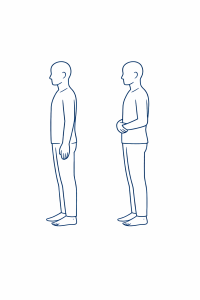
Lower the hands to the sides or crossed over the stomach.
Fourth — Recitation (Standing)
Recite Al-Fātiḥah (The Key) in Arabic.
Arabic
بِسْمِ اللَّهِ الرَّحْمَٰنِ الرَّحِيمِ
الْحَمْدُ لِلَّهِ رَبِّ الْعَالَمِينَ
الرَّحْمَٰنِ الرَّحِيمِ
مَالِكِ يَوْمِ الدِّينِ
إِيَّاكَ نَعْبُدُ وَإِيَّاكَ نَسْتَعِينُ
اهْدِنَا الصِّرَاطَ الْمُسْتَقِيمَ
صِرَاطَ الَّذِينَ أَنْعَمْتَ عَلَيْهِمْ
غَيْرِ الْمَغْضُوبِ عَلَيْهِمْ وَلَا الضَّالِّينَ
Transliteration
Bismillāhi r-raḥmāni r-raḥīm
Al-ḥamdu lillāhi rabbi l-ʿālamīn
Ar-raḥmāni r-raḥīm
Māliki yawmi d-dīn
Iyyāka naʿbudu wa iyyāka nastaʿīn
Ihdinā ṣ-ṣirāṭa l-mustaqīm
Ṣirāṭa lladhīna anʿamta ʿalayhim
Ghayri l-maghḍūbi ʿalayhim wa lā ḍ-ḍāllīn
Meaning
In the name of God, the Most Gracious, the Most Merciful.
Praise be to God, Lord of the universe.
The Most Gracious, the Most Merciful.
Master of the Day of Judgment.
You alone we worship; You alone we ask for help.
Guide us in the right path.
The path of those whom You blessed;
not of those who incurred wrath, nor of those who went astray.
Fifth — Bowing (Rukūʿ)
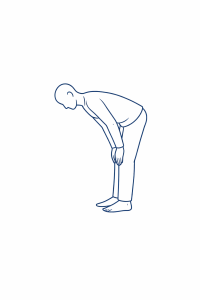
Bow from the waist.
Say:
Arabic
سُبْحَانَ رَبِّيَ الْعَظِيمِ
Transliteration
Subḥāna Rabbiyal ʿAẓīm
Meaning
Glory be to my Lord, the Great
Sixth — Return to Standing
Say:
Arabic
سَمِعَ اللَّهُ لِمَنْ حَمِدَهُ
Transliteration
Samiʿa llāhu liman ḥamidah
Meaning
God hears those who praise Him
Seventh — Prostration (Sujūd)
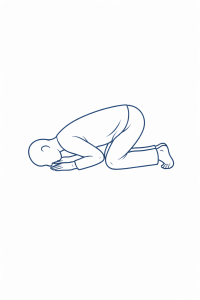
Move into full prostration.
Say:
Arabic
سُبْحَانَ رَبِّيَ الْأَعْلَى
Transliteration
Subḥāna Rabbiyal Aʿlā
Meaning
Glory be to my Lord, the Most High
Eighth — Rise to Sitting
Say:
Arabic
الله أكبر
Transliteration
Allāhu Akbar
Ninth — Second Prostration
Return to prostration and repeat:
Subḥāna Rabbiyal Aʿlā
This completes one unit (rakʿah).
Tenth — Sitting and Completion
At the end of every two units and at the end of the final unit, remain seated and say:
Arabic
أَشْهَدُ أَنْ لَا إِلَٰهَ إِلَّا اللَّهُ
وَحْدَهُ لَا شَرِيكَ لَهُ
Transliteration
Ashhadu an lā ilāha illā llāh
Waḥdahu lā sharīka lah
Meaning
I bear witness that there is no god except God.
He has no partner.
To complete the prayer, look to the right and say As-Salāmu ʿAlaykum,
then look to the left and say As-Salāmu ʿAlaykum.

Tone (Individual Salat)
Recitation should be in a moderate voice, neither loud nor silent.
CONGREGATIONAL SALAT
One person leads the prayer
The leader recites Al-Fātiḥah aloud
Other utterances, except Allāhu Akbar, are said silently
Anyone may join the congregation at any point
Missed portions are completed after the congregation finishes
FRIDAY CONGREGATIONAL PRAYER
Held during the noon period
Two sermons precede the prayer
Each sermon begins with:
Al-Ḥamdu li-llāh
Lā ilāha illā llāh
Each sermon lasts approximately 15 minutes
Sermons are delivered in the language of the congregation
After the first sermon, the Imam says Tūbū ilā llāh
The Imam sits briefly, then delivers the second sermon
A member of the congregation calls the Azan
The Imam then leads the remaining two units of prayer