God in the Quran
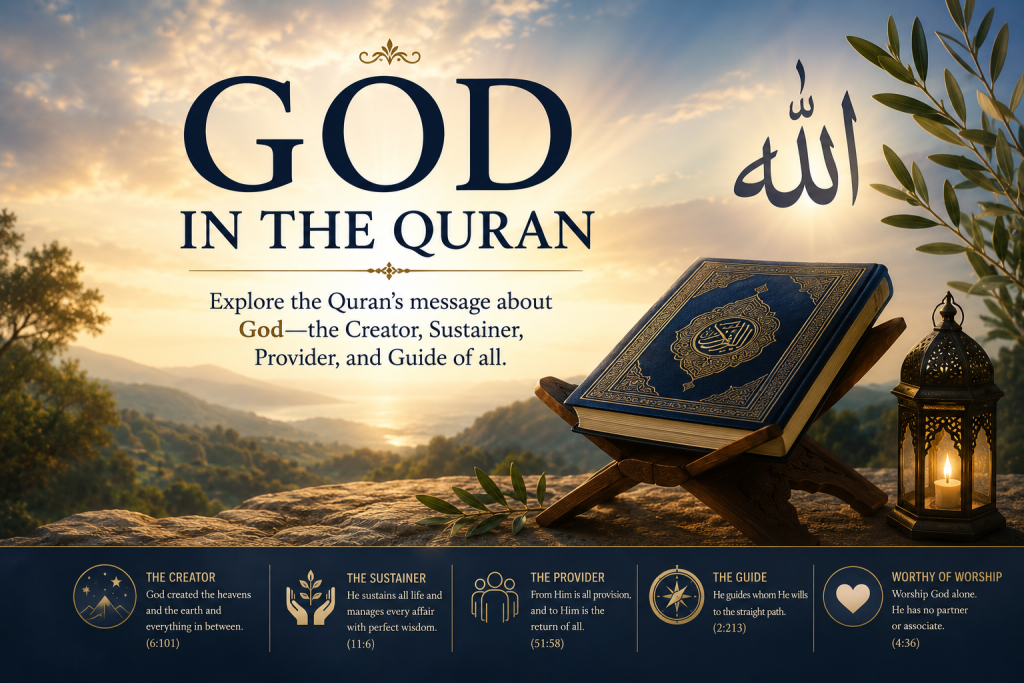
This page examines how the Quran presents God — His attributes, uniqueness, authority, and relationship with creation — based on the Quran alone.
Why the Quran Alone Defines God
The Quran does not present God as an abstract concept to be inferred, debated, or reconstructed through philosophy or tradition. It presents God as a self-describing reality. God speaks, identifies Himself, declares His attributes, establishes His authority, and defines humanity’s relationship to Him in clear and repeated terms.
For this reason, the Quran does not authorize any external source to define God. Neither religious institutions, inherited traditions, scholarly opinions, mystical systems, nor cultural practices are permitted to supplement or reinterpret what God has revealed about Himself. (Quran 6:114, 12:40)
The Quran consistently affirms that God is complete in His communication. He is not dependent on later explanations, oral transmissions, or interpretive frameworks to clarify His identity. To seek descriptions of God outside the Quran is therefore not an act of reverence, but a departure from the very source that claims exclusive authority in matters of belief, law, and accountability. (Quran 6:38, 16:89)
God Introduces Himself
Throughout the Quran, God speaks in the first person. He declares who He is, what He is not, and what He expects from human beings. This self-disclosure leaves no conceptual vacuum that needs to be filled by human speculation.
God does not delegate the definition of His nature to prophets, scholars, or communities. Messengers convey the message, but the message itself remains God’s own words. The Quran therefore positions itself as the final reference point for knowing God—not one reference among many.
Authority Cannot Be Shared
To define God is an act of authority. The Quran repeatedly emphasizes that authority belongs to God alone—authority over law, guidance, judgment, and the unseen. When additional sources are used to describe God’s attributes, intentions, or requirements, authority is effectively shared with something other than God.
This is not presented in the Quran as a neutral practice. It is identified as a serious deviation: attributing to God statements He did not make, or accepting descriptions of God that He did not authorize. Such practices reshape God into an image influenced by history, culture, or power structures rather than revelation.
The Risk of Inherited Theology
Most religious understandings of God are inherited rather than examined. They are absorbed through family, institutions, rituals, and repetition. Over time, these inherited ideas acquire emotional weight and social reinforcement, making them resistant to scrutiny.
The Quran repeatedly challenges this inheritance-based belief system. It calls individuals to set aside what they have received from their forefathers when it conflicts with revelation. Knowing God, according to the Quran, is not a communal inheritance but a personal responsibility.
A Single Methodological Principle
Accordingly, this site adopts a single governing principle:
God is known only by what God says about Himself in the Quran.
Nothing is added. Nothing is removed. Nothing is redefined to fit philosophical trends, mystical symbolism, or institutional needs. Where the Quran speaks, it is accepted. Where it is silent, silence is maintained. (Quran 7:3)
This approach does not reduce God; it preserves Him from human projection.
God’s Oneness and Incomparability
The Quran presents God as absolutely one, unique, and without equal. This oneness is not merely numerical; it is qualitative and exclusive. God is one in His essence, one in His authority, one in His law, and one in His right to be worshiped and obeyed.
The Quran repeatedly emphasizes that nothing resembles God in any way. No being shares His attributes, His power, or His role. Any attempt to liken God to creation—whether physically, emotionally, or functionally—is rejected outright.
God is not part of creation, nor is creation an extension of Him. He is not confined by space, time, or form. He does not incarnate, divide, or manifest as multiple persons or entities. The Quran consistently negates all such notions, not as philosophical abstractions, but as clear doctrinal boundaries. (Quran 112:1–4)
God Has No Equals, Partners, or Counterparts
The Quran rejects the idea that God shares His divinity or authority with anyone or anything. This includes not only overt partners, but also subtle forms of association—such as granting divine authority to intermediaries, institutions, or sacred figures.
God alone creates. God alone sustains. God alone legislates. God alone judges.
No prophet, messenger, angel, or righteous individual participates in these roles independently or jointly. Any system that assigns divine functions to others—whether through intercession, religious lawmaking, or ritual mediation—violates the Quranic description of God’s uniqueness. (Quran 42:11, 16:60)
God Is Independent and Self-Sufficient
The Quran describes God as completely independent of His creation. He does not need human acknowledgment, rituals, structures, or systems to validate His existence or authority. Acts of worship do not benefit God; they benefit the individual who submits.
God does not require assistants, representatives, or guardians. He is not strengthened by obedience nor diminished by rejection. This independence sharply distinguishes the Quranic concept of God from human institutions that rely on hierarchy, enforcement, or collective participation to sustain themselves.
God Is Not Physical or Localized
The Quran does not describe God as occupying a physical location or dwelling within constructed spaces. While places may be designated for remembrance or submission, God Himself is not contained within them.
God cannot be approached through physical proximity, geographic direction, or architectural symbolism. Nearness to God in the Quran is moral and conscious—not spatial. Any attempt to localize God within buildings, objects, or directions reflects human projection rather than revelation. (Quran 6:103, 50:16)
Incomparability as a Safeguard
By emphasizing God’s incomparability, the Quran protects belief from distortion. Human beings naturally project their limitations, emotions, and social structures onto what they worship. The Quran interrupts this tendency by repeatedly negating resemblance and likeness.
God is not a magnified human. He is not subject to human psychology, needs, or conflicts. He is not shaped by history, culture, or theology. He is exactly as He describes Himself—nothing more and nothing less.
Recognizing this incomparability is essential. Without it, belief gradually shifts away from submission to God and toward submission to humanly constructed images of Him.
God’s Authority: Law, Guidance, and Judgment
The Quran does not present God merely as a creator to be admired or a spiritual symbol to be contemplated. It presents Him as the sole authority over belief, conduct, law, guidance, and ultimate judgment. God’s oneness is inseparable from His authority; to accept one while diluting the other is a contradiction.
In the Quran, authority is not distributed. It is not shared with institutions, scholars, traditions, or communities. God alone determines what is lawful and unlawful, what is right and wrong, and what leads to success or failure in this life and the Hereafter.
God Alone Legislates
The Quran repeatedly affirms that legislation belongs exclusively to God. Religious law is not derived from consensus, precedent, or scholarly interpretation layered over revelation. It is derived from what God has revealed.
When human beings introduce additional sources of religious law—whether texts, traditions, or inherited practices—they effectively place those sources alongside God as lawmakers. The Quran treats this not as a procedural difference, but as a theological violation: accepting authority in religion that God did not grant.
Submission to God, as defined by the Quran, therefore requires accepting God as the only source of binding religious guidance. (Quran 5:44-50, 12:40)
Guidance Comes Directly from God
The Quran presents itself as complete, clear, and sufficient guidance. God does not describe His message as partial, symbolic, or dependent on later explanations. Guidance is delivered through revelation, not through religious elites or interpretive hierarchies.
While individuals may study, reflect, and learn, no person or institution possesses inherent authority to define belief or duty for others. Guidance is personal and direct: God addresses humanity as individuals, each accountable for how they respond to what has been revealed.
This direct relationship removes the need for intermediaries and dismantles religious gatekeeping. No one stands between a person and God’s guidance. (Quran 2:38, 39:41)
.
Judgment Belongs to God Alone
The Quran consistently returns to a single reality: every human being will stand individually before God. No one will carry another’s burden. No authority, affiliation, or religious identity will shield anyone from accountability.
Judgment is not delegated. It is not exercised by institutions in God’s name, nor can it be deferred to representatives or systems. God alone evaluates belief, intentions, and actions.
This principle strips religious power structures of ultimate authority. No human being has the right to declare another saved or condemned. Such claims belong exclusively to God. (Quran 6:164, 99:7-8)
The Consequences of Dividing Authority
When authority is divided—when law comes from one source, guidance from another, and judgment is implied by social or religious standing—the Quranic concept of God is fundamentally altered. God becomes symbolic rather than sovereign.
The Quran repeatedly warns that this division leads to confusion, conflict, and moral instability. Without a single, unshared authority, belief fragments, and religion becomes a human-managed system rather than submission to God.
Recognizing God as the sole authority restores coherence. Law, guidance, and judgment converge under one source, one standard, and one accountability.
What God Is Not: Quranic Negations
The Quran does not only describe who God is; it also repeatedly clarifies who God is not. These negations are essential. Without them, human beings tend to project their own limitations, institutions, and social structures onto God, gradually reshaping belief to resemble human authority rather than divine revelation.
By setting firm boundaries, the Quran protects the concept of God from corruption and misuse.
God Is Not in Need of Intermediaries
The Quran does not authorize intermediaries between God and human beings. No person, institution, or spiritual class is assigned the role of mediating access to God, securing forgiveness, or conveying divine approval.
God hears directly. God responds directly. God judges directly.
When intermediaries are introduced—whether saints, clergy, scholars, or religious systems—the relationship between God and the individual is altered. Responsibility shifts away from personal accountability and toward reliance on representation. The Quran consistently dismantles this structure by affirming direct accountability and direct access. (Quran 2:186, 39:44)
God Does Not Share Authority in Religion
God does not share His authority over religious law, belief, or obligation. The Quran repeatedly warns against accepting religious rulings from sources that God did not authorize.
This includes not only explicit lawmaking, but also subtle forms of authority: declaring practices obligatory, redefining core terms, or assigning spiritual status that God did not grant.
When religious authority is shared, God becomes symbolic rather than sovereign. The Quran presents this as a fundamental deviation, not a minor disagreement. (Quran 9:31, 42:21)
God Does Not Dwell in Buildings or Objects
The Quran does not describe God as residing in physical structures, sacred objects, or geographic locations. While certain places may be designated for remembrance or submission, God Himself is not contained by them.
Buildings do not house God. Objects do not channel God. Directions do not locate God.
When physical spaces or symbols are treated as if they possess divine presence or special access to God, reverence quietly shifts from God to what humans have constructed. The Quran consistently redirects attention away from material representations and back to conscious submission. (Quran 2:115, 22:40)
God Is Not Defined by Ritual Performance
The Quran does not portray God as dependent on ritual acts for validation or appeasement. Acts of worship are meaningful only insofar as they reflect awareness, sincerity, and obedience to God’s guidance.
Rituals performed without understanding, conscience, or moral consistency do not elevate belief. When ritual becomes an end in itself, it replaces submission with habit and appearance.
The Quran repeatedly warns against outward religious displays that are disconnected from justice, honesty, and accountability. (Quran 2:177, 107:4-7)
God Is Not Contradictory or Ambiguous
The Quran does not present God as inconsistent, self-contradictory, or deliberately obscure in matters of belief and accountability. God’s message is described as clear, complete, and internally consistent.
Confusion arises not from revelation, but from layering revelation with external assumptions, inherited doctrines, or philosophical reinterpretations. When contradictions appear, the Quran directs the individual to re-examine the source of those contradictions—not to attribute them to God. (Quran 4:82, 12:111)
The Consequences of Distorting God
Distorting the concept of God is not a harmless intellectual exercise. According to the Quran, how God is understood directly shapes how people live, judge, obey, justify themselves, and relate to others. When God’s identity or authority is altered, the consequences unfold both individually and collectively.
The Quran consistently links corrupted belief about God with moral confusion, social injustice, and false security.
Psychological Consequences: False Security and Anxiety
When God is redefined through intermediaries, rituals, or institutions, individuals often develop a sense of security that is disconnected from personal accountability. Responsibility is transferred to systems, leaders, or symbolic acts, reducing the urgency of conscience-driven behavior.
At the same time, distortion produces anxiety. When God’s expectations are unclear, contradictory, or filtered through competing authorities, individuals oscillate between fear and complacency—never grounded in clarity. The Quran presents this instability as a consequence of abandoning God’s direct guidance.
Moral Consequences: Selective Obedience
Distorting God often leads to selective obedience. Certain commands are emphasized because they are socially visible or institutionally enforced, while others—such as justice, honesty, restraint, and compassion—are minimized or postponed.
When religious authority is fragmented, moral priorities become negotiable. The Quran repeatedly criticizes this pattern: outward compliance paired with inward neglect. A distorted image of God permits behavior that a clear understanding of God would immediately expose as incompatible with submission. (Quran 4:82, 12:111)
Social Consequences: Power and Control
Throughout history, distorted concepts of God have been used to legitimize human authority. When God is portrayed as endorsing specific hierarchies, institutions, or classes, dissent becomes framed as rebellion against God rather than disagreement with people.
The Quran consistently challenges this fusion of divine authority with human power. It depicts religious elites who “take others as lords besides God” not by explicit worship, but by accepting their authority in matters God reserved for Himself. The result is a religious system that serves control rather than guidance. (Quran 28:83, 40:26)
Spiritual Consequences: Distance Disguised as Devotion
Ironically, distortion often increases religious activity while diminishing genuine awareness of God. Rituals multiply. Symbols proliferate. Language becomes elaborate. Yet the sense of nearness, responsibility, and humility fades.
The Quran warns that remembrance without understanding and worship without consciousness do not bring one closer to God. When God is obscured by layers of tradition and reinterpretation, devotion becomes performance rather than submission.
Accountability in the Hereafter
The Quran consistently returns to one unavoidable reality: every individual will answer directly to God. No inherited belief, religious identity, or communal affiliation will substitute for personal responsibility.
Distorted beliefs will not be corrected by association or intention alone. The Quran portrays the Day of Judgment as a moment when assumptions collapse and clarity is restored—too late to revise one’s understanding of God.
For this reason, the Quran urges people to examine what they accept about God now, while accountability can still be acted upon. (Quran 23:101, 75:13-15)
Explore Related Topics
The Quran’s description of God is not abstract theology. It has direct implications for belief, religious practice, authority, accountability, and daily life. The following topics examine those implications in greater depth, always using the Quran alone as the reference point. (Quran 17:36)
Each page expands on a specific dimension introduced in this pillar and links back here to preserve coherence and accountability.
Quran references link to the site’s centralized Quran index for direct verse access.
God's Attributes
-
God is One
The Quran emphasizes again and again that God is absolutely One. -
God is Independent
The Quran presents God as absolutely independent. -
God is Merciful and Just
The Quran repeatedly describes God as both Most Merciful and Perfectly Just. - God is Aware of All Things The Quran presents God as completely aware of all things.
- God is The Most Gracious and the Most Merciful
The Quran distinguishes between God as the Most Gracious and the Most Merciful, revealing complementary dimensions of His grace and mercy.
God and Authority
God Alone as Lawgiver
How the Quran defines religious authority and why no external sources can share it.Judgment Belongs to God Alone
Personal accountability, individual responsibility, and the limits of human judgment.Guidance Without Intermediaries
Why the Quran removes clerical and institutional gatekeeping.God Controls Everything
The Qur’an presents God as the sole sovereign over creation.Intercession in the Quran
Quran never allows intercession to compete with or override God’s judgment.No Representatives Before God
The Quran repeatedly affirms that each person stands alone before God.
God and Religious Practice
-
God and Religious Practice
The Quran presents religious practice as guidance for human beings, not as a necessity for God. - What Is Worship in the Quran?
Distinguishing conscious submission from ritual performance. -
Does God Need Rituals?
Examining intention, awareness, and moral consistency. -
What is Salat in the Quran
Understanding salat without inherited assumptions.
God and Sacred Space
Does God Dwell in a House?
A Quranic examination of buildings, places, and divine presence.Masjid in the Quran
Meaning, function, and misuse of the term.Direction, Nearness, and Focus
Physical orientation versus conscious orientation.
God and the Individual
Conscience, Awareness, and Submission
How belief translates into lived responsibility.Preparing for the Hereafter
Why understanding God correctly matters now.
How to Use This Page
This page serves as the foundation for the topic of God. Each article linked above explores one aspect in detail but returns here as its reference point. Readers are encouraged to revisit this page regularly, especially when encountering claims about God that rely on sources outside the Quran.
Understanding God correctly is not a peripheral matter. According to the Quran, it is the axis upon which belief, conduct, and accountability turn.
Explore Additional Articles on God
For a deeper exploration of how the Quran defines God – His attributes, His role as Creator, and His relationship to creation – see the full collection of articles:
Continue Your Study
Worship God Alone
How understanding God leads to exclusive worship and religious devotion.
The Opening Chapter of the Quran
How the Quran introduces God, mercy, judgment, worship and guidance.
The Quran: How Guidance Works
Explore how God communicates His guidance through revelation.
The Religion of Abraham
Explore the Quranic model of pure submission to God alone.