Introduction: Beyond the Basmalah
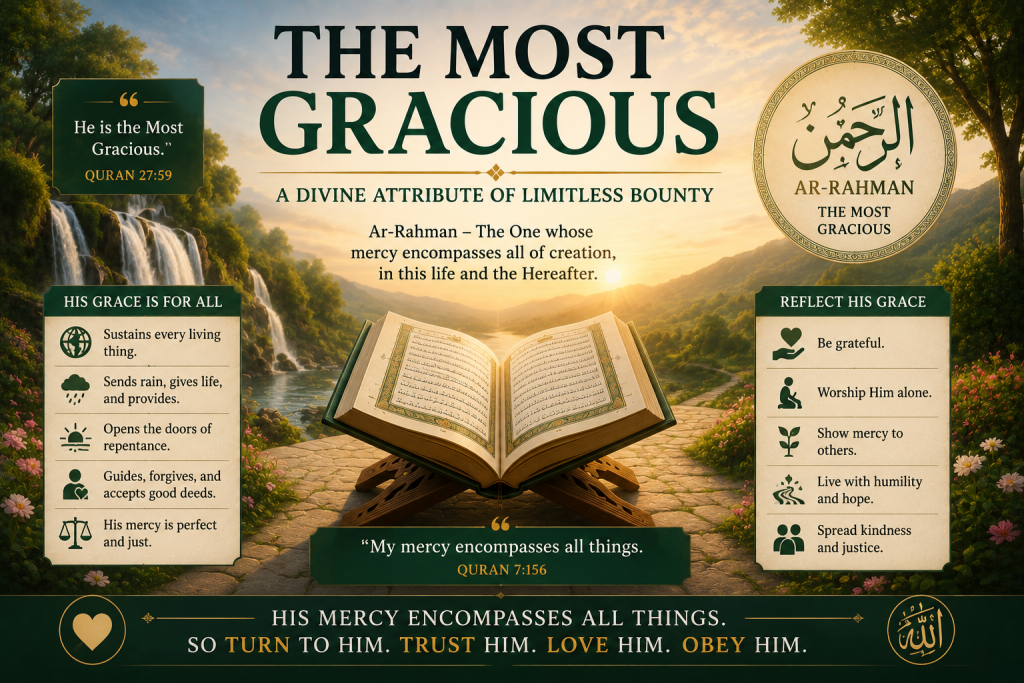
For many readers, the phrase “Most Gracious” is most familiar from the opening line of the Quran:
“In the name of GOD, Most Gracious, Most Merciful.”
Yet the Quran does not limit this name to the Basmalah. Instead, it repeatedly uses “Al-Rahman” (The Most Gracious) as a central and independent name of God – one that defines His relationship with creation, His authority, and His guidance.
Understanding this name is essential to understanding the Quran itself.
The Most Gracious” Is a Name of God
The Quran makes this explicit:
“Say, ‘Call Him GOD, or call Him the Most Gracious (Al-Rahman); whichever name you use, to Him belong the best names.’” (17:110)
This verse establishes:
- “The Most Gracious” is not just a description
- It is a primary name of God
- It is interchangeable with the name “God” (Allah)
This elevates the concept of grace from a secondary attribute to a defining identity.
The Most Gracious and Absolute Authority
The Quran links this name directly to divine authority:
“The Most Gracious; He has assumed all authority.” (20:5)
“The Most Gracious; Creator of the heavens and the earth… then assumed all authority.” (25:59)
This connection is critical:
- God’s grace is not separate from His power
- The One who governs the universe is The Most Gracious
Grace in the Quran is not weakness—it is the governing principle of existence under divine control.
The Most Gracious as the Only Teacher of the Quran
One of the most profound statements in the Quran appears at the very opening of Surah 55:
“The Most Gracious.
Teacher of the Quran.” (55:1–2)
This establishes a foundational truth:
- God alone is the Teacher of the Quran
- No human being—messenger or scholar—shares this role
This directly aligns with:
The implication is decisive:
- The Quran teaches itself through God’s design
- Human beings are recipients—not authorities over it
Thus, “The Most Gracious” is not only:
- The Creator
- The Sustainer
He is also:
- The sole source of understanding and guidance of the Quran
The Universality of Divine Grace
The name “The Most Gracious” reflects a mercy that encompasses all creation:
- Believers and disbelievers
- Humans and all living beings
- The entire universe
Everything we experience:
- Life
- Sustenance
- Order in the universe
is a manifestation of this grace.
This shows that divine grace is:
- Continuous
- Universal
- Not dependent on human belief
Human Resistance to “The Most Gracious”
Despite its centrality, the Quran records resistance:
“When they are told, ‘Prostrate to the Most Gracious,’ they say, ‘What is the Most Gracious?’” (25:60)
This reflects:
- Ignorance of God’s attributes
- Resistance to submission
- A disconnect between recognition and obedience
Even when grace is evident, it is often unrecognized or rejected.
The Servants of the Most Gracious
The Quran defines a special group:
“The عباد الرحمن (worshipers of the Most Gracious)…” (25:63)
Their characteristics include:
- Humility in conduct
- Peaceful response to ignorance
- Devotion during the night
- Moderation in spending
- Avoidance of idolatry and immorality
This shows:
- God’s name is not theoretical
- It produces a distinct type of human being
To understand “The Most Gracious” is to reflect that grace in behavior.
A Complete Manifestation of Grace
Surah 55 is entirely centered on “The Most Gracious.”
It begins:
“The Most Gracious. Teacher of the Quran.” (55:1–2)
Then it unfolds:
- Creation of the human being
- Teaching of communication
- Balance in the universe
- Countless blessings
Repeated refrain:
“Which of your Lord’s marvels do you deny?”
This repetition emphasizes:
- Grace is visible and undeniable
- It surrounds human existence completely
The structure of the surah itself teaches that:
Recognition of grace is a moral responsibility
Grace Does Not Negate Accountability
A common misunderstanding is:
- Grace means absence of judgment
The Quran corrects this:
- God is Most Gracious
- But also Just and Accountable
Grace provides:
- Opportunity
- Guidance
- Sustenance
But human beings are still:
- Responsible
- Accountable for their choices
The Contrast Between Divine and Human “Grace”
Human mercy is often:
- Limited
- Conditional
- Inconsistent
By contrast, God’s grace is:
- Continuous
- Independent
- Unrestricted
This contrast highlights:
- The uniqueness of divine mercy
- The dependency of all creation on it
The Most Gracious and Revelation as Mercy
The Quran itself is one of the greatest manifestations of grace:
“The Most Gracious. Teacher of the Quran.” (55:1–2)
Guidance is not earned—it is granted.
Without revelation:
- Truth would be unclear
- Human beings would be left to speculation
Thus, the Quran is:
- A direct expression of divine grace
- A means of guiding humanity to truth
A Call to Reflect
The repeated use of “The Most Gracious” in the Quran calls the reader to:
- Recognize God’s blessings
- Reflect on His authority
- Accept His guidance
It is not merely a name to recite, it is a reality to understand.
Conclusion
“The Most Gracious” is one of the most profound and comprehensive names of God in the Quran.
It encompasses:
- Creation
- Sustenance
- Authority
- Guidance
It defines:
- God’s relationship with humanity
- Humanity’s responsibility in return
And at the center of it all is a critical truth:
The Most Gracious is the Teacher of the Quran.
Understanding this transforms how we approach the Quran:
- Not as a text requiring external authority
- But as a complete, divinely taught guidance
To recognize “The Most Gracious” is to recognize:
- The source of all blessings
- The source of all knowledge
- The source of all truth
Continue Your Study
Surah Al-Fatihah introduces many of the foundational themes that are developed throughout the Quran. If you would like to explore these subjects in greater depth, the following studies may be helpful.
Understanding God
- Belief in God
- Belief in God and Believing God
- The Most Gracious
- The Most Gracious and the Most Merciful in the Quran
- Who Created God?
Understanding the Quran
- God Explains the Quran
- Who Explains the Quran?
- Three Responses to God’s Guidance: Believers, disbelievers and Hypocrites
- The Purpose of Life According to the Quran
Worship and Guidance
- Worship God Alone
- Religious Authority in the Quran
- The Meaning of Idolatry in the Quran
- Who Were the Mushrikeen?
- Belief in God and Believing God
Understanding God’s Messengers
- Jesus in the Quran
- Moses in the Quran
- Jonah and Self-Accountability
- Quranic Criteria for God’s Messengers