Introduction
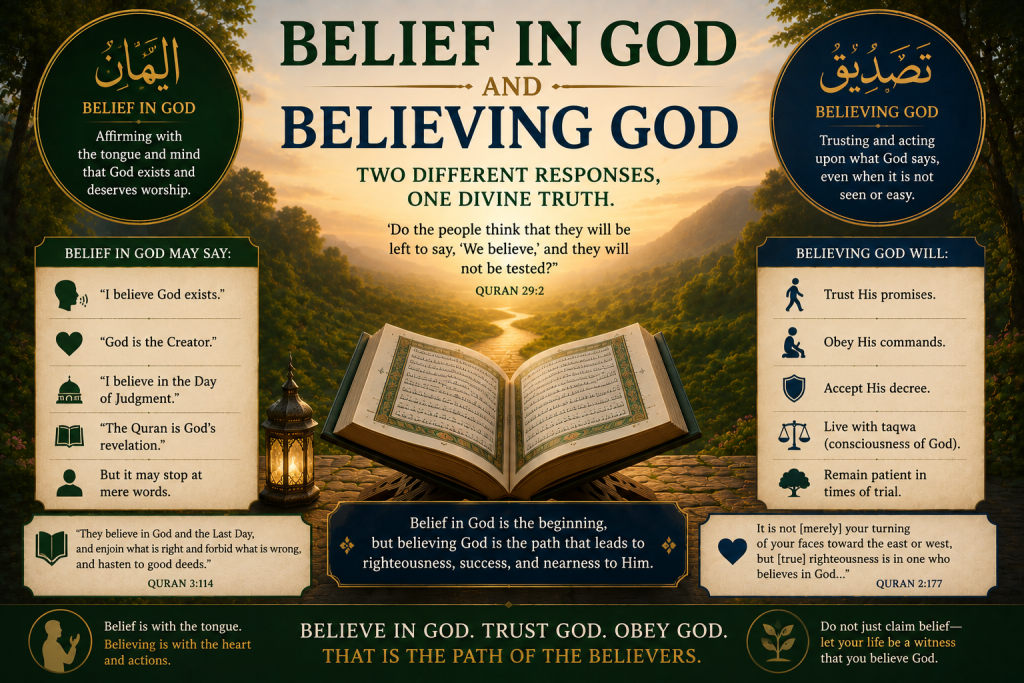
The Quran makes a crucial distinction between belief in God and believing God. Many people, including those who identify as Muslims, acknowledge God’s existence, yet the Quran shows that true belief requires submission to God’s revelation alone.
The real test is not whether one acknowledges God, but whether one accepts, submits to, and upholds His revelation without resistance or substitution.
Belief in God Is Common, But Not Enough
The Quran confirms that belief in God is widespread, even among those who fall into error:
“Most of them do not believe in God without committing idolatry.” (12:106, Rashad Khalifa)
“Most people, no matter what you do, will not believe.” (12:103)
These verses establish a critical reality:
A person may believe in God, yet still be engaged in shirk (association) or rejection.
Thus, the central issue is not atheism. The issue is failure to believe what God reveals.
Disbelief Defined: Rejecting Revelation
In the Quran, disbelief (kufr) is not primarily defined as denial of God’s existence. Rather, it is defined as rejecting God’s revelations:
“Miserable indeed is what they sold their souls for, rejecting what God has revealed…” (2:90)
“Mankind used to be one community… then they disputed… after the knowledge had come to them.” (2:213)
This shows that:
- People may recognize truth
- Yet still reject it due to bias, pride, or self-interest
The Quran identifies this rejection, despite knowledge, as the essence of disbelief.
Which Authority Do You Believe?
The Quran directly challenges the acceptance of any authority alongside it:
“Which hadith, other than this, do they believe in?” (77:50)
“In which hadith other than God and His revelations do they believe?” (45:6)
These verses raise a profound question:
If one truly believes in God, why seek or accept religious authority beyond His revealed words?
This exposes a contradiction:
- Claiming belief in God
- While relying on sources that are not from God
True belief requires recognizing the Quran as the sole, final, and sufficient authority.
Awareness Is Not Belief
The Quran addresses those who are familiar with revelation but do not truly accept it:
“O People of the Scripture, why do you disbelieve in God’s revelations while you bear witness?” (3:70)
This applies universally.
Knowing the Quran exists, reading it, or even teaching it does not equal belief.
True belief requires:
- Acceptance without selective filtering
- Submission without resistance
The Internal Barrier: The Human Self
The Quran identifies the real obstacle to belief:
“The self is an advocate of evil, except for those who attain mercy from my Lord.” (12:53)
The surrounding narrative (12:51–53) shows that truth can become clear, yet acceptance depends on overcoming the ego (nafs).
Thus, disbelief is not usually due to lack of evidence.
It is due to resistance to change, humility, and submission.
Selective Acceptance and Rationalization
The Quran exposes how people justify their positions instead of submitting:
“If the Most Gracious willed, we would not worship them.” (43:20)
Here, belief in God is used as an excuse to avoid correction.
Similarly, when confronted with clear signs within the Quran, people react differently:
“Over it is nineteen… it is a test… so that those who believe will increase in faith…” (74:30–31)
The Quran itself describes the reactions:
- Some increase in faith
- Others doubt or mock
This demonstrates that belief is not merely exposure to truth, but willingness to accept it as it is.
Submission vs. Inherited Religion
The Quran defines the true religion clearly:
“The only religion approved by God is Submission.” (3:19)
Submission is not:
- Cultural identity
- Inherited practice
- Sectarian affiliation
It is direct alignment with God’s revelation.
The Quran also establishes a continuing principle:
“…when there comes to you a messenger confirming what is with you, you shall believe in him and support him.” (3:81)
This shows that true believers:
- Remain open to God’s guidance
- Do not restrict truth to inherited frameworks
The Majority Is Not the معيار (Criterion)
The Quran repeatedly emphasizes:
“Most people do not believe.” (12:103)
Therefore:
- Truth is not determined by majority opinion
- Popular practice is not a measure of correctness
Belief is measured by faithfulness to revelation, not numbers.
The Quranic Definition of a Believer
A true believer is one who:
- Accepts the Quran as fully detailed and sufficient (6:114)
- Does not seek other religious authority alongside it (45:6, 77:50)
- Submits without selective acceptance
- Responds to God’s guidance sincerely and consistently
Disbelief (kufr), therefore, includes:
- Rejecting or bypassing God’s revelations
- Diluting them with external sources
- Resisting them when they challenge personal or inherited beliefs
Conclusion: The Real Test of Faith
The Quran shifts the focus from a basic claim:
“Do you believe in God?”
to a far more demanding question:
“Do you believe what God says, and only what God says?”
Many affirm the first.
Far fewer uphold the second.
True belief is not acknowledgment, it is complete submission to the Quran without resistance, substitution, or hesitation.