Jesus in the Quran
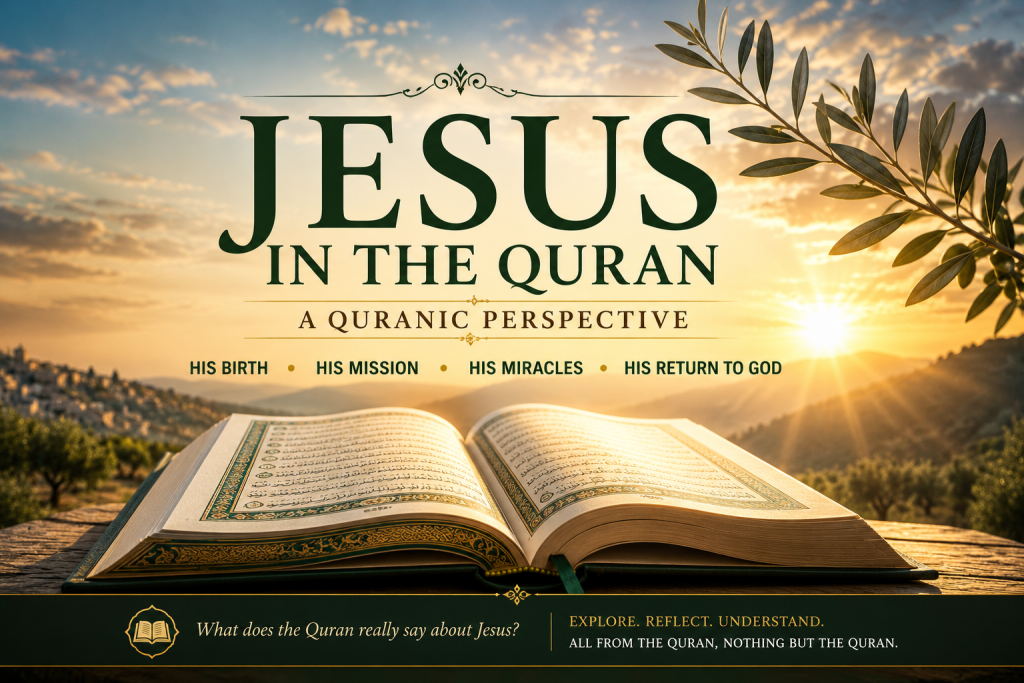
Jesus occupies a distinguished place in the Quran. He is described as a messenger of God, born miraculously to Mary, supported by clear signs, and entrusted with scripture. The Quran affirms his prophethood, defends the purity of his mother, and clarifies the nature of his mission.
At the same time, it firmly corrects theological developments that elevate him beyond the role of messenger. The Quran restores Jesus to the consistent framework applied to all messengers: servant of God, recipient of revelation, and caller to pure monotheism.
Understanding Jesus in the Quran requires careful attention to his birth, mission, divine support, death, and the rejection of divine sonship.
The Virgin Birth and the Honor of Mary
The Quran gives extraordinary attention to Mary. An entire chapter bears her name (Surah Maryam), and she is described as chosen and purified.
The Quran never states that Mary was married at the time of Jesus’ conception. The narrative consistently emphasizes that no man had touched her. When she asks how she could have a child without being touched, she is told that God creates what He wills.
The miraculous nature of the birth is affirmed without ambiguity. By never introducing a husband into the narrative, the Quran removes doubt regarding the virgin birth.
Yet the miracle does not elevate Jesus to divinity. The Quran compares his creation to that of Adam — both brought into existence by divine command. The extraordinary origin highlights divine power, not divine offspring.
Jesus as Messenger and Servant of God
The Quran repeatedly identifies Jesus as:
A messenger of God
A servant of God
A prophet
A word from God
A sign for the Children of Israel
He is given the Gospel (Injeel) as guidance and light. His mission confirms the Torah and calls to moral reform and worship of God alone.
The Quran quotes Jesus as declaring:
“Indeed, God is my Lord and your Lord, so worship Him. This is a straight path.”
This statement situates Jesus firmly within the unified Quranic proclamation shared by all messengers: worship God alone.
Divine Support and the Holy Spirit
The Quran states that Jesus was strengthened by the Holy Spirit. This support is mentioned explicitly in connection with his mission.
In the Quran, the “Ruh” (Spirit) associated with revelation is identified with the angel Gabriel — the bearer of divine communication. From the annunciation of his birth to the confirmation of his message, Jesus is described as being supported by this divine assistance.
The Quran’s presentation emphasizes that his signs occurred “by God’s permission.” The support he received reinforces his role as messenger under divine authority.
While the Quran recounts moments of human limitation or correction among several other messengers, it does not record a comparable episode regarding Jesus. His narrative centers consistently on proclamation, sign, and divine support — without attributing divinity to him.
Signs Given to Jesus
The Quran describes several signs associated with Jesus:
Speaking in the cradle
Healing the blind and leper
Raising the dead by God’s permission
Fashioning a bird from clay by God’s permission
The repeated qualification — “by God’s permission” — is essential. The power belongs to God. Jesus functions as the vehicle of divine sign, not as an independent source of power.
The signs confirm his mission but do not alter his status as servant and messenger.
The Question of Crucifixion and Death
The Quran directly addresses the claim that Jesus was killed and crucified.
It states that they did not kill him, nor did they crucify him — though it was made to appear so to them (4:157).
Verse 3:55 records God saying to Jesus: “I am taking you and raising you to Myself.”
The Quran’s wording emphasizes two key points:
His enemies did not succeed in killing him.
His taking was by divine decree, not by human triumph.
The phrase “I am taking you” indicates that his soul was taken by God’s will. The denial in 4:157 clarifies that the claim of execution by crucifixion was not accomplished as asserted.
The theological emphasis is clear: his persecutors did not prevail over him. The event remained under divine authority.
The Quran does not describe humiliation at the hands of his enemies as the final outcome. Instead, it affirms divine control over the conclusion of his earthly life.
Rejection of Divine Sonship
The Quran firmly rejects the attribution of sonship to God. It declares that God does not beget, nor is He begotten. The idea that God would take a son is presented as incompatible with divine transcendence.
On the Day of Judgment, the Quran depicts Jesus affirming that he told people only to worship God — not to worship himself or his mother.
The rejection of divine sonship is not framed as hostility toward Jesus, but as protection of monotheism.
Rejection of the Trinity
The Quran explicitly warns against saying “Three.” It calls believers to desist and affirms that God is One.
The concept of Trinity is described as an exaggeration in religion. The Quran restores Jesus to his role as messenger within the consistent proclamation of all prophets.
The correction is theological and principled: worship belongs to God alone.
Jesus Within the Messenger Pattern
Jesus’ narrative fits within the Quran’s recurring structure:
A messenger is sent to a defined people.
He confirms previous scripture.
He calls to worship of God alone.
Some believe; others reject.
Accountability follows.
His mission is part of a unified chain of revelation culminating in the Quran.
Conclusion
Jesus in the Quran is a messenger of God, born miraculously to Mary, supported by divine assistance, entrusted with scripture, and devoted to the call of pure monotheism.
The Quran affirms his mission while correcting theological developments that attribute divinity to him. It clarifies that his death occurred under divine decree, not through the triumph of his enemies, and that he remained a servant of God rather than a son of God.
His message aligns with the consistent proclamation of all messengers: worship God alone.
Continue Your Study
This page is the starting point for a comprehensive Quranic study of Jesus. The articles below examine individual topics in greater depth, allowing you to explore what the Quran says directly about his life, mission, and message.