Worship God Alone
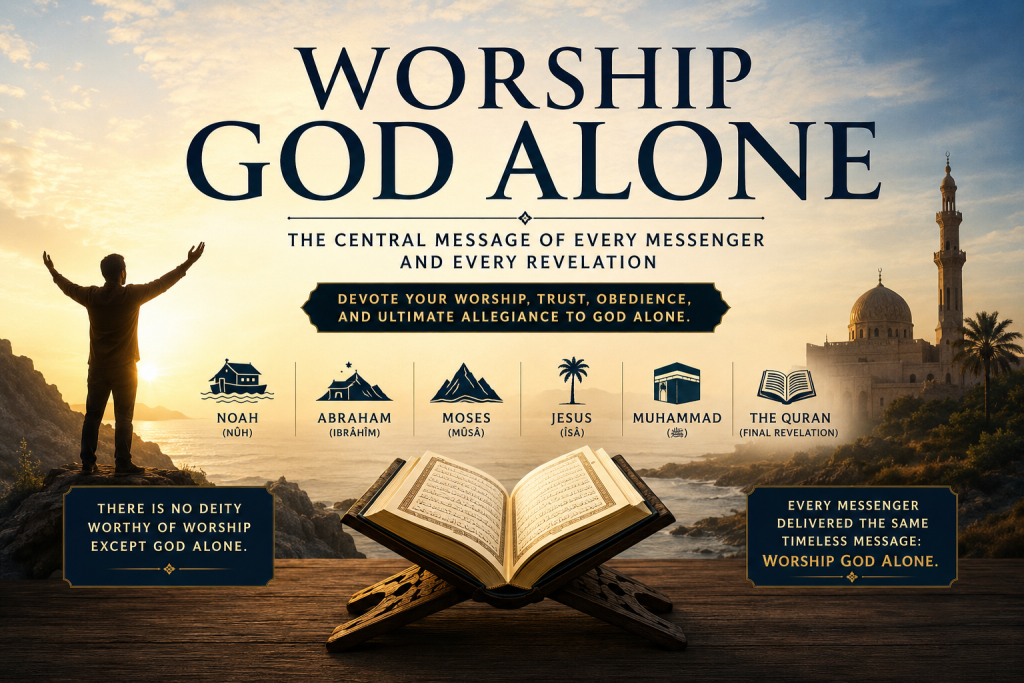
The Central Message of Every Messenger and Every Revelation
We have sent a messenger to every community, saying, “You shall worship God, and avoid idolatry.” 16:36
Every messenger delivered the same timeless message: worship God alone. This page serves as the gateway to that message and to the Quran-based studies throughout IslamUnraveled that explain its meaning, implications, and relevance today.
Introduction
If the message of the Quran could be summarized in a single command, it would be this:
Worship God alone.
From the first messenger to the last prophet, God’s call to humanity has never changed. Nations differed. Languages differed. Circumstances differed. Yet the central message remained the same:
Devote your worship, trust, obedience, and ultimate allegiance to God alone.
The Quran presents this message as the foundation of true religion and the purpose for which messengers were sent. It is also the central theme of IslamUnraveled. Every study on this website ultimately points back to this one principle.
God Alone Is Worthy of Worship
The Quran repeatedly affirms that God alone created, sustains, provides, judges, and controls all things. Because He alone possesses these qualities, He alone deserves worship.
The declaration that there is no deity except God is not merely a statement of belief. It is a declaration that no one shares God’s authority, sovereignty, or right to receive worship.
True worship includes love, reverence, trust, gratitude, prayer, reliance, and complete devotion to God alone.
Related Studies
The Message of Every Messenger
The Quran presents a remarkable continuity throughout history.
Noah called his people to worship God alone.
Abraham rejected every form of association and devoted himself entirely to God.
Moses called the Children of Israel back to God’s guidance.
Jesus reaffirmed pure monotheism.
Muhammad delivered the final revelation calling humanity back to the same message.
The messengers did not establish different religions. They delivered the same fundamental invitation:
Worship God alone.
Related Studies
Worship Requires Accepting God's Authority Alone
The Quran teaches that worship extends beyond outward acts of devotion.
To worship God alone also means accepting God alone as the ultimate authority in matters of religion.
God asks:
“Shall I seek other than God as a judge when He has revealed to you this Book fully detailed?” (6:114)
The Quran repeatedly describes itself as:
- fully detailed (6:114)
- complete in truth and justice (6:115)
- explaining everything necessary for guidance (16:89)
Throughout history, religious communities gradually elevated human words, traditions, and interpretations until they became independent sources of religious authority.
The Quran repeatedly warns against attributing to God religious laws that He has not authorized.
When human words are treated as possessing independent religious authority alongside God’s revelation, the exclusive authority that belongs to God alone is shared with others.
For this reason, worshipping God alone includes recognizing God’s words as the supreme authority in matters of faith and religious law.
This principle lies at the heart of the Quran’s call to pure monotheism.
Related Studies
The Religion of Abraham
The Quran repeatedly directs believers to follow the religion of Abraham.
Abraham did not belong to a sect or denomination. He devoted himself completely to God without associating partners with Him.
The religious duties associated with Abraham—including prayer, charity, fasting, and pilgrimage—are not ends in themselves. They are expressions of complete submission to God.
The purpose of every act of worship is to strengthen one’s relationship with God alone.
Related Studies
The Greatest Danger: Association (Shirk)
The Quran’s greatest warning is not directed toward atheism.
Instead, it repeatedly warns against association (shirk)—sharing God’s exclusive rights with others.
Association can take many forms:
- directing worship toward others besides God
- accepting religious authority beside God
- seeking intermediaries or intercessors as part of worship
- following religious laws that God has not authorized
- blindly following parents or religious leaders in matters of faith
The Quran calls believers to examine every belief and practice in the light of God’s revelation.
Pure monotheism requires preserving God’s exclusive authority in every aspect of religion.
Related Studies
Worship Is a Way of Life
The Quran presents worship as far more than rituals.
Prayer, charity, fasting, and pilgrimage are important acts of devotion, but worship also includes:
- honesty
- justice
- compassion
- patience
- gratitude
- fulfilling trusts
- caring for parents
- helping those in need
- protecting the vulnerable
Every aspect of life becomes an act of worship when it is directed toward pleasing God.
Related Studies
Returning to the Quran
Throughout history, God’s messengers called people back to the same source:
God’s revelation.
The Quran continues that invitation today.
It calls every individual to examine inherited beliefs, to reflect, to reason, and to devote worship exclusively to God.
Every messenger delivered this message.
Every generation faces the same choice.
Will we devote ourselves entirely to God, or will we allow other authorities to share what belongs only to Him?
The Quran’s answer is clear:
Worship God alone.