Introduction
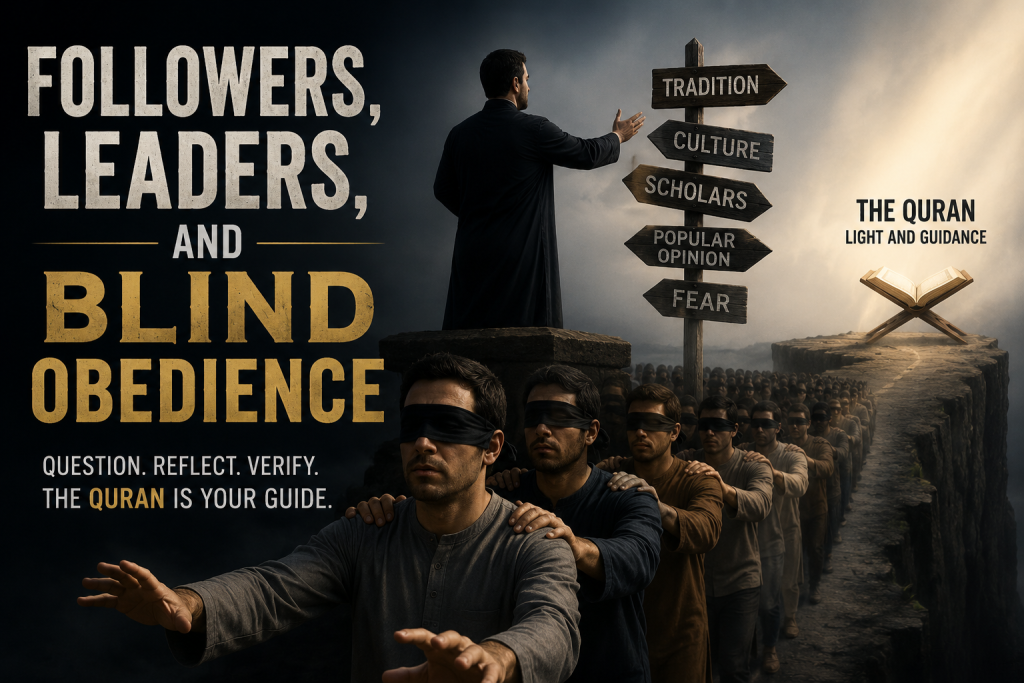
Human beings naturally organize themselves around followers, leaders and blind obedience.
Families, tribes, nations, political systems, and religious communities all develop structures of authority. Leadership itself is not condemned in the Quran. In fact, the Quran acknowledges the existence of:
- leaders
- judges
- rulers
- teachers
- guides
The danger arises when human beings surrender:
- conscience
- reason
- moral responsibility
to leaders without reflection.
The Quran repeatedly warns that one of the greatest causes of corruption is blind obedience.
Again and again, the Quran presents scenes where followers blame leaders on the Day of Judgment—only to discover that blind following does not remove personal accountability before God.
The Day Followers Blame Their Leaders
One of the Quran’s most striking scenes occurs in Surah 33:
“They will say, ‘Our Lord, we obeyed our masters and leaders, but they misled us from the path.’” (33:67)
This verse captures one of the deepest human tendencies:
- transferring responsibility upward
Followers frequently assume:
- leaders know better
- authority guarantees truth
- institutions cannot be fundamentally wrong
But the Quran repeatedly dismantles this assumption.
The Quran Never Abolishes Personal Responsibility
The Quran acknowledges that leaders possess influence.
Yet influence is not compulsion.
This is why the Quran repeatedly insists:
“No soul bears the sins of another soul.” (6:164)
Even when people are:
- manipulated
- pressured
- socially conditioned
- emotionally influenced
the Quran still preserves individual accountability.
This principle is foundational.
No leader, scholar, institution, sect, or movement can stand between a human being and his responsibility before God.
Blind Following in Religion
The Quran especially warns against inherited religious obedience.
One of the most repeated Quranic criticisms is:
“We found our parents doing this.”
“When they are told, ‘Follow what GOD has revealed,’ they say, ‘We follow only what we found our parents doing.’” (2:170)
The Quran consistently presents inherited religion as one of the greatest barriers to truth.
People often:
- inherit beliefs
- inherit sects
- inherit rituals
- inherit assumptions
without examination.
The Quran repeatedly challenges this mentality by calling human beings to:
- think
- reflect
- reason
- examine evidence
Religious Leaders and Manufactured Authority
The Quran strongly criticizes religious systems that elevate scholars and leaders into unquestioned authorities.
“They set up their religious leaders and scholars as lords beside GOD…” (9:31)
This does not necessarily mean literal worship.
It refers to surrendering religious authority in a way that competes with God’s revelation.
The Quran repeatedly warns against:
- human legislation in religion
- fabricated teachings
- unquestioned clerical authority
The Psychology of Blind Obedience
Why do people follow blindly?
The Quran reveals several reasons:
- fear of isolation
- social pressure
- emotional comfort
- tribal identity
- desire for certainty
- avoidance of personal responsibility
Blind obedience can feel psychologically safer than independent reflection.
If the authority is wrong, the follower hopes:
“It is their fault, not mine.”
But the Quran repeatedly rejects this excuse.
Leaders Also Blame Their Followers
The Quran’s scenes of Judgment are remarkable because blame moves in every direction.
Followers blame leaders:
“Our Lord, they misled us…” (33:67)
But leaders reply:
“Did we repel you from the guidance after it came to you? No—you yourselves were guilty.” (34:32)
This exchange exposes a profound Quranic truth:
Corruption often survives through cooperation between:
- deceptive leadership
and - willing surrender
Pharaoh — The Archetype of Corrupt Leadership
The Quran repeatedly presents Pharaoh as a model of manipulative authority.
“Pharaoh misled his people; he did not guide them.” (20:79)
But the Quran never portrays the people as entirely innocent.
Again and again, they:
- obeyed
- surrendered conscience
- accepted corruption
The Quran therefore condemns both:
- tyrannical leadership
and - passive submission to tyranny
Sectarianism and Group Identity
The Quran repeatedly warns against sectarian division:
“Those who divide themselves into sects—you have nothing to do with them.” (6:159)
One reason sectarianism becomes so powerful is that group identity often replaces sincere pursuit of truth.
People begin defending:
- tribe
- school
- denomination
- movement
- scholar
instead of defending revelation itself.
The Quran repeatedly calls believers back to God’s revelations as the ultimate criterion.
The Danger of Charismatic Personalities
The Quran repeatedly warns humanity about emotional attachment to personalities.
People are often drawn toward:
- charisma
- confidence
- authority
- eloquence
- social influence
rather than truth itself.
This is why the Quran constantly redirects attention away from personalities and back toward:
- revelation
- evidence
- reason
- accountability before God
Even Messengers Were Not to Be Followed Blindly
Remarkably, even God’s messengers did not ask for blind devotion.
The Quran repeatedly presents messengers saying:
“I ask you for no wage.”
They consistently directed attention toward:
- God
- revelation
- truth
rather than themselves.
The Quran never teaches personality worship.
Common Sense Before Submission
The Quran repeatedly appeals to:
- reason
- observation
- reflection
- conscience
It condemns those who:
- refuse to think
- inherit blindly
- surrender intellect
“Will you not reason?”
This question echoes throughout the Quran.
True submission to God is not blind obedience to human authority.
It is conscious, reflective submission grounded in truth.
The Balance Between Leadership and Accountability
The Quran does not abolish leadership.
Communities require:
- organization
- cooperation
- guidance
- administration
But the Quran insists that every human being retains:
- conscience
- moral responsibility
- direct accountability before God
No authority can replace this responsibility.
The Final Collapse of Excuses
On the Day of Judgment:
- leaders will deny responsibility
- followers will seek excuses
- sectarian identities will collapse
- inherited narratives will fail
The Quran repeatedly returns humanity to one central principle:
“Every human being is responsible for his own destiny.” (17:13)
No person will stand before God and successfully argue:
“I merely followed others.”
Part of a Quranic Reflection Series
This article is part of a broader Quranic series exploring accountability, blame, free will, repentance, conscience, leadership, and the human soul through the Quran alone.
Main article:
The Day of Mutual Blaming — A Quranic Study of Accountability and Human Nature
Related articles in this series:
- Satan Never Forced Anyone — Free Will in the Quran
- The Blaming Soul (75:2) — Psychology in the Quran
- Followers, Leaders, and Blind Obedience
- Jonah and the Path of Self-Accountability
Conclusion
The Quran presents blind obedience as one of humanity’s greatest spiritual dangers.
Followers often surrender:
- thought
- conscience
- accountability
to leaders, institutions, traditions, or sects.
But the Quran repeatedly refuses to transfer responsibility away from the individual.
Leaders may deceive.
Scholars may corrupt.
Communities may pressure.
Satan may tempt.
Yet every soul still chooses.
This is why the Quran constantly calls human beings to:
- reflect
- reason
- examine
- and stand consciously before God
The Quran does not call for blind followers.
It calls for thoughtful believers.
Related Discussion (Video)
This article was inspired in part by themes discussed in the following video: