Introduction to Common Sense Before Submission (Islam)
Before any scripture was revealed, before any ritual was practiced, God endowed human beings with something fundamental:
intellect
The Quran consistently presents faith not as blind acceptance, but as a reasoned, conscious response grounded in observation, reflection, and moral awareness.
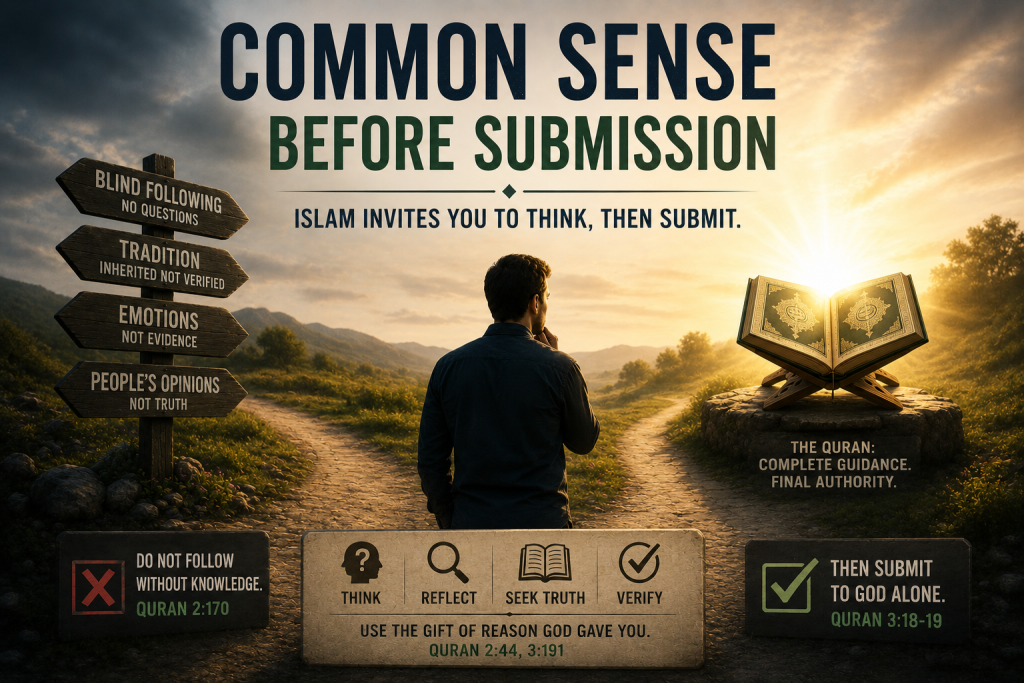
Common Sense Before Submission (Islam) emphasizes the importance of a reasoned approach to faith.
“We have given them the hearing, the eyes, and the brains; but rarely do they give thanks.” (23:78)
This verse establishes a powerful principle:
Thinking is not separate from faith, it is its foundation.
Religion, in the Quran, does not replace reason. It refines and directs it.
The Innate Disposition: Fitrah as Common Sense
The Quran teaches that every human being is created with a natural inclination toward truth:
“Devote yourself to the religion of strict monotheism—such is the natural instinct given by God… This is the perfect religion.” (30:30)
This innate disposition, often described as fitrah, is:
- an internal compass
- a moral awareness
- a form of common sense rooted in creation itself
True religion does not contradict this instinct
It confirms and elevates it
The Quran’s Warning Against Blind Following
One of the Quran’s strongest criticisms is directed at blind imitation:
“When they are told, ‘Follow what God has revealed,’ they say, ‘We follow what we found our parents doing.’” (2:170)
This mindset represents:
- unexamined belief
- inherited assumptions
- surrender of independent thought
The Quran does not call for imitation
It calls for verification and understanding
As explored in Belief in God Dictates That You Believe God, true belief requires accepting what God says—not what tradition preserves.
Reflection: The Gateway to Faith
The Quran repeatedly praises those who reflect:
“They reflect on the creation of the heavens and the earth…” (3:191)
Reflection transforms:
- observation – understanding
- understanding – conviction
Faith, in the Quran, is not passive
It is actively constructed through thought
This is further aligned with the Quran’s call to:
“reflect upon its verses” (38:29)
When Religion Loses Reason
When intellect is removed from religion, the result is distortion:
- rituals without meaning
- division without understanding
- authority without accountability
The Quran describes such a condition:
“They have minds with which they do not understand… they are like animals; no, they are worse.” (7:179)
The problem is not lack of intelligence
It is failure to use it
Common Sense as a Safeguard
Common sense acts as a filter against misinterpretation.
The Quran encourages believers to test claims against fundamental principles:
- justice
- mercy
- wisdom
“God does not advocate sin. Do you say about God what you do not know?” (7:28)
This raises essential questions:
- Does this interpretation uphold justice?
- Does it reflect God’s mercy?
- Does it align with reason?
If not, it cannot be from God
The Example of Abraham: Faith Through Reason
The Quran presents Abraham as a model of reasoned faith:
“When the night fell, he saw a planet… but when it set, he said, ‘I do not love things that fade away.’” (6:76)
Abraham did not inherit belief, he arrived at it through:
- observation
- reasoning
- rejection of falsehood
His journey demonstrates:
faith begins with thought, not imitation
The Balance Between Heart and Mind
The Quran does not promote intellect at the expense of humility, nor emotion at the expense of reason.
“My Lord advocates justice…” (7:29)
Faith requires:
- intellect – to understand
- humility – to submit
Without intellect, faith becomes empty
Without humility, intellect becomes arrogance
Common Sense and Submission to God
Submission (Islam) is not blind surrender.
It is:
informed, conscious alignment with truth
This aligns with the Quran’s consistent message that:
- God explains His revelations (75:19)
- God teaches the Quran (55:1–2)
As discussed in Who Explains the Quran?, understanding comes from engaging with the revelation sincerely and thoughtfully.
Conclusion: The Internal Light of Guidance
Common sense is not external to religion, it is part of God’s design.
It is:
- the internal light
- the starting point
- the means by which truth is recognized
The Quran does not call for blind followers.
It calls for:
thinkers
reflectors
people who use their intellect to recognize and uphold truth
“A scripture… that they may reflect upon its verses, and those who possess intelligence will take heed.” (38:29)
Final Reflection
True submission begins before ritual,
it begins with the willingness to think.