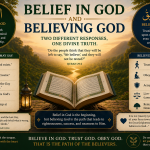
True faith is not acknowledging God’s existence – it is accepting His words and living by them.
Many people claim belief in God. This belief is often expressed as:
- acknowledgment of God’s existence
- emotional attachment
- cultural or inherited identity
However, the Quran presents belief in God in a fundamentally different way.
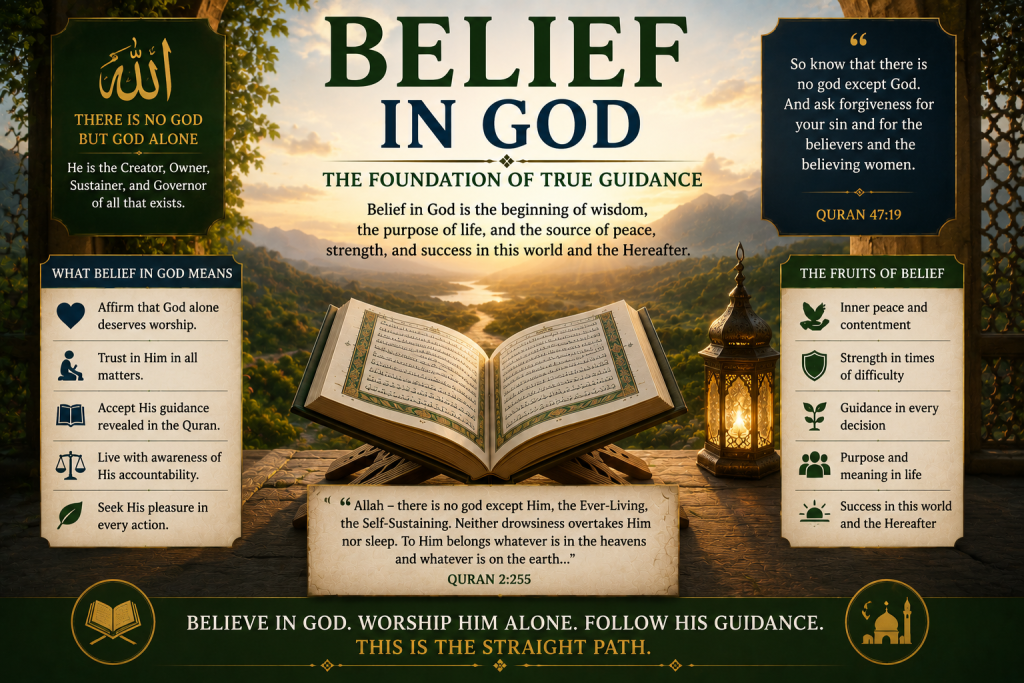
Belief in God is not merely acknowledging that God exists.
It is believing God – accepting what He says and aligning oneself with His revelations.
This distinction is essential.
Belief Is Inseparable from God’s Revelations
The Quran directly links belief in God with belief in His words:
“These are God’s revelations that we recite to you truthfully. In which Hadith other than God and His revelations do they believe?” (45:6)
This verse establishes a critical principle:
True belief in God must be grounded in His revelations
To claim belief in God while:
- neglecting His revelations
- replacing them
- or placing other sources alongside them
is, by Quranic definition, a contradiction.
God’s Revelation Is Complete and Sufficient
The Quran repeatedly affirms that it is fully detailed for religious guidance:
“Shall I seek other than God as a source of law, when He has revealed to you this book fully detailed?” (6:114)
“Most blessed is the One who revealed the Statute Book to His servant, so he can serve as a warner to the whole world.” (25:1)
These verses leave no ambiguity:
- the Quran is complete
- the Quran is sufficient
- the Quran is the sole authority in matters of religion
To believe in God, therefore, is to accept:
His revealed system as final and complete
Belief Requires Acceptance of God’s System
The Quran does not present religion as a new invention. Rather, it confirms an existing monotheistic system:
“Then we inspired you to follow the religion of Abraham, monotheism…” (16:123)
This system includes established practices such as:
- Contact Prayer (Salat)
- Obligatory Charity (Zakat)
- Fasting
- Hajj
These were taught to earlier messengers:
“…we taught them how to observe the Contact Prayers (Salat), and the Obligatory Charity (Zakat). They were worshipers of us.” (21:73)
The Quran confirms, not invents, the core practices of submission.
The Quran as Guardian and Corrector
While the practices existed, distortions entered over time.
The Quran restores and corrects them. For example:
“O you who believe, when you observe the Contact Prayers… wash your faces, wash your arms… wipe your heads, and wash your feet…” (5:6)
This demonstrates:
- the Quran refines religious practice
- it removes additions and corruption
- it restores the original system
Belief Is Not Passive – It Is Action-Oriented
The Quran defines believers not by claim, but by response:
“The believers are those whose hearts tremble when God is mentioned, and when His revelations are recited to them, it strengthens their faith…” (8:2)
Belief includes:
- trust in God
- response to revelation
- implementation of commands
It is not abstract, it is lived.
Rejecting the Message Is Rejecting God
The messenger’s role is to deliver God’s message. The Quran states:
“The sole duty of the messenger is delivery.” (5:99)
This means:
rejecting the message is not rejecting a person
it is rejecting what God has said
Thus:
belief in God requires belief in His message
The Distinction: Believing in God vs Believing God
This is the central point.
- Believing in God is acknowledging His existence
- Believing God is accepting His words as truth and acting upon them
The Quran consistently calls for the latter.
A Consistent Quranic Pattern
The Quran repeatedly emphasizes:
- God speaks truth (3:95)
- His revelations are truth (2:176)
- His words are complete (6:115)
Therefore:
To believe in God while questioning or bypassing His words is inconsistent with the Quranic definition of belief.
Conclusion
The Quran defines belief in clear and uncompromising terms.
To believe in God is:
- to believe His words
- to accept His authority
- to follow His guidance
Anything less reduces belief to:
- an idea
- a label
- or a claim without substance
Final Reflection
True faith is not simply saying “I believe in God.”
It is saying:
“I believe God.”
And living accordingly.