Introduction
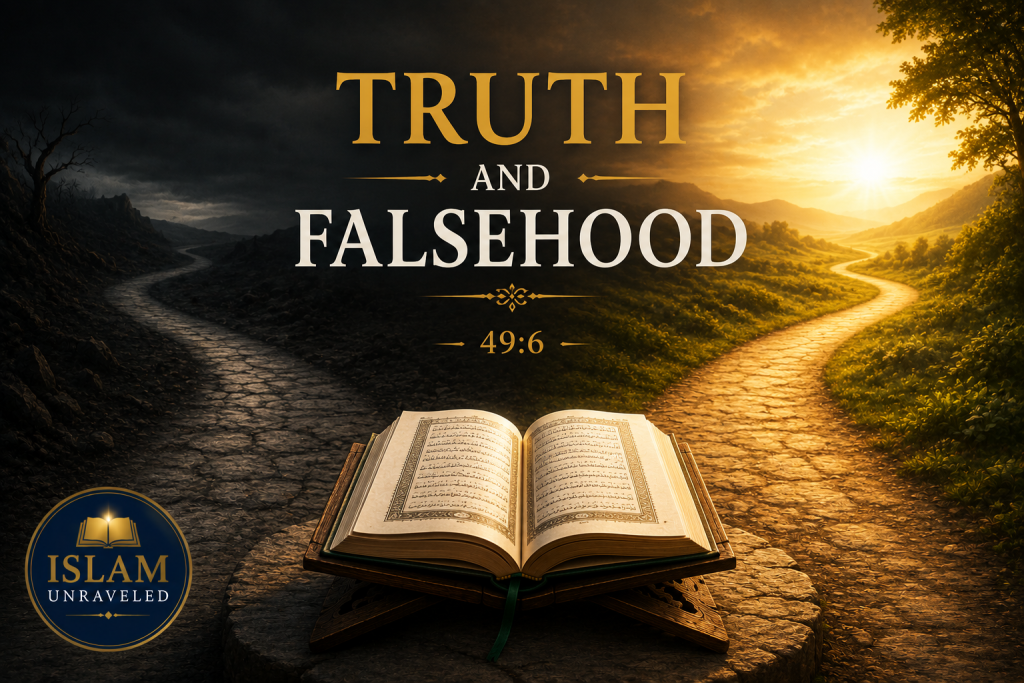
The Quran presents a clear and consistent worldview: truth and falsehood are not equal, nor can they coexist indefinitely. From the beginning of creation to the final outcome, the Quran describes an ongoing conflict in which truth is destined to prevail and falsehood is destined to vanish.
This is not merely a philosophical concept – it is a living reality that unfolds within human societies, beliefs, and religious systems.
God Is the Truth
At the foundation of the Quranic worldview is a central declaration:
“This proves GOD is the Truth…” (22:6)
“…GOD is the Truth, while any idols they set up beside Him are falsehood…” (31:30)
Truth is not abstract—it is rooted in God Himself.
From this follows:
- What aligns with God is truth
- What deviates from His guidance is falsehood
The Quran: A Scripture of Absolute Truth
The Quran affirms:
“…God has revealed this scripture, bearing the truth…” (2:176)
“Absolutely, this is the narration of the truth…” (3:62)
“No falsehood could enter it, in the past or in the future…” (41:42)
The Quran is therefore:
- The criterion of truth
- Protected from corruption
- The final reference for guidance
For a deeper discussion on how the Quran functions as complete guidance.
Messengers Brought the Truth, But Communities Drifted
All messengers came with the same mission: to deliver the truth from God.
However, the Quran highlights a recurring pattern:
communities received the truth, but later introduced additions and competing authorities.
This pattern is explored across multiple themes, including how inherited practices and law evolve over time.
Falsehood as a Competing Authority
The Quran states:
“…Those who disbelieve argue with falsehood to defeat the truth…” (18:56)
Falsehood often appears not as outright rejection, but as:
- Additional sources of authority
- Interpretations elevated to divine status
- Traditions placed alongside revelation
Practical Manifestations Among the People of the Scripture
The Quran’s message applies to all communities who received scripture.
Among Muslims
The Quran presents itself as complete and fully detailed. Yet in practice, many rely on external sources such as Hadith and Sunnah as independent authorities.
This creates a tension between:
- Revelation (the Quran)
- Inherited religious frameworks
Among Christians
The original message of Jesus (the Gospel) emphasized monotheism and submission to God. Over time, doctrinal formulations, such as creeds, became central to belief systems.
This reflects a broader shift from:
- Scripture to Institutional doctrine
Among Jews
The Torah represents divine revelation. However, interpretive traditions developed into authoritative frameworks governing belief and law.
Again, the pattern is consistent:
- Revelation is accompanied, and sometimes overshadowed, by human interpretation
A Quranic Pattern, Not a Sectarian Claim
These examples reflect a universal pattern described in the Quran:
- Truth is revealed
- Additions emerge
- Authority becomes shared
- Truth becomes obscured
The Quran calls all people back to pure devotion to God alone and His revealed scripture.
This broader theme is central to understanding many issues. where social practices are often contrasted with Quranic guidance
Truth vs Falsehood: A Divine Law
The Quran declares:
“…it is our plan to support the truth against falsehood, in order to defeat it.…” (21:18)
This applies to:
- Belief systems
- Religious structures
- Social practices
For example, cultural practices around marriage often contradict Quranic guidance.
The Inevitability of Truth’s Victory
The Quran confirms:
“The truth has prevailed, and falsehood has vanished; falsehood inevitably vanishes.” (17:81)
“…the truth shall prevail, and the falsehood shall vanish…” (8:8)
Falsehood may persist temporarily, but it cannot endure indefinitely.
After the Truth, There Is Only Falsehood
The Quran presents a clear binary:
“What is there after the truth, except falsehood?” (10:32)
There is no middle ground:
- Either authority belongs to God alone
- Or it is shared with human constructs
The Religion of Truth Will Prevail
The Quran declares:
“He is the One who sent His messenger with the guidance and the religion of truth, to make it prevail over all other religions.…” (48:28)
This dominance is:
- Intellectual
- Moral
- Spiritual
Truth ultimately prevails through clarity and consistency.
The Role of Believers
Believers are part of this process:
- Upholding truth
- Rejecting falsehood
- Returning to the Quran alone
This is how truth continues to confront falsehood across generations.
The Larger Purpose
Across all themes—belief, law, and social practice—the same pattern emerges:
- Truth is revealed
- Falsehood challenges it
- Humans are tested
This is reflected in practical issues such as:
Conclusion
The Quran presents truth and falsehood not as abstract ideas, but as realities embedded within human belief systems.
- God is the Truth
- His scripture carries the Truth
- Human beings are tested by competing claims
History shows:
- Truth is revealed
- Falsehood is introduced alongside it
- But falsehood cannot endure
Truth will prevail, and falsehood will vanish.