Introduction
The concept of “dowry” in many parts of the world, especially in South Asia, has become deeply misunderstood and culturally distorted. In countries such as Pakistan and India, the financial burden of marriage often falls heavily on the bride’s family, sometimes leading to long-term debt, delayed marriages, and social injustice.
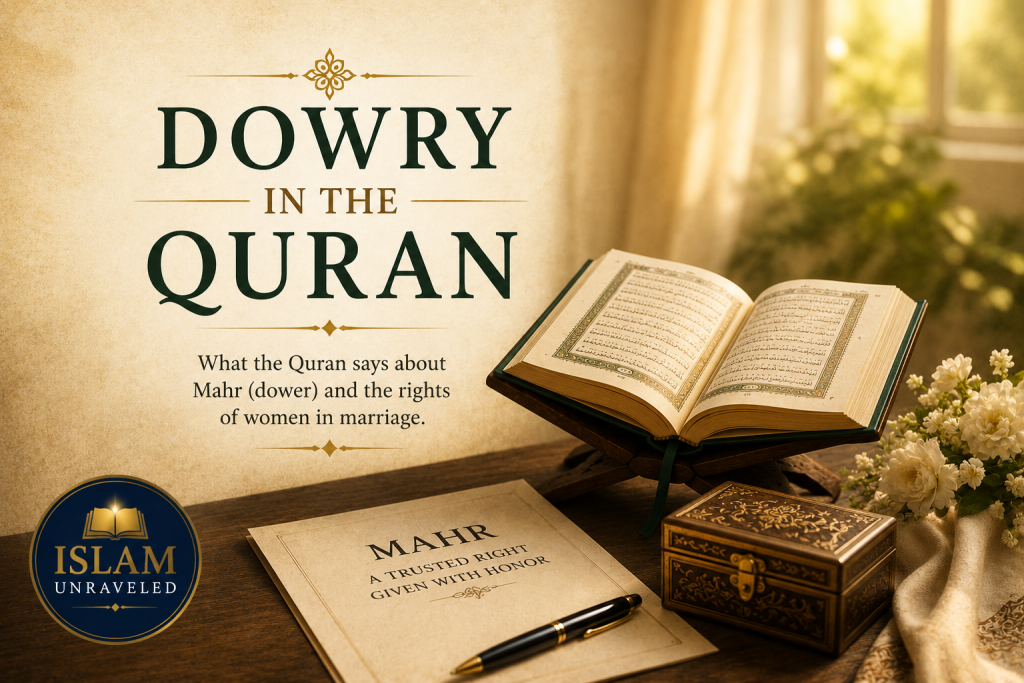
However, when we look at dowry in the Quran alone, a completely different system emerges, one that is just, balanced, and protective of women.
The Quran does not support the idea of dowry flowing from the woman’s family to the man. Instead, it establishes a clear and consistent principle: the financial obligation in marriage flows from the man to the woman.
Dowry in the Quran Is Given to the Woman
The Quran explicitly commands:
“You shall give the women their due dowries, equitably…” (4:4)
This verse establishes foundational principles:
- The dowry (mahr) is mandatory
- It is given by the man
- It is given directly to the woman
- It is given equitably and willingly
This is not a payment to her family, nor a cultural exchange—it is her personal right granted by God.
The Dowry Belongs Exclusively to the Woman
The same verse continues:
“If they willingly give up anything thereof, then you may accept it.” (4:4)
This establishes:
- The dowry is her exclusive property
- No one, not her father, husband, or society, has a claim over it
- Any return of it must be completely voluntary
The Quran further reinforces this:
“If you wish to marry another wife in place of your present wife, and you had given any of them a great deal, you shall not take back anything you had given her…” (4:20)
Even in divorce, the man has no right to reclaim the dowry.
Dowry Is a Condition of Marriage
The Quran repeatedly ties marriage to the giving of dowry:
“…provided you pay them their due dowries…” (4:24)
“…the women you have given their dowries…” (33:50)
From these verses:
- Dowry is not optional
- It is part of the marriage contract
- It reflects responsibility and sincerity
Mutual Agreement and Flexibility
The Quran introduces balance and flexibility:
“There is no blame upon you for anything you mutually agree upon after the initial agreement.” (4:24)
This shows:
- The amount is not fixed
- It must be mutually agreed upon
- It can be adjusted with mutual consent
The Quran avoids rigid formulas while ensuring justice and fairness.
The Quranic Reform of Marriage Economics
Before the Quranic revelation, financial transactions in marriage often benefited guardians or families rather than the woman herself.
The Quran corrected this by:
- Redirecting the dowry to the woman
- Establishing her independent financial ownership
- Removing family control and exploitation
This was a transformational reform, restoring dignity and autonomy to women.
Cultural Dowry vs. Quranic Dowry
Quranic Model
- Paid by: Man
- Received by: Woman
- Ownership: Exclusively hers
- Nature: Obligatory and honorable gift
Cultural Practice (e.g., South Asia)
- Paid by: Bride’s family
- Received by: Husband or his family
- Nature: Social pressure or demand
- Outcome: Financial burden and inequality
The cultural model is essentially the reverse of the Quranic system.
The Situation in Pakistan and Similar Societies
In countries like Pakistan:
- The bride’s family often provides:
- Furniture, cash, appliances, jewelry
- Wedding expenses
- These expectations are often:
- Socially enforced
- Financially burdensome
- A barrier to marriage
This practice:
- Has no basis in the Quran
- Contradicts the Quranic directive
- Transfers responsibility away from the man, where the Quran places it
Ethical and Social Implications
The Quranic system:
- Protects women financially and socially
- Establishes accountability for men
- Prevents exploitation of families with daughters
- Encourages fair and accessible marriage
By contrast, cultural dowry systems:
- Create economic injustice
- Lead to social pressure and hardship
- Often result in long-term harm
Conclusion
The Quran presents a clear and consistent framework:
- Dowry is a right of the woman
- It is given by the man
- It is mutually agreed upon
- It is never taken back unjustly
What is practiced in many societies today, where the bride’s family pays, is not only unsupported by the Quran, but directly contradicts it.
Returning to the Quran alone restores justice, balance, and dignity to marriage.
Continue Your Study
Explore related studies on women, marriage, family, and individual rights in the Quran.
Women in the Quran
Begin with the broader Quranic framework for the dignity, equality, rights, responsibilities, and protection of women.
Marriage in the Quran
Examine the Quranic foundations of marriage, mutual responsibility, commitment, and the rights of both spouses.
Marriage in the Quran: Women
Explore marriage specifically from the perspective of women’s dignity, rights, financial independence, and protection.
Divorce in the Quran
Study the Quran’s regulated process for separation, including reconciliation, financial protection, waiting periods, and dignified treatment. Your current article already emphasizes these protections.
Polygamy in the Quran
Examine the context and conditions of polygamy, particularly its connection with justice, responsibility, orphans, and protection of women.
Abortion in the Quran
Examine abortion through the Quranic principles of creation, the sanctity of life, divine knowledge, and individual accountability.