Introduction
Marriage in the Quran is often presented through cultural practices, traditions, or religious interpretations. As a result, many misconceptions arise—especially regarding the role and status of women.
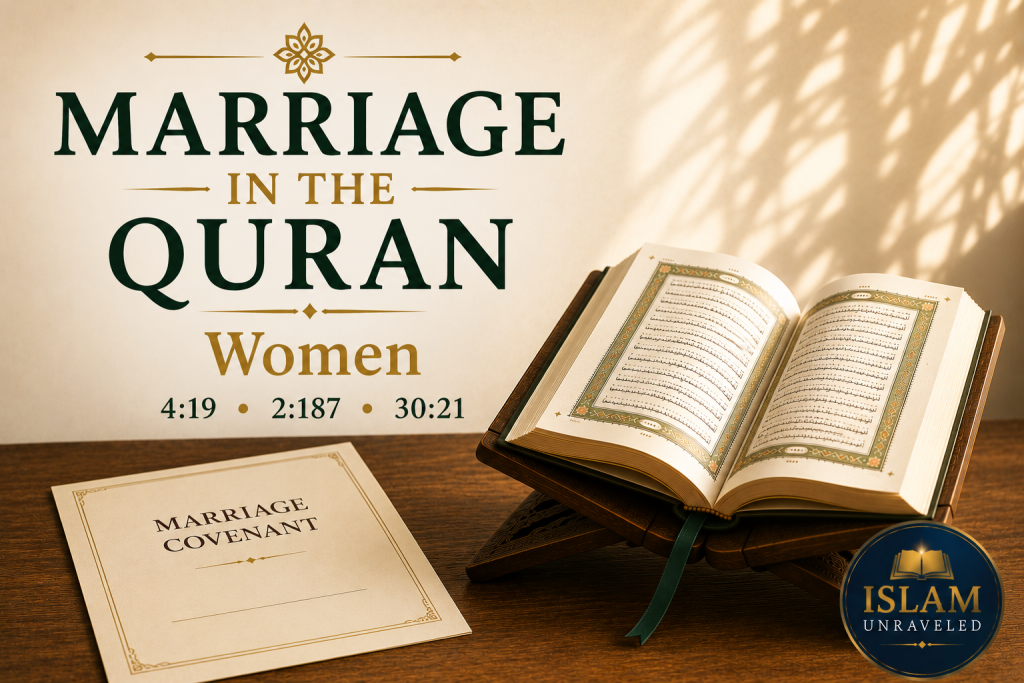
The Quran presents marriage not as a ritualistic or institutional construct, but as a moral, contractual, and spiritual relationship rooted in justice, mutual consent, and dignity. When understood from the Quran alone, marriage emerges as a system that elevates women, protects their rights, and establishes balance between spouses.
Marriage as a Quranic Institution
The Quran describes marriage as a natural and purposeful union:
“He created for you from yourselves spouses that you may find tranquility in them, and He placed between you love and mercy.” (30:21)
Marriage is therefore:
- A source of tranquility (sukoon)
- Built on love and mercy
- A mutual relationship, not a hierarchy of domination
This directly challenges cultural narratives that reduce marriage to control or ownership.
Mutuality and Equality Between Spouses
One of the most powerful Quranic descriptions of marriage is:
“They are a garment for you, and you are a garment for them.” (2:187)
This verse establishes:
- Equality in function and purpose
- Mutual protection, comfort, and dignity
- A relationship based on complementarity, not superiority
The Quran does not present the woman as inferior. Rather, both spouses are described as essential to each other’s well-being.
Marriage Is a Contract, Not Ownership
The Quran frames marriage as a mutually agreed contract, not a religious sacrament controlled by clergy or rigid ceremony.
Key principles include:
- Consent of the woman is essential
- The marriage is based on mutual agreement
- The woman retains her independent identity and rights
Women are not transferred, owned, or controlled. They enter marriage as equal moral agents.
Financial Rights and Independence of Women
The Quran gives women clear financial rights:
“Give the women their dowries graciously…” (4:4)
This establishes:
- The dowry (mahr) belongs exclusively to the woman
- It is not a payment to her family
- It is not symbolic—it is a right
Women also:
- Retain ownership of their wealth
- Are not financially dependent by obligation
- Are not required to surrender their assets
This was historically revolutionary and remains distinct even today.
A Historical Perspective: Rights Given by the Quran vs. Modern Recognition
An important dimension of marriage in the Quran is that it establishes women as independent legal and financial individuals, not dependents or extensions of their husbands.
The Quran affirms:
“For the men is a share of what they earn, and for the women is a share of what they earn.” (4:32)
It also grants women the right to inherit and own property:
“For men is a share of what the parents and relatives leave, and for women is a share of what the parents and relatives leave…” (4:7)
Within marriage itself, the Quran secures:
- The woman’s right to receive and retain her dowry (4:4)
- Her independent ownership of wealth and earnings
- Her status as a contracting party, not property
This framework establishes marriage as a union between two legally independent individuals, each with defined rights and responsibilities.
These rights were established in the Quran over 1400 years ago.
By contrast, in many Western societies, women historically:
- Could not own property independently after marriage
- Had limited or no control over their earnings
- Lacked equal legal standing in marital contracts
Such rights only began to be formally recognized in the late 19th and early 20th centuries.
This comparison highlights a key reality:
The Quran did not introduce a system that restricts women—it introduced a system that recognizes, protects, and preserves their rights and dignity.
Choice and Compatibility in Marriage
The Quran emphasizes compatibility in belief and values:
- Marriage is tied to faith and moral alignment
- It discourages unions that compromise belief
The goal is not merely companionship, but a shared commitment to righteousness.
Limits and Boundaries in Marriage
The Quran clearly defines prohibited relationships (4:23), ensuring:
- Protection of family structure
- Prevention of exploitation or abuse
Marriage is not unrestricted—it is regulated to preserve dignity and social order.
The Role of Ceremony: Minimal and Non-Ritualistic
Contrary to common belief, the Quran does not prescribe a detailed marriage ceremony.
There is:
- No mandated ritual format
- No required religious officiant
- No fixed cultural structure
Marriage in the Quran is defined by:
- Agreement
- Public acknowledgment
- Fulfillment of rights
This shows that marriage is simple in form but profound in responsibility.
Misconceptions About Women in Marriage
Many cultural practices contradict the Quran by:
- Restricting women’s choice
- Treating them as dependents or subordinates
- Imposing conditions not found in the Quran
The Quran, however:
- Affirms women’s agency and consent
- Protects their financial independence
- Establishes mutual respect and balance
Women are not secondary participants in marriage—they are equal partners in a moral contract.
Marriage as a Means of Justice and Stability
Marriage in the Quran serves broader purposes:
- Establishing stable families
- Promoting moral conduct
- Protecting individuals from exploitation
It is not merely personal—it is social and ethical.
Conclusion
The Quran presents marriage as a balanced, just, and dignified institution.
It is:
- A relationship of mutual support
- A contract based on consent and responsibility
- A system that protects and elevates women, not diminishes them
The absence of rigid ceremony highlights an important truth:
What matters in marriage is not ritual—but justice, commitment, and adherence to God’s guidance.
When stripped of cultural additions and external interpretations, marriage in the Quran stands as a model of equity, dignity, and harmony between men and women.
Frequently Asked Questions
Does the Quran require a marriage ceremony?
No. The Quran does not prescribe a specific marriage ceremony. It emphasizes mutual agreement, consent, and fulfillment of rights.
What rights does a woman have in marriage according to the Quran?
The Quran grants women financial independence, ownership of dowry, and equal moral status within the marriage.
Is marriage in the Quran a contract or a religious ritual?
Marriage in the Quran is a contract based on consent and responsibility, not a ritual requiring specific ceremonies.
Does the Quran allow forced marriage?
No. The Quran emphasizes justice and mutual agreement, which excludes coercion.
Continue Your Study
Explore related studies on women, marriage, family, and individual rights in the Quran.
Women in the Quran
Begin with the broader Quranic framework for the dignity, equality, rights, responsibilities, and protection of women.
Marriage in the Quran
Examine the Quranic foundations of marriage, mutual responsibility, commitment, and the rights of both spouses.
Dowry in the Quran
Examine the dowry as a right belonging to the woman and the Quranic principles governing it.
Divorce in the Quran
Study the Quran’s regulated process for separation, including reconciliation, financial protection, waiting periods, and dignified treatment. Your current article already emphasizes these protections.
Polygamy in the Quran
Examine the context and conditions of polygamy, particularly its connection with justice, responsibility, orphans, and protection of women.
Abortion in the Quran
Examine abortion through the Quranic principles of creation, the sanctity of life, divine knowledge, and individual accountability.