Religious Duties in the Quran
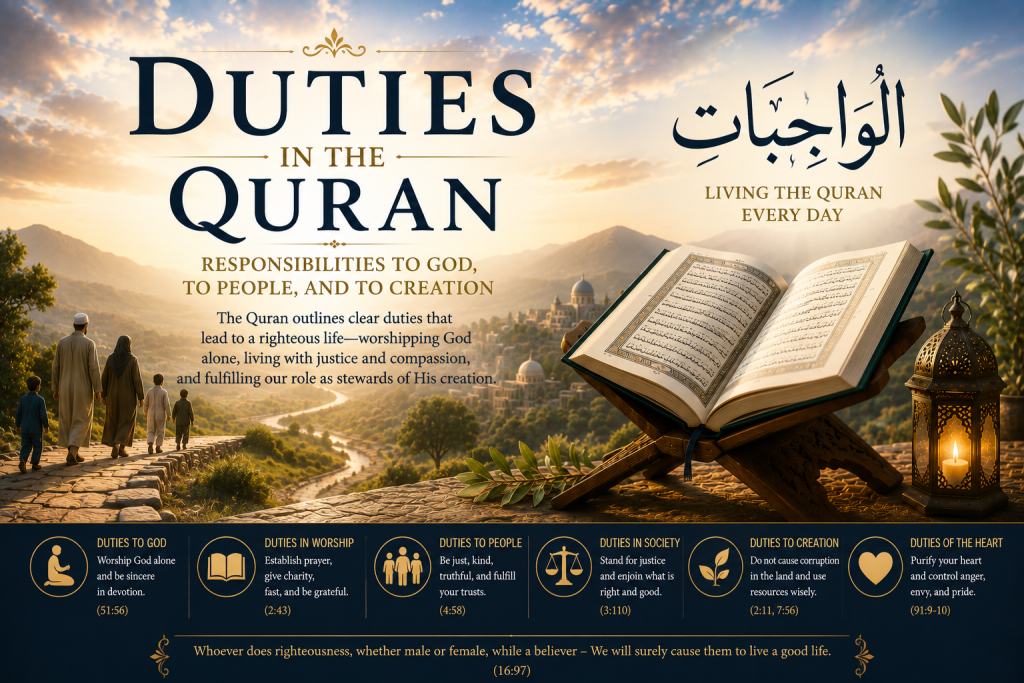
The Qur’an presents a clear system of religious duties rooted in devotion, charity, discipline, and pilgrimage. These duties are not cultural inventions or sectarian constructions — they are prescribed acts that God Himself commanded for believers, and they have been observed since Abraham (2:128, 22:27).
This page introduces the major duties described in the Qur’an, summarizes their core features, and links to detailed subpages for deeper study and practical implementation.
What the Quran Means by Religious Duties
The Quran uses terms like ḥaqq (due right), farīḍah (prescription), and ʿibādah (devotion) to describe obligations owed to God and society. These duties serve three main functions:
Devotion toward God (salat)
Support for society (zakat)
Discipline and restraint (fasting)
Public proclamation and unity (pilgrimage)
Related page:
Salat (Contact Prayer)
Salat is a prescribed contact prayer that affirms devotion, remembrance, and submission to God alone (20:14). The Quran emphasizes its inherited nature from Abraham, its structure, its timings, and its corrective function against inherited distortions.
Subpages cover:
Practical guide:
Zakat (Obligatory Charity)
Zakat is a prescribed duty that fulfills the needs of the poor, supports social stability, and purifies income and wealth (9:60). The Quran distinguishes zakat from sadaqah, explains when it becomes due, and identifies legitimate recipients.
Subpages cover:
Practical guide:
Fasting (Ṣawm)
Fasting is prescribed for believers to develop taqwā — moral restraint and higher awareness of God (2:183). The Quran defines the time frame, exemptions, makeup, compensation, and its deeper behavioral purpose.
Subpages cover:
Practical guide:
Pilgrimage (Ḥajj)
Pilgrimage is a public duty tied to Abraham (22:27), involving proclamation, sacred months, rites of sanctity, and public unity. The Quran outlines the acts of pilgrimage and corrects distortions introduced afterward.
Subpages cover:
Practical guide:
Relationship to Abraham
All four major duties are connected to Abraham’s system of devotion, charity, fasting, and pilgrimage (2:128, 22:26–27). The Quran emphasizes:
duties inherited from Abraham
correction of distortions
preservation of core forms
This establishes historical continuity without sectarian mediation.
Related page:
Beyond Legalism
While duties are prescribed, God clarifies that:
He does not burden beyond capacity (2:286)
Intention and sincerity matter
Exemptions and compensations exist
Justice and accountability remain central
This prevents ritualism without ethics and legalism without compassion.