Major Themes of the Quran
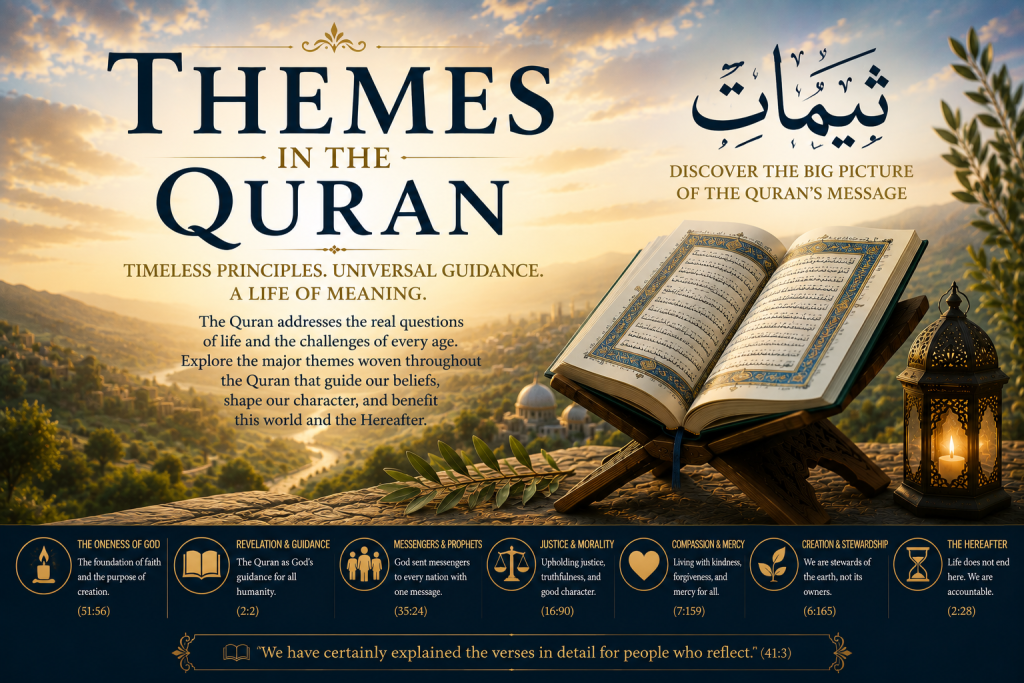
The Quran presents a unified message centered on the worship of God alone and accountability before Him. Across its chapters, recurring themes appear repeatedly, shaping its moral, theological, and social framework.
Studying the Quran thematically allows readers to trace how these central ideas develop across different narratives and contexts. The following themes represent key areas where misunderstanding, cultural overlays, or inherited interpretations often obscure the Quran’s direct wording.
Each section below links to a focused study grounded in the Quran itself.
Worship God Alone
From Noah to Abraham, Moses, Jesus, Muhammad, and every messenger sent by God, the call remained unchanged. While communities and circumstances differed throughout history, God’s message never changed: devote your worship, trust, obedience, and ultimate allegiance to God alone.
The Quran teaches that worship extends beyond rituals. It includes recognizing God as the sole source of religious authority, following His revelation above all human opinions, and avoiding every form of association (shirk). Every major theme of the Quran ultimately points back to this one principle.
Freedom in the Quran
The Quran presents freedom as one of God’s greatest gifts to humanity.
Human beings are free to believe or reject, to pursue justice or injustice, and to choose whether they will devote themselves to God. At the same time, every freedom carries responsibility and accountability before God.
The Quran protects freedom of belief, respects private property, encourages lawful trade and mutually acceptable transactions, and establishes enduring moral principles that allow individuals and societies to flourish. Rather than promoting unrestricted freedom, the Quran presents freedom as the opportunity to choose righteousness within the guidance established by God.
Ultimately, the greatest freedom is freedom from every authority that competes with God, allowing believers to worship Him alone with sincerity and conviction.
Idolatry (Shirk)
The Quran’s central warning is against associating partners with God. Idolatry in the Quran is not limited to statues; it includes elevating human authorities, traditions, or ideologies to a status that competes with divine revelation. From Abraham’s confrontation with idol worship to repeated calls to worship God alone, the Quran frames shirk as the fundamental deviation from submission.
Explore how the Quran defines idolatry and how it manifests in both historical and contemporary forms.
Woman in the Quran
The Quran addresses women within a framework of spiritual equality and moral accountability. It corrects pre-Islamic injustices while emphasizing responsibility and dignity for both men and women.
Many discussions about women in religion rely more on cultural practice than on Quranic text. This study examines what the Quran explicitly states regarding women, inheritance, marriage, testimony, and spiritual standing — separating scripture from inherited assumptions.
Satan in the Quran
The Quran presents Satan (Iblis) as a conscious being who refused divine command out of arrogance. His role is not coercion but suggestion — he invites, whispers, and beautifies wrongdoing, while human beings remain accountable for their choices.
Understanding Satan’s function in the Quran clarifies the relationship between free will, temptation, and personal responsibility.
Jihad in the Quran
The word “jihad” in the Quran fundamentally means striving or exerting effort. While the Quran addresses armed conflict in specific historical contexts, it also speaks extensively of intellectual, moral, and spiritual struggle.
Modern discourse often narrows the term to warfare. A Quran-centered reading restores its broader meaning while placing combat verses within their proper historical and textual framework.
Animals and the Arts in the Quran
The Quran frequently points to animals, nature, and the created world as signs for reflection. It describes animals as communities like humans and frames artistic expression within moral boundaries rather than blanket prohibition.
This theme explores how the Quran views the natural world, creativity, and human engagement with beauty and expression.
A Text-Centered Approach
The purpose of these thematic studies is not to introduce new doctrines, but to return to the Quran’s own language. Where inherited interpretations diverge from the text, clarification becomes necessary.
The Quran repeatedly calls upon readers to reflect, reason, and examine its verses carefully. These themes are presented in that spirit — grounded in the text and attentive to context.