Freedom in the Quran
A Divine Gift and Human Responsibility
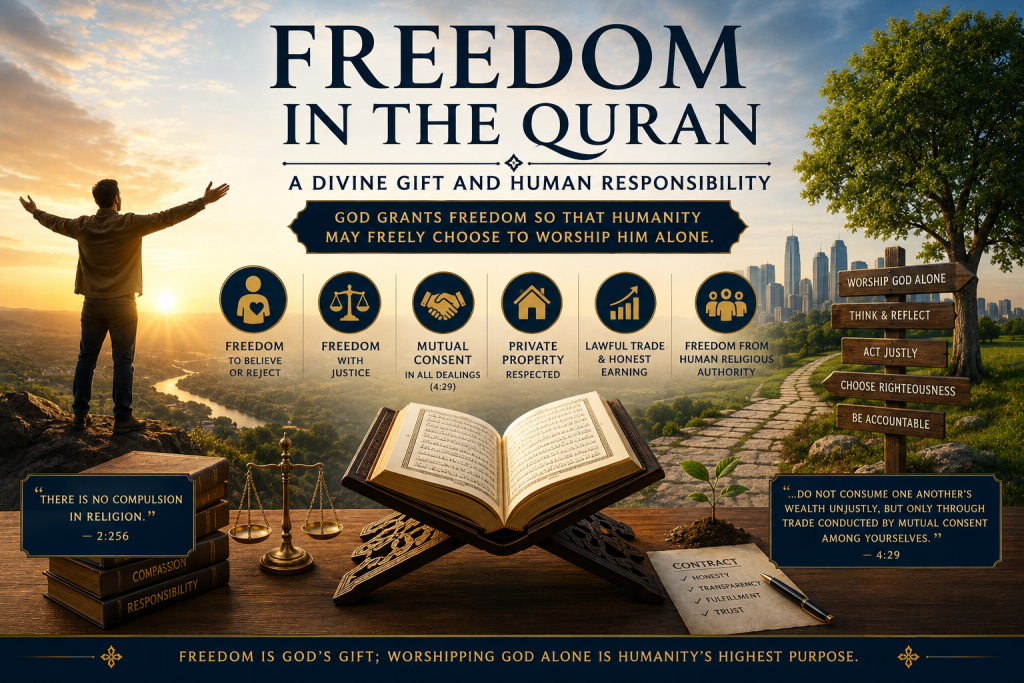
The Quran presents freedom not as the absence of God’s guidance, but as the opportunity to choose righteousness within the moral framework established by God.
Introduction
Freedom is one of God’s greatest gifts to humanity.
The Quran presents human beings as moral, rational, and responsible individuals who have been given the ability to choose. That freedom is not accidental—it is part of God’s design. Without freedom, there could be no sincere faith, no genuine submission, no moral responsibility, and no accountability.
Throughout the Quran, God calls people to observe, reflect, reason, and decide for themselves. The invitation to believe is never presented as blind acceptance or forced conformity. Rather, the Quran repeatedly appeals to the human mind and conscience, asking individuals to recognize the truth and willingly submit to God.
This freedom, however, is never separated from responsibility. Every choice has consequences, and every individual will ultimately answer to God for the decisions made during this life.
The Quran therefore presents freedom and accountability as complementary principles. One gives human life dignity; the other gives it purpose.
This page explores how the Quran presents freedom—not as unrestricted license, but as a divine gift that allows people to worship God sincerely, pursue justice, build prosperous societies, and live responsibly under God’s guidance.
Freedom: One of God's Greatest Gifts
Unlike the rest of creation, human beings possess the ability to choose.
The Quran describes mankind as being entrusted with a responsibility that requires freedom of choice. Every individual has the ability to believe or reject, to obey or disobey, to pursue justice or injustice, and to accept or ignore God’s guidance.
This freedom gives meaning to every command and every act of worship.
Without freedom:
- belief would have no value,
- submission would be meaningless,
- gratitude could not be genuine,
- love for God could not be sincere,
- and judgment would have no purpose.
The Quran repeatedly reminds us that life itself is a test. A test has meaning only when individuals are free to make choices.
God could have compelled every human being to believe. Instead, He created humanity with the ability to choose, allowing faith to become a conscious and voluntary response rather than an act of compulsion.
Freedom is therefore not a weakness in God’s plan; it is one of its essential features.
Related Studies
Freedom to Believe or Reject
One of the clearest expressions of freedom in the Quran concerns belief itself.
The Quran repeatedly calls people to faith, yet it never authorizes forced belief.
God declares:
“There shall be no compulsion in religion…” (2:256)
Likewise, the Quran states:
“The truth is from your Lord. So whoever wills—let him believe; and whoever wills—let him reject.” (18:29)
Even the Prophet Muhammad was not given authority to compel belief.
God reminds him:
“Had your Lord willed, everyone on earth would have believed. Will you then compel people until they become believers?” (10:99)
These verses establish a profound principle.
Faith has value only when it is chosen freely.
Compelled belief may produce outward conformity, but it cannot produce sincere submission to God.
For this reason, the Quran consistently appeals to reason, evidence, and reflection rather than coercion. Throughout its pages, readers are invited to think, observe creation, consider history, and examine the signs of God.
The goal is not forced religion but informed conviction.
This freedom also places responsibility upon every individual. Since belief is freely chosen, every person becomes accountable before God for the choices made during life.
Related Studies
Freedom Requires Responsibility
The Quran never presents freedom as the absence of moral boundaries.
Instead, freedom and responsibility exist together.
Human beings are free to choose, but they are not free from the consequences of their choices.
Every action carries moral significance.
Every decision contributes to one’s character.
Every individual will ultimately stand before God to answer for how freedom was used.
This principle runs throughout the Quran.
People are encouraged to think independently, yet they are warned against injustice.
They are free to pursue wealth, yet commanded to earn it honestly.
They are free to speak, yet instructed to speak truthfully.
They are free to own property, yet prohibited from violating the rights of others.
The Quran therefore rejects two extremes.
On one hand, it rejects coercion that removes human freedom.
On the other, it rejects the idea that freedom means living without moral accountability.
True freedom is exercised within the framework established by God.
That framework protects human dignity while preserving justice, compassion, honesty, and responsibility.
Rather than controlling every detail of human life, the Quran establishes enduring moral principles that allow individuals and societies to flourish while remaining accountable to God.
Freedom is therefore not the absence of guidance.
It is the opportunity to choose righteousness within the guidance that God has provided.
Related Studies
Freedom and Religious Authority
One of the Quran’s most profound teachings is that freedom includes freedom from unauthorized religious authority.
Throughout history, people have often surrendered their responsibility to think, reflect, and judge according to God’s revelation. Instead, they placed ultimate trust in religious leaders, inherited traditions, or the opinions of respected scholars.
The Quran repeatedly calls believers back to God’s own words.
God asks:
“Shall I seek other than God as a judge when He has revealed to you this Book fully detailed?” (6:114)
This question is not merely rhetorical. It establishes an enduring principle.
The ultimate authority in matters of faith belongs to God alone.
The Quran describes itself as:
- fully detailed (6:114),
- complete in truth and justice (6:115),
- and an explanation of all things necessary for guidance (16:89).
This does not mean that teachers, scholars, or knowledgeable people have no value. They can explain, educate, and help others understand God’s revelation.
However, no human explanation possesses independent religious authority alongside God’s words.
Every opinion remains open to examination in the light of the Quran.
This principle protects both religion and human freedom.
Believers are encouraged to think, question, reflect, and verify rather than surrender their conscience to another human being.
By preserving God’s exclusive authority in matters of religion, the Quran also preserves the freedom and responsibility of every individual believer.
Related Studies
Freedom and Worship
The Quran repeatedly connects freedom with sincere worship.
Worship has meaning only when it is freely offered.
A person compelled to pray, give charity, or profess belief may display outward conformity, but genuine devotion cannot be forced.
God desires willing submission rather than mechanical obedience.
For this reason, every messenger invited people to worship God through persuasion, reason, and clear signs—not through compulsion.
The Quran calls people to:
- remember God,
- reflect upon His signs,
- observe creation,
- use reason,
- and willingly devote themselves to Him.
This voluntary response is what gives worship its spiritual value.
True worship is therefore much more than performing religious rituals.
It is the conscious decision to recognize God’s authority, trust His guidance, and direct one’s entire life toward pleasing Him.
Freedom makes sincere worship possible.
Related Studies
Freedom in Human Relationships and Economic Life
The Quran does not limit freedom to matters of belief.
It also recognizes the dignity and responsibility of individuals in their relationships with one another.
Human beings are treated as morally responsible individuals who are capable of making decisions, entering agreements, owning property, conducting business, and building families.
Rather than regulating every detail of society, the Quran establishes enduring moral principles that protect both freedom and justice.
Private property is recognized.
Honest work is honored.
Trade is lawful.
Contracts are to be fulfilled.
Trusts are to be respected.
Fraud, theft, bribery, exploitation, and deception are prohibited because they violate both justice and the freedom of others.
The Quran does not present wealth itself as evil.
Instead, it repeatedly emphasizes how wealth is acquired, managed, and shared.
Freedom therefore carries responsibility.
Individuals remain free to earn, own, trade, invest, and build, but they remain accountable before God for the honesty, fairness, and compassion with which those freedoms are exercised.
Rather than controlling economic activity through detailed regulations, the Quran establishes moral principles that allow individuals and communities to flourish while remaining responsible to God.
This balance between freedom and accountability reflects the Quran’s broader approach to human life.
Related Studies
By Mutual Consent
One of the Quran’s most remarkable expressions of personal freedom appears in its guidance regarding human transactions.
God instructs believers:
“…do not consume one another’s wealth unjustly, but only through trade conducted by mutual consent among yourselves…” (4:29)
This simple phrase—“by mutual consent”—captures a profound Quranic principle.
The Quran consistently respects the ability of responsible individuals to make decisions for themselves.
Agreements are not to be based upon force, deception, or exploitation.
Instead, they are founded upon honesty, transparency, and the voluntary agreement of those involved.
Although this verse speaks directly about financial transactions, the principle extends far beyond commerce.
Throughout the Quran, relationships are built upon mutual responsibility, consultation, justice, and consent rather than coercion.
Marriage is entered through mutual agreement.
Business depends upon mutual trust.
Contracts are voluntarily accepted.
Communities are encouraged to conduct their affairs through consultation.
These principles reflect the Quran’s confidence in human beings as morally responsible individuals.
Freedom is not exercised in isolation.
It flourishes where justice, honesty, and mutual respect are preserved.
The Quran therefore presents freedom not as unrestricted individualism, but as responsible interaction between free individuals who remain accountable to God.
Related Studies
Freedom and Justice
Freedom cannot exist without justice.
Throughout the Quran, justice is presented as one of the foundations upon which a healthy society is built. God repeatedly commands believers to stand firmly for justice, even when doing so is difficult or contrary to personal interests.
Justice protects the weak from the powerful.
It safeguards property.
It preserves trust.
It gives every individual confidence that their rights will be respected.
For this reason, the Quran repeatedly condemns oppression, corruption, bribery, dishonesty, and every form of exploitation.
True freedom is not the freedom of the strong to dominate the weak.
Rather, it is the freedom of every individual to live under principles of justice established by God.
Where justice flourishes, freedom flourishes.
Where injustice prevails, freedom gradually disappears.
Related Studies
Freedom from Human Religious Authority
One of the greatest freedoms offered by the Quran is freedom from religious domination by other human beings.
History repeatedly shows how sincere religious communities gradually elevated scholars, clergy, traditions, and inherited teachings until they possessed authority alongside God’s revelation.
The Quran consistently calls believers back to a different model.
God alone possesses absolute authority.
His revelation is the ultimate standard.
Teachers and scholars can educate, explain, and encourage, but they cannot establish religious law independent of what God has revealed.
The Quran repeatedly invites every believer to think, reflect, examine the evidence, and judge according to God’s words.
This responsibility cannot be delegated.
Freedom therefore carries an obligation.
Every believer is personally responsible before God for understanding and following His guidance.
No one will answer on another person’s behalf.
This principle protects believers from blind dependence while encouraging continual learning, reflection, and sincere submission to God.
Related Studies
The Greatest Freedom
The Quran ultimately presents freedom in a way that is both profound and paradoxical.
The greatest freedom is not freedom from God.
It is freedom from everything except God.
When a person’s ultimate loyalty belongs only to God:
- no ruler possesses absolute authority over his conscience,
- no religious scholar possesses unquestioned authority,
- no sect defines his relationship with God,
- no tradition stands above God’s revelation.
His first and final allegiance belongs to the One who created him.
This freedom liberates people from fear of human authority while placing them under the guidance of the One whose knowledge, wisdom, justice, and mercy are perfect.
The Quran therefore presents worshipping God alone as the highest expression of human freedom.
Freedom and submission are not opposites.
True freedom is found in willingly submitting to God alone.
Related Studies
Conclusion
Freedom is one of God’s greatest gifts to humanity.
It allows people to believe or reject, to pursue justice or injustice, to build or destroy, and ultimately to choose whether they will devote themselves to God.
The Quran protects this freedom because without it there can be no sincere faith, no genuine worship, and no meaningful accountability.
At the same time, freedom is never separated from responsibility.
God establishes enduring moral principles that protect human dignity while allowing individuals and societies to flourish.
The Quran does not attempt to regulate every detail of life.
Instead, it establishes timeless principles such as:
- justice,
- honesty,
- private ownership,
- lawful trade,
- mutual consent,
- fulfillment of contracts,
- compassion,
- charity,
- accountability,
- and exclusive devotion to God.
These principles provide the framework within which free people can live responsibly before their Creator.
Ultimately, the Quran’s vision of freedom is not merely political, economic, or social.
It is spiritual.
The greatest freedom belongs to those who recognize no ultimate authority except God.
They worship Him alone.
They seek judgment from His revelation.
They live responsibly toward others.
And they prepare to meet Him knowing that every choice made in freedom carries eternal significance.
Continue Your Study
Final Reflection
The Quran presents freedom as a trust from God.
It is not freedom without limits, nor freedom under the domination of other human beings.
It is the freedom to seek the truth, to choose righteousness, to conduct one’s affairs with justice and integrity, and ultimately to devote one’s worship, loyalty, and obedience to God alone.
In that freedom lies both human dignity and humanity’s greatest responsibility.
Freedom is God’s gift; worshipping God alone is humanity’s highest use of that gift.