Introduction
Few questions are raised more often than: “Who created God?” or “Where did God come from?” At first glance, these seem like logical extensions of how we understand the world – everything we observe has a cause, so shouldn’t God also have one?
The Quran approaches this issue differently. It shows that these questions arise from placing God within the same framework as creation, when in fact the Quran defines Him as beyond that framework entirely. When this distinction is understood, the question does not need to be answered – it simply no longer applies.
Two Different Types of Questions
What is often overlooked is that two very different questions are being merged into one:
- How did things within the universe come into existence?
- What is the origin of the ultimate cause itself?
The first question deals with:
- Life
- DNA
- The universe
- Physical processes
The second question attempts to apply the same logic to the source of all existence.
The Quran separates these clearly.
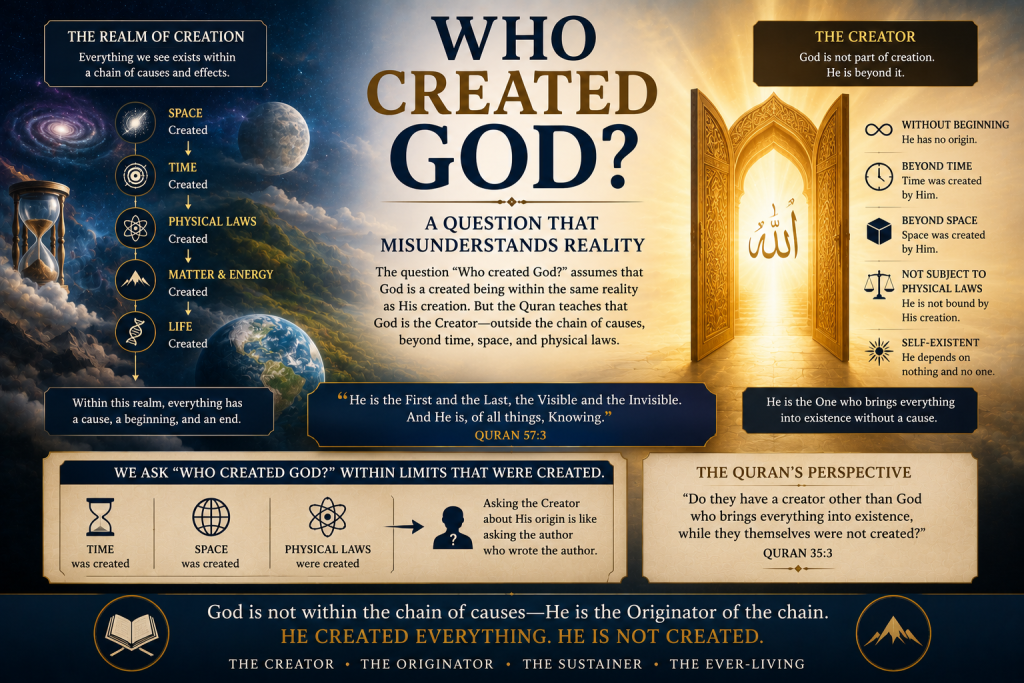
God Is Not Within the Chain of Causes
The Quran does not present God as one more entity inside creation. Instead, it describes Him as:
“The Originator of the heavens and the earth…” (6:101)
“He is the First and the Last…” (57:3)
These verses establish a fundamental principle:
- Everything we observe has a beginning and depends on something else
- God is the source of all beginnings, not something that began
In other words:
God is not part of the chain of causes – He is the origin of the chain itself
The Question Reframed by the Quran
Because of this, asking:
- “Where did God come from?”
is actually applying:
- time
- causation
- origin
to something the Quran defines as beyond time and creation
The Quran simplifies the issue:
“Were they created from nothing? Or are they the creators?” (52:35)
This presents only two possibilities:
- Everything came from nothing (which contradicts reason)
- Or there exists a self-sufficient, independent origin
Once this is understood, asking “What caused God?” becomes a contradiction. The Quran defines God as the First – the origin of all causes. To ask what caused Him is to assume He is part of creation, when He is in fact the source of creation. In other words, it is like asking, “What caused the first cause?” – a question that no longer applies.
The Beginning of the Universe
As for the universe itself, the Quran points to a beginning:
“The heavens and the earth were once one mass, then We split them apart…” (21:30)
Whether one describes this in modern terms as the “Big Bang” or otherwise, the Quran’s point is clear:
- The universe is not eternal in its current form
- It had an origin
And anything that begins: requires a cause outside itself
But the Quran does not focus on explaining the mechanism. Instead, it directs attention to:
the source behind the beginning
From Complexity to Source
When we reflect on:
- DNA
- Life
- The structure of the universe
we are not just seeing complexity – we are seeing:
- order
- consistency
- balance
The Quran repeatedly draws attention to this:
“In the creation of the heavens and the earth… are signs for those who understand.” (3:190)
The deeper question then becomes:
What kind of reality must exist for such order to arise?
The Quran’s answer is:
- A source that is:
- independent
- not created
- not subject to change
“He begets not, nor is He begotten.” (112:3)
The Scale of Creation and the Greatness of the Creator
When we reflect further, the scale of creation itself becomes overwhelming.
- The human body is an intricate system of staggering complexity
- The universe extends far beyond comprehension
Modern observation tells us:
- The known universe contains countless galaxies, far exceeding the human population
- Each galaxy contains billions of stars and systems
Yet the Quran presents an even greater reality:
“They have not valued GOD as He should be valued. The whole earth will be within His fist on the Day of Resurrection, and the heavens will be folded within His right hand…” (39:67)
This is not a physical description—it is a statement of absolute power and control.
The entire universe, with all its vastness, is insignificant compared to the Creator.
When this is understood:
- God is not a “thing” within the universe
- He is the One who sustains and holds the universe itself
In light of this, the question “Where did God come from?” loses its footing. It attempts to place the Creator of all existence within the very system He created.
Why the Question Persists
The difficulty lies in how we think.
We are used to:
- everything having a beginning
- everything having a cause
So we try to apply the same rules universally.
But the Quran introduces a critical distinction:
- These rules apply to creation
- Not to the Creator
The concept of “before” itself belongs to time – and time is part of creation.
When the Question Dissolves
Once God is understood as:
- the independent origin
- the source of all beginnings
- not subject to time, change, or dependency
then the question:
“Where did God come from?”
no longer applies.
It is not that the question is unanswered – it is that it is misapplied.
Conclusion
The Quran does not leave us without an answer – it redirects us to the correct framework.
- The universe has a beginning
- Creation depends on causes
- But the ultimate source is independent of all causes
This leads to a simple but profound conclusion:
God is not something that “came from” anywhere
He is the reason anything else exists at all
When this is understood, the question does not need an answer – it simply melts away.
Frequently Asked Questions
Who created God according to the Quran?
The Quran does not present God as something created. It defines Him as the “First” and the originator of all existence, meaning He is not subject to creation.
Where did God come from?
The Quran explains that God did not “come from” anywhere. He exists independently and is the source of all beginnings.
Does the Quran explain the beginning of the universe?
Yes. The Quran states that the heavens and the earth were once a single entity and were then separated (21:30), indicating a beginning of the universe.
Why does the question “Who created God?” not apply?
Because it assumes God is part of creation, whereas the Quran defines Him as beyond creation and the source of all causes. The question itself arises from human knowledge – which is part of creation and granted by the Creator – and therefore cannot fully apply to what lies beyond creation.