Introduction
The Quran records a striking statement that will be made on the Day of Judgment:
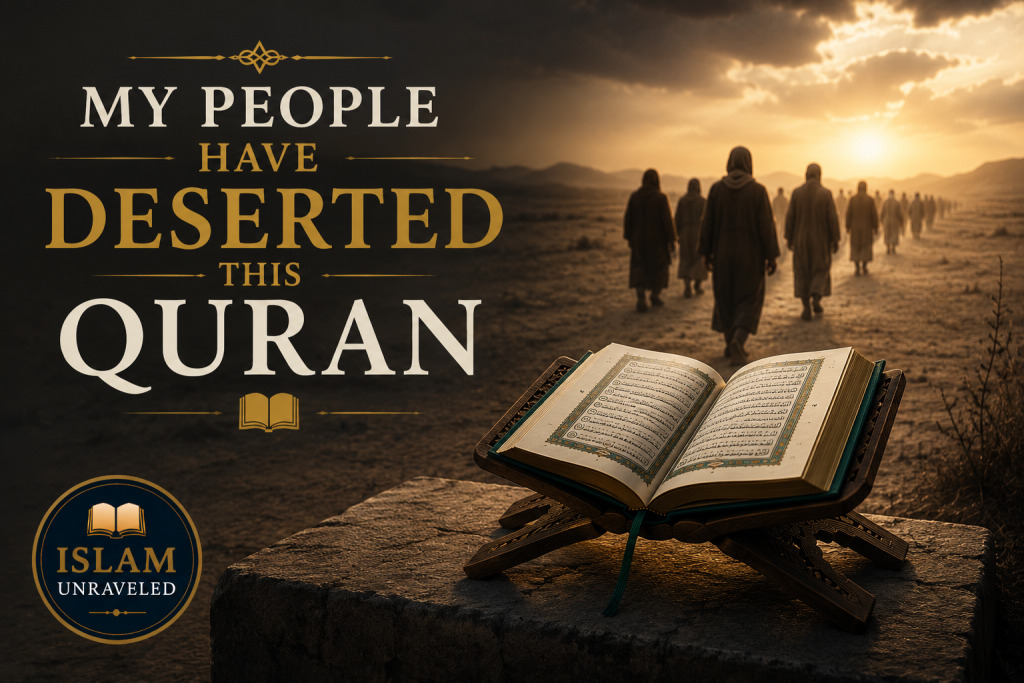
“The messenger said, ‘My Lord, my people have deserted this Quran.’” (25:30)
This is not a historical remark—it is a future testimony. It reflects a condition that will exist among those who claimed to follow the message, yet in reality turned away from the Quran.
The verse demands a serious question:
What does it mean to “desert” the Quran?
The answer is not found in abandoning the Quran physically—most who fall under this description will still recite it, print it, and revere it outwardly. The desertion described by the Quran is deeper: it is a functional abandonment of its authority, sufficiency, and central role in religion.
Desertion Despite Presence
The Quran does not describe a people who have no access to it. Rather, it describes a people who:
- Possess the Quran
- Yet do not use it as their sole authority
This creates a paradox:
The Quran is present—but its role is diminished.
The Quran Declares Itself Complete and Fully Detailed
The Quran explicitly defines its own scope:
“Shall I seek other than GOD as a source of law, when He has revealed to you this book fully detailed?” (6:114)
“The word of your Lord is complete, in truth and justice…” (6:115)
These verses establish:
- The Quran is complete
- It is fully detailed for law
- It is perfect in truth and justice
Desertion, therefore, occurs when:
Other sources are treated as necessary to complete what God has declared complete.
The Quran as the Only Acceptable Hadith (Narration)
The Quran repeatedly asks:
“Which hadith other than this do they believe in?” (45:6)
“Which hadith after this do they believe in?” (77:50)
“This is not a fabricated hadith…”(12:111)
The message is consistent:
- The Quran is the true narration (hadith)
- It is sufficient as guidance
Desertion occurs when:
External narrations are elevated alongside or above the Quran.
Replacing Divine Authority with Secondary Systems
A key symptom of desertion is the introduction of parallel authorities.
The Quran never establishes:
- A second legislative source beside itself
- A separate body of religious law outside revelation
Yet, in practice, many religious systems rely on:
- Additional narrations
- Secondary frameworks
- Interpretive traditions treated as binding
This shifts the center of authority away from the Quran.
The Misuse of “Sunnah”
The term “sunnah” is often used to refer to a religious system attributed to the Prophet. However, in the Quran:
- “Sunnah” consistently refers to God’s system (Sunnat Allah)
It is never used to establish:
- A parallel “sunnah of Muhammad” as an independent source of law
Thus, when a secondary system is constructed and given binding authority, it represents:
A departure from Quranic terminology and structure.
When God Alone Is Mentioned
The Quran describes a revealing reaction:
“When GOD alone is mentioned, the hearts of those who do not believe in the Hereafter shrink with aversion…” (39:45)
This verse exposes a deeper issue:
- True believers are satisfied with God alone
- Others seek:
- Additional authorities
- Supplementary sources
- Names next to God’s name
Desertion of the Quran is therefore linked to:
Discomfort with exclusive reliance on God’s word
“Quran Alone” — A Neglected Principle
The Quran itself instructs a singular focus:
“When you preach your Lord using the Quran alone…” (17:46)
Yet, this phrase is often:
- Underemphasized
- Poorly translated
- Or overlooked entirely
This reflects a broader pattern:
Even explicit Quranic instructions can be minimized when they challenge established systems.
The Infallibility of the Quran
The Quran declares:
“Falsehood cannot enter it, in the past or in the future…” (41:42)
This establishes:
- The Quran is infallible
- It is protected from error
When fallible human sources are introduced alongside it, the result is:
Mixing certainty with speculation
This is a key form of desertion.
The Religion of Abraham: Simplicity and Purity
The Quran repeatedly calls believers to:
- The religion of Abraham
- Pure monotheism
- Direct submission to God
“Follow the religion of Abraham…” (multiple verses)
This religion is characterized by:
- Simplicity
- Direct devotion
- Absence of layered traditions
Desertion occurs when:
Complexity replaces clarity
Tradition replaces revelation
A Living Reality Today
The statement in 25:30 is not abstract—it reflects a condition that can be observed:
- The Quran is recited but not used as sole authority
- Other sources define law and practice
- Clear verses are overridden by external frameworks
This is not rejection—it is replacement.
Conclusion
On the Day of Judgment, the messenger will say:
“My Lord, my people have deserted this Quran.” 25:30
This statement is not directed at those who denied the Quran outright—but at those who:
- Possessed it
- Yet did not uphold it as the sole source of guidance
The Quran defines itself as:
- Complete
- Fully detailed
- Infallible
- The only true narration
To desert it is not to abandon it physically, but to:
Displace it from its rightful position
The warning is clear, and it is present today.