Introduction
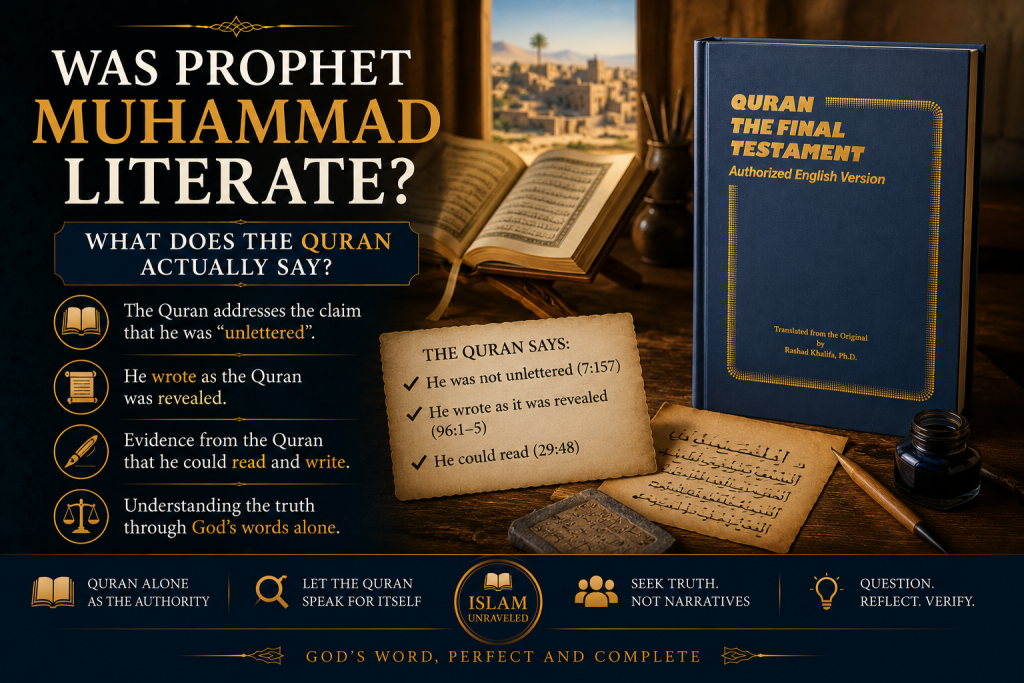
A widely held belief across Muslim tradition is that Prophet Muhammad was illiterate, unable to read or write. This assumption is often used to support the divine origin of the Quran—arguing that an illiterate man could not have produced such a scripture.
However, when we turn to the Quran itself, the argument is presented differently.
The Quran does not explicitly state that the Prophet was unable to read or write. Instead, it emphasizes something far more significant: that the Quran is a divinely revealed, internally consistent, and self-evident proof.
This article examines the issue of the Prophet’s literacy based on the Quran alone, while also highlighting how the Quran establishes its truth independently of such assumptions. It also seeks to answer the question: Was Prophet Muhammad Literate? It explores the implications of this inquiry on the understanding of his prophetic role.
Understanding “Ummi” in the Quran: A Quran-Based Definition
A central issue in the literacy discussion is the meaning of the word “ummi.” It is commonly translated as “illiterate” or “unlettered,” largely based on classical Arabic dictionaries and later interpretations.
However, the Quran establishes a different method:
Its terms must be understood through its own usage—not external definitions.
The Quran Defines “Ummi” Through Context
“Among them are ummiyyūn who do not know the scripture except through wishful thinking…” (2:78)
This verse directly explains the term.
It does NOT say:
- they cannot read or write
It says:
- they do not know the scripture
This shows that “ummi” refers to lack of knowledge of revelation, not literacy ability.
A Quranic Contrast: “Ummi” vs “People of the Scripture”
Across the Quran, there is a consistent distinction:
- People of the Scripture (Ahl al-Kitab)
- Ummiyyūn
This contrast appears in:
- 3:20
- 3:75
- 62:2
The distinction is not literacy vs illiteracy—it is:
- scripture-based vs non-scripture-based communities
Applying This to the Prophet (7:157)
“the ummi prophet” (7:157)
This means:
A prophet sent to a people without prior scripture
—not a prophet defined by inability.
Quran 29:48 Confirms the Meaning
“You did not read any scripture before this, nor did you write it with your hand…” (29:48)
This verse clarifies:
- “did not” ≠ “could not”
- It refers to:
- absence of prior engagement
- not incapacity
The focus is independence from earlier revelation
Why Dictionary Meanings Are Not Decisive
Dictionaries reflect:
- later usage
- interpretive traditions
But the Quran:
defines words through context, contrast, and repetition
The Correct Quranic Meaning
“Ummi” = one who is not grounded in prior scripture
Not:
- illiterate
- uneducated
- or linguistically speculative meanings
Implication for the Literacy Debate
This clarification reshapes the entire discussion:
- The Quran does not argue from illiteracy
- It argues from:
- absence of prior scripture
- independence of revelation
- internal proof (74:30–35)
Quran 29:48 — Independence, Not Inability
As already established, the Quran clarifies:
“You did not read any scripture before this, nor did you write it with your hand…” (29:48)
This reinforces that the Prophet had:
- no prior exposure to earlier scriptures
The emphasis is independence—not incapacity.
The distinction between receiving divine scripture and the physical writing of scripture is examined further in What Is Scripture in the Quran?
The Quran’s Argument Is Not Based on Illiteracy
If the Quran intended to prove its divine origin through illiteracy, it would explicitly state:
- The Prophet could not read or write
But instead, the Quran consistently argues from:
- Its content
- Its consistency
- Its truth
This shifts the foundation of belief away from assumptions about the messenger and toward the message itself.
The Quran as Its Own Proof
With the question of literacy clarified, the Quran directs attention to its true basis of authenticity – its own internal proof.:
“Over it is nineteen.” (74:30)
“…a proof for the people… and to remove all doubt…” (74:31)
“Absolutely, this is one of the great miracles.” (74:35)
These verses establish that:
- The Quran contains internal, verifiable structure
- Its truth is embedded within it
- It functions as its own evidence
This is explored in detail here.
Why This Matters for the Literacy Question
Once the Quran establishes itself as self-evident proof, the question of literacy becomes secondary.
The logic shifts:
- The Quran does not depend on: The Prophet being illiterate
- It depends on: Its own divine structure and truth
Thus: Whether the Prophet could read or write is not the basis of the Quran’s authenticity
A Stronger Quranic Position
By not relying on illiteracy, the Quran presents a stronger argument:
- It does not appeal to personal limitation
- It appeals to objective evidence within the revelation
This aligns with the Quran’s broader approach:
- دعوت (invitation) through reflection
- Evidence through structure and meaning
Academic Convergence
Interestingly, modern scholarship has also revisited this issue.
Scholars such as Nicolai Sinai have noted that:
- The term “ummi” does not necessarily mean “illiterate”
- It can refer to a non-scriptural background
This aligns with the Quranic context, reinforcing that the traditional interpretation is not the only—or even the strongest—reading.
The Role of the Messenger
The Quran defines the Prophet’s role clearly:
- Deliver the message
- Convey revelation
- Serve as a warner
It does not define him by:
- Literacy status
- Educational background
The emphasis remains: on the revelation, not the individual
A Broader Quranic Principle
This issue reflects a deeper Quranic theme:
Truth is not validated by external assumptions
It is validated by clear signs within revelation
This connects directly to:
- The Quran’s internal proof (74:30–35)
- Its consistency (41:42)
- Its role as a criterion
Conclusion
The Quran does not explicitly state that Prophet Muhammad was illiterate. Instead, it presents:
- A messenger with no prior engagement with earlier scriptures
- A revelation that stands independently as proof
The term “ummi” refers more accurately to:
- A non-scriptural background, not inability
Most importantly, the Quran establishes its authenticity through:
- Its internal structure
- Its clarity
- Its divine origin
Not through the personal condition of the messenger
This leads to a more precise and Quran-based understanding:
The truth of the Quran stands on its own—independent of assumptions about literacy.