Introduction
The Quran repeatedly describes God as:
“Most Gracious, Most Merciful”
This pairing appears so frequently—especially in the opening of chapters—that it is often recited without reflection. Yet the Quran does not use these two attributes redundantly. Each carries a distinct meaning, and together they present a comprehensive understanding of God’s relationship with creation.
Understanding the difference between The Most Gracious (Al-Rahman) and The Most Merciful (Al-Raheem) is essential for understanding the Quran’s message.
Two Distinct Names, Not Repetition
The Quran consistently pairs these two names:
- Al-Rahman (The Most Gracious)
- Al-Raheem (The Most Merciful)
If they meant the same thing, the repetition would be unnecessary. The Quran’s precision indicates:
Each name highlights a different dimension of divine mercy
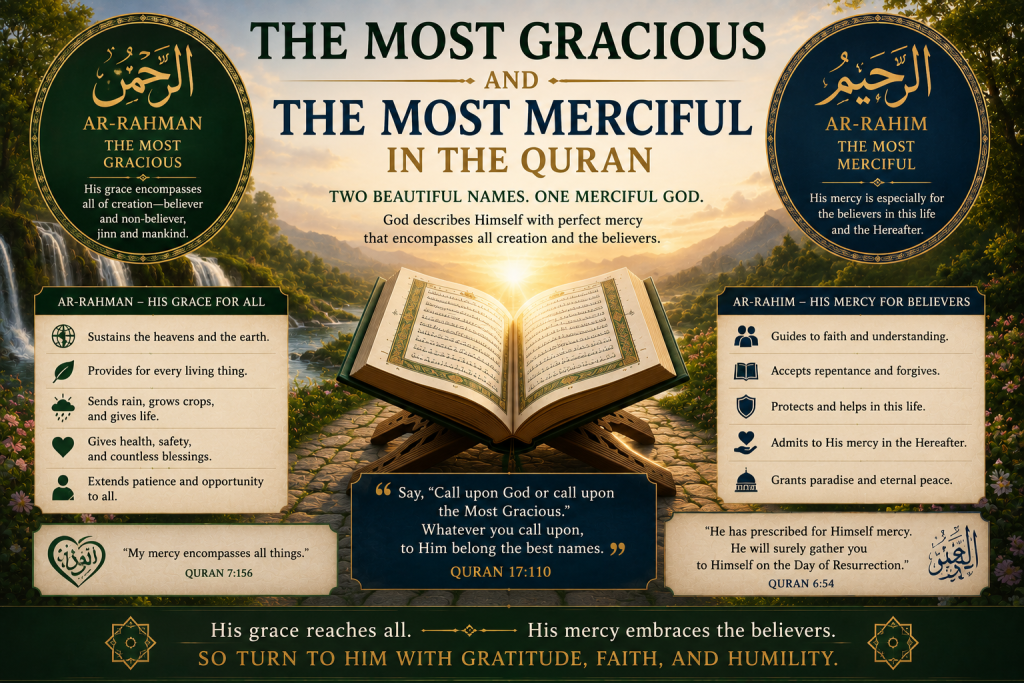
The Most Gracious (Al-Rahman): Universal Mercy
The Quran establishes “The Most Gracious” as a primary name of God:
“Call Him GOD, or call Him the Most Gracious…” (17:110)
“The Most Gracious; He has assumed all authority.” (20:5)
“The Most Gracious. Teacher of the Quran.” (55:1–2)
Key Characteristics of “The Most Gracious”
- Universal mercy to all creation
- Independent of belief or obedience
- Connected to:
- Creation
- Sustenance
- Natural order
- Revelation itself
Everything we experience, life, provision, the balance of the universe, is a manifestation of this all-encompassing grace.
This is explored in detail here.
The Most Merciful (Al-Raheem): Specific Mercy
While “The Most Gracious” is universal, “The Most Merciful” is used in more specific contexts.
Examples across the Quran show it is often associated with:
- Forgiveness
- Redemption
- Guidance accepted
- Believers
Key Characteristics of “The Most Merciful”
- Mercy directed toward those who:
- Respond to guidance
- Seek forgiveness
- Closely tied to:
- Accountability
- Judgment
- The Hereafter
Thus:
- Al-Rahman – Mercy given to all
- Al-Raheem – Mercy realized by those who accept truth
The Relationship Between the Two
The two names are not separate concepts—they are complementary.
The Flow of Mercy in the Quran
- Al-Rahman (The Most Gracious)
- Creates
- Provides
- Sustains
- Reveals guidance
- Al-Raheem (The Most Merciful)
- Forgives
- Guides further
- Rewards
- Grants success in the Hereafter
In simple terms:
- Grace is given freely
- Mercy is fulfilled through response
Surah 55: The Central Role of “The Most Gracious”
Surah 55 begins:
“The Most Gracious. Teacher of the Quran.” (55:1–2)
This establishes a critical principle:
- God’s grace is expressed through teaching the Quran
This teaching:
- Is universal in availability
- But not universally accepted
Here we see the transition:
- From Al-Rahman (offering guidance)
- To Al-Raheem (guiding those who accept it)
Mercy and Accountability
The Quran never presents mercy as unconditional in outcome.
While God is:
- Most Gracious
- Most Merciful
He is also:
- Just
- Fully aware
- The ultimate Judge
This creates a balanced system:
- Grace ensures opportunity
- Mercy rewards acceptance
- Justice ensures accountability
Misunderstanding the Two Attributes
A common misunderstanding is:
- Treating both names as identical
- Or assuming mercy guarantees salvation regardless of response
The Quran corrects this by:
- Differentiating universal grace from responsive mercy
- Linking mercy with:
- Belief
- Repentance
- Righteous conduct
Practical Reflection
Understanding these two names changes how we see life:
Recognizing “The Most Gracious”
- Every blessing is from God
- Life itself is undeserved grace
Responding to “The Most Merciful”
- Guidance must be accepted
- Forgiveness must be sought
- Truth must be followed
Connection to Truth and Guidance
The distinction also ties directly to the Quran’s broader message:
- Truth is revealed through divine grace
- Acceptance of truth leads to divine mercy
This relationship is explored further here.
A Complete System of Divine Mercy
Together, these two names form a complete system:
- Creation – Grace (Al-Rahman)
- Guidance – Offered (Al-Rahman)
- Response – Required (Human)
- Outcome – Mercy (Al-Raheem)
This system reflects:
- Balance
- Justice
- Purpose
Conclusion
The Quran’s pairing of “The Most Gracious” and “The Most Merciful” is deliberate and precise.
- The Most Gracious gives to all
- The Most Merciful rewards those who respond
Together, they define:
- God’s relationship with creation
- Humanity’s responsibility within that relationship
Understanding this distinction removes confusion and clarifies a central Quranic truth:
Divine grace is universal – but divine mercy is realized through response.
Continue Your Study
Surah Al-Fatihah introduces many of the foundational themes that are developed throughout the Quran. If you would like to explore these subjects in greater depth, the following studies may be helpful.
Understanding God
- Belief in God
- Belief in God and Believing God
- The Most Gracious
- The Most Gracious and the Most Merciful in the Quran
- Who Created God?
Understanding the Quran
- God Explains the Quran
- Who Explains the Quran?
- Three Responses to God’s Guidance: Believers, disbelievers and Hypocrites
- The Purpose of Life According to the Quran
Worship and Guidance
- Worship God Alone
- Religious Authority in the Quran
- The Meaning of Idolatry in the Quran
- Who Were the Mushrikeen?
- Belief in God and Believing God
Understanding God’s Messengers
- Jesus in the Quran
- Moses in the Quran
- Jonah and Self-Accountability
- Quranic Criteria for God’s Messengers