Introduction
The command:
“Obey God and obey the messenger”
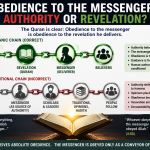
appears repeatedly in the Quran. It is often cited as a universal and ongoing directive, extending beyond the lifetime of the messenger.
However, a careful reading ‘Obey the messenger’ in the Quran raises an important question:
What is the scope of this command within the Quran itself?
When examined in context, the Quran shows that obedience to the messenger was real, necessary, and binding, but tied to his living role within a functioning community.
The Principle of Context
The Quran consistently presents its commands within:
- a specific audience
- a specific situation
- a specific function
To detach a command from its context is to risk misunderstanding its intent.
This is especially important with:
“Obey God and obey the messenger”
The Messenger as a Living Authority
During his lifetime, the messenger functioned as:
- leader of a community
- judge in disputes
- organizer of collective affairs
Obedience to him was therefore:
– practical
– immediate
– necessary for order
This included both:
- everyday matters
- critical decisions affecting the entire community
A Clear Example: Community Coordination (24:62)
“The believers are those who… do not leave him without permission…” (24:62)
This verse describes:
- organized gatherings
- leadership structure
- coordinated decision-making
Obedience here is clearly:
- situational
- tied to physical presence
- necessary for discipline and cohesion
Obedience in Critical Situations (Battle Context)
The Quran gives multiple examples from times of conflict:
These verses show:
obedience linked to:
- immediate commands
- battlefield decisions
- collective survival
Failure to obey resulted in:
- confusion
- loss
- breakdown of order
The Messenger as Judge in Disputes
The Quran states:
“…if you dispute, refer it to God and the messenger…” (4:59)
During the messenger’s lifetime:
– disputes could be brought directly to him
– he could judge and resolve them
This was:
- practical
- immediate
- enforceable
After the Messenger: What Remains?
After the messenger’s death:
– he is no longer physically present
– disputes cannot be referred to him directly
What remains is:
God’s revelation (the Quran)
This is consistent with the Quran’s repeated emphasis on:
- completeness (6:114)
- clarity (5:15)
- detailed explanation
The Messenger’s Core Duty: Delivery
The Quran defines the messenger’s role clearly:
“The sole duty of the messenger is delivery.” (5:99)
“…only the clear delivery.” (16:82)
His role was to:
- convey the message
- recite the revelations
- teach the Book
Who Explains the Quran?
The Quran gives a direct answer:
“Then it is upon Us to explain it.” (75:19)
“The Most Gracious. Taught the Quran.” (55:1–2)
Explanation and teaching are attributed to:
God alone
A Clear Pattern
Across the Quran:
- God + revelation + explanation is present in various verses
- messenger + explanation of revelation is absent
There is no verse that states:
- the messenger explains the Quran
This absence is not incidental, it is consistent.
Teaching vs Explaining: A Necessary Distinction
The Quran states that the messenger:
- teaches the Book
- teaches Hikmah (2:129, 2:151, 3:164, 62:2)
But it does not say he:
- explains the revelation independently
Teaching = conveying and instructing
Explaining = clarifying meaning
The Quran assigns:
- teaching to messenger
- explanation to God
The Use of “Prophet”
All verses which address:
“O Prophet…”
These are:
- direct instructions
- tied to specific events
- applicable during his lifetime only
They are not abstract or timeless directives detached from context
A Simple Analogy
In any organized system:
- a leader must be obeyed when present
- for coordination and decision-making
Once the leader is gone:
- the system remains
- the message remains
- but real-time authority does not continue
A Critical Observation
The Quran presents a complete and self-contained framework:
- God reveals
- God teaches
- God explains revelations or verses
The messenger:
- delivers
- leads
- teaches within his lifetime
- does not explain revelations
Where the Misapplication Occurs
A significant shift occurs when:
obedience to the messenger is extended beyond his lifetime
and used to justify:
- external sources
- secondary authorities
- additional religious frameworks
This interpretation:
- is not explicitly stated in the Quran
- goes beyond the contextual role described in the text
Conclusion
The Quran shows that obedience to the messenger was:
- essential
- real
- binding
But also:
contextual and time-bound
It applied to:
- a living messenger
- a functioning community
- real-time decisions
What remains after him is not a continuation of personal authority, but:
Final Reflection
The Quran preserves the message with clarity and completeness.
To extend the command “obey the messenger” beyond its Quranic context, and use it to establish external authority, is not supported by the text itself.
The Quran directs the believer back to:
- God
- His revelation
- and His explanation