Introduction
A fundamental question arises when approaching the Quran:
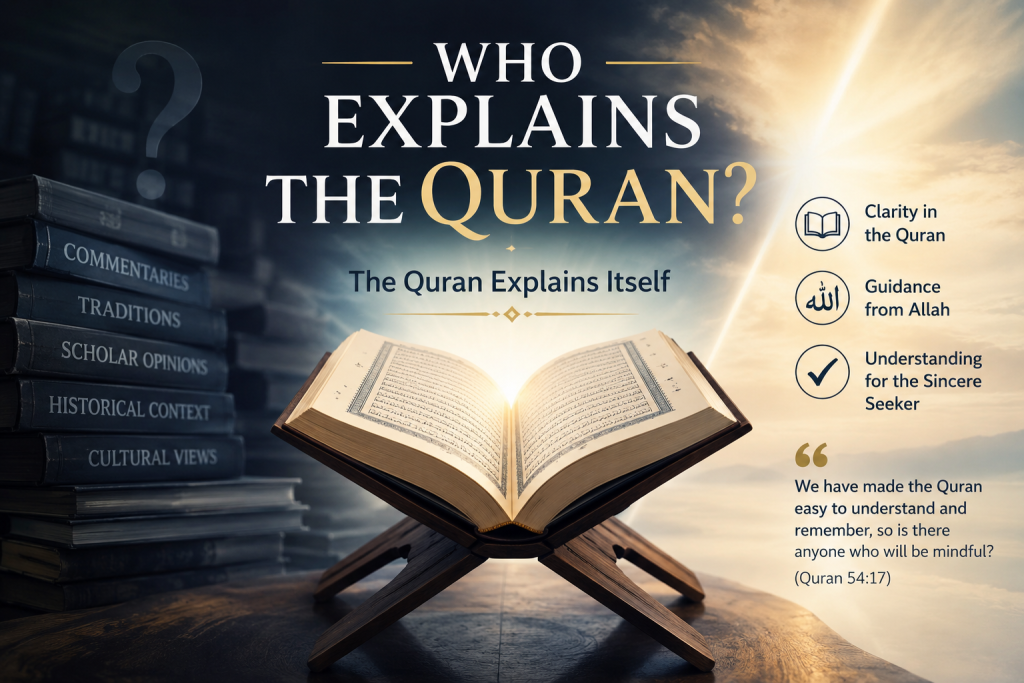
Who explains the Quran?
Many assume that explanation must come from human sources, scholars, traditions, or even the messenger himself. The Quran, however, presents a different and consistent answer.
It repeatedly attributes the explanation, teaching, and clarification of the Quran to God alone.
The Core Principle: Explanation Belongs to God
The Quran makes a direct and unambiguous statement:
“Then it is upon Us to explain it.” (75:19)
This verse establishes a foundational principle:
The explanation of the Quran is a divine responsibility
There is:
- no intermediary mentioned
- no delegation implied
The statement is complete and exclusive.
God as the Teacher of the Quran
This principle is reinforced in:
“The Most Gracious. Teacher of the Quran.” (55:1–2)
Here, God is identified not only as the revealer, but also as the teacher of the Quran.
Teaching and explanation are inseparable functions
If God teaches the Quran, then its understanding is ultimately from Him, not from any independent human source.
The Mechanism: How God Communicates
The Quran explains the process of communication:
“It is not for any human that God should speak to him except through inspiration, or from behind a barrier, or by sending a messenger…” (42:51)
This verse clarifies three modes:
- inspiration
- behind a barrier (applied to Moses)
- through a messenger
The messenger’s role is part of delivery, not independent explanation.
The source remains God.
A Critical Distinction: Teaching vs Explaining
Several verses describe the role of the messenger:
- 2:129
- 2:151
- 3:164
- 62:2
- 5:19
They state that the messenger:
- recites the revelations
- teaches the Book
- teaches Hikmah
At first glance, this may seem to overlap with explanation. However, the Quran maintains a clear distinction:
Teaching is not the same as explaining revelation independently
- Teaching is conveying and instructing
- Explaining is clarifying the meaning of revelation
The Quran assigns:
- teaching to the messenger
- explanation to God
The Quranic Pattern: God Explains Revelation
Across the Quran, a consistent pattern emerges:
When “explanation” is mentioned, it is attributed to God
Examples include:
- “Then it is upon Us to explain it” (75:19)
- “A scripture whose verses are detailed…” (41:3)
- “We have detailed everything in this book…” (6:114)
- “…a detailed explanation of all things…” (12:111)
The combination is consistent:
- God
- revelation
- explanation
A Notable Absence
Equally important is what the Quran does not say.
There is no verse that states:
the messenger explains the Quran
There is also no verse combining:
- messenger
- explanation
- revelation
This absence is significant.
If explanation by the messenger were central, it would be stated explicitly, as clearly as:
- revelation
- teaching
- delivery
The Quran Explains Itself
The Quran presents itself as:
- fully detailed (6:114)
- clear (5:15)
- self-explanatory (75:19)
As explored in the Quran as the sole source of guidance, the text consistently directs the reader back to itself.
Explanation occurs:
- within the Quran
- through its internal coherence
- through reflection guided by God
Who Receives This Understanding?
The Quran indicates that understanding is not automatic.
God teaches those who:
- submit to Him
- are sincere
- worship Him alone
- dedicate their religion and religious practices to Him alone
Understanding is:
- granted
- guided
- dependent on sincerity
Not inherited through institutions or external authority.
Implications of This Distinction
When the distinction is blurred:
- human explanation is elevated
- external sources gain authority
- the Quran’s completeness is undermined
When the distinction is maintained:
- the Quran remains central
- God remains the ultimate teacher
- understanding remains tied to divine guidance
Conclusion
The Quran presents a consistent framework:
- God reveals the Quran
- God teaches the Quran
- God explains the Quran
The messenger:
- delivers
- recites
- teaches
But does not independently explain revelation.
The distinction is subtle—but essential.
The Quran directs the reader:
not to human authority for its explanation,
but back to God – the One who revealed it.