Introduction
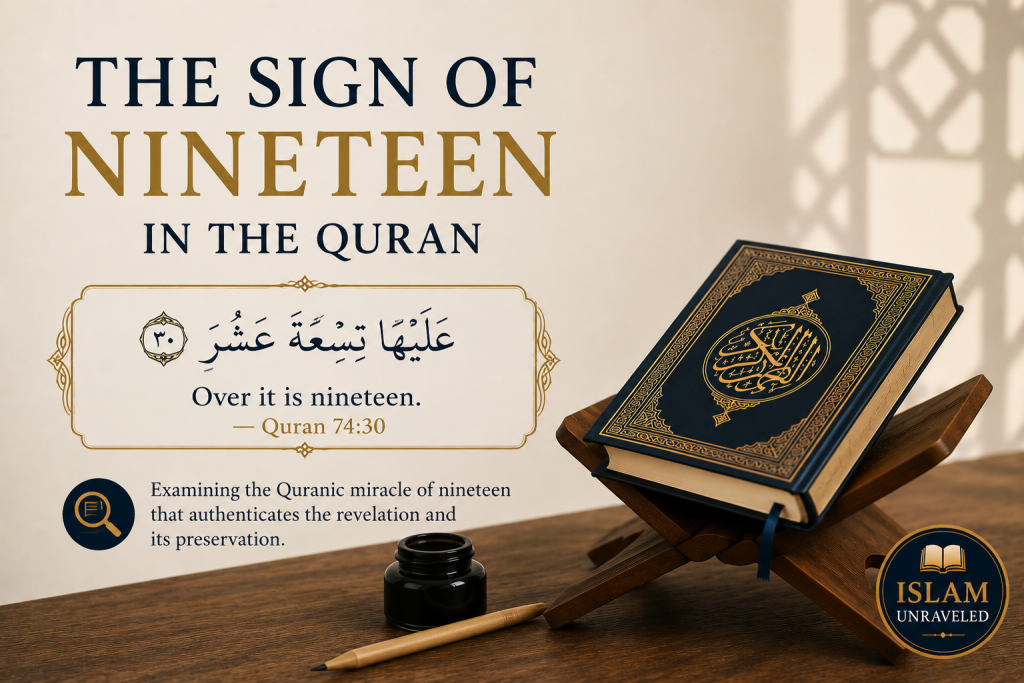
Among the most striking statements about the sign of nineteen in the Quran is:
“Over it is nineteen.” (74:30)
For centuries, this statement raised questions. The very next verse explains why:
“We appointed their number (19)…” (74:31)
This verse does not merely mention a number, it explains its purpose, its function, and how different people will respond to it.
A careful reading reveals that the issue is not the clarity of the sign itself, but the condition of the person encountering it.
The Five Outcomes in 74:31
The verse lists multiple outcomes:
- to disturb the disbelievers
- to convince the People of the Scripture
- to strengthen the believers
- to remove doubt
- to expose those with doubt in their hearts
This is remarkable.
The same sign produces different results for different people.
Not a Question of Information, but Disposition
The verse continues:
“They will say, ‘What did God mean by this?’”
This is not due to lack of information.
It reflects a state of mind.
The Quran repeatedly emphasizes that guidance is tied to the condition of the heart, not merely exposure to evidence.
The Quran’s Broader Principle of Guidance
This pattern appears elsewhere:
“a beacon for the righteous.” (2:2)
“God guides those who seek His approval…” (5:16)
“He misleads many thereby, and guides many thereby…” (2:26)
The same message:
- guides some
- misleads others
depending on their response.
A Sign That Strengthens or Exposes
74:31 explicitly states:
- it strengthens the believers
- it removes doubt
- it exposes hidden doubt
This aligns with:
“Indeed, it did strengthen the faith of those who believed…” (9:124)
“As for those who harbored doubts in their hearts, it actually added unholiness to their unholiness…” (9:125)
The Quran does not create the condition – it reveals it.
Convincing the People of the Scripture
An important part of 74:31 is:
“to convince the Christians and Jews”
This shows:
the sign is also evidence directed outward, not just inward
It is meant to:
- confirm the Quran’s divine origin
- connect with prior knowledge
Why Some Do Not Understand
The Quran explains:
“God does not shy away from citing any kind of allegory… He misleads many thereby, and guides many thereby…” (2:26)
“They have hearts with which they do not understand…” (7:179)
The issue is not the sign itself
It is receptivity
Understanding Requires Engagement
The Quran repeatedly calls for:
- reflection
- examination
- sincere engagement
“Will they not reflect upon the Quran?” (4:82)
“A scripture… that they may reflect upon its verses.” (38:29)
Understanding is not passive
It requires:
- willingness
- sincerity
- openness to truth
The Role of Sincerity and Submission
The Quran links guidance to:
- sincerity
- devotion to God alone
- submission
“As for those who strive in our cause, we will surely guide them in our paths…” (29:69)
“God guides whoever turns to Him.” (13:27)
This explains why the same sign:
- enlightens some
- confuses others
A Clarified Conclusion
It would be inaccurate to say that the sign of nineteen is only meaningful after belief.
Rather:
The sign is objectively present and meaningful
But:
Its significance is recognized only by those who approach the Quran with sincerity and openness.
Final Perspective
74:31 ends with:
“None knows the soldiers of your Lord except He. This is a reminder for the people.”
The purpose of the sign is not mere curiosity.
It is:
- a test
- a proof
- a means of distinction
Conclusion
The sign of nineteen is not inherently obscure.
The Quran itself explains its purpose clearly.
The difference lies not in the sign, but in the person encountering it.
- For some – it strengthens faith
- For others – it exposes doubt
The Quran does not simply inform, it reveals what is within the heart.