Introduction
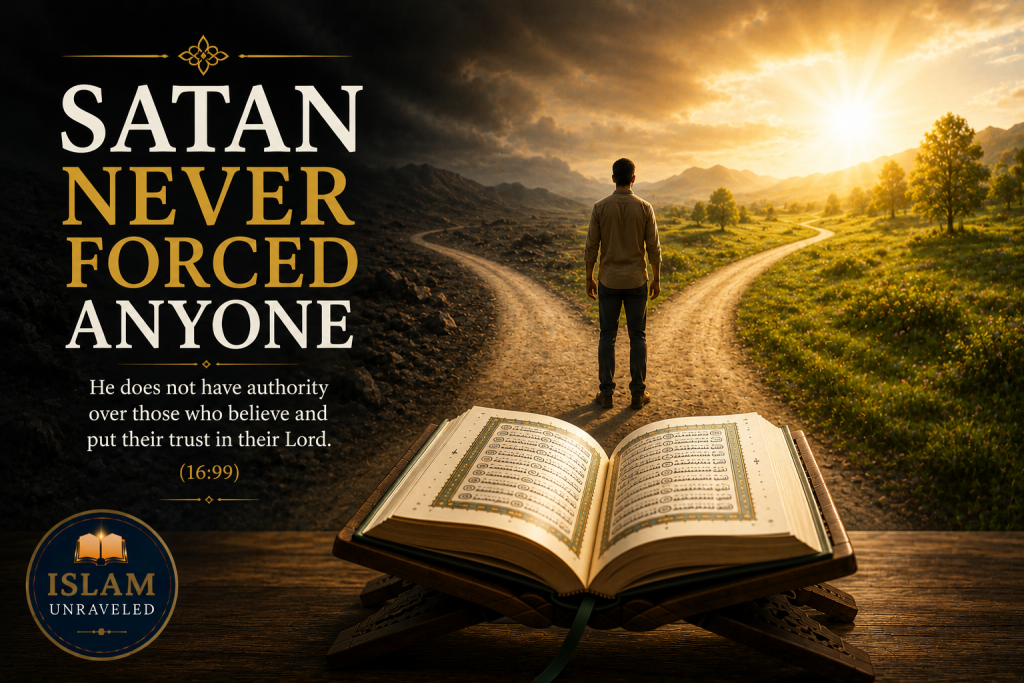
One of the most persistent human tendencies is the desire to escape responsibility. Satan never forced anyone.
People often explain their failures, sins, or corruption by blaming:
- society
- leaders
- upbringing
- circumstances
- or Satan himself
Yet the Quran repeatedly dismantles this mentality.
The Quran presents Satan as:
- a tempter
- a whisperer
- a deceiver
But never as a being capable of forcing human beings to disobey God.
This distinction is fundamental to the Quranic understanding of:
- free will
- accountability
- moral responsibility
- and judgment
The Most Important Verse on Satan and Human Responsibility
Perhaps the clearest verse on this subject appears in Surah 14:
“The devil will say, after the judgment has been issued, ‘GOD has promised you the truthful promise, and I promised you, but I broke my promise. I had no power over you; I simply invited you, and you accepted my invitation. Therefore, do not blame me; blame only yourselves…’” (14:22)
This verse is extraordinary.
Satan himself admits:
- he possessed no coercive authority
- he forced nobody
- he merely invited
The human being still chose.
This single verse destroys one of humanity’s oldest excuses:
“The devil made me do it.”
According to the Quran:
He did not.
Satan’s Real Method — Invitation, Not Compulsion
The Quran repeatedly describes Satan’s method.
He:
- whispers
- beautifies evil
- deceives
- promises
- suggests
- invites
But he does not compel.
“The devil promises you poverty and commands you to commit evil…” (2:268)
“He only invites his party to be the dwellers of Hell.” (35:6)
The language is consistent:
- invitation
- temptation
- persuasion
not force.
Why Satan Cannot Force Humans
The Quran’s entire moral structure depends on human freedom.
Without genuine choice:
- accountability becomes meaningless
- judgment becomes unjust
- reward and punishment lose moral coherence
This is why the Quran repeatedly emphasizes:
- personal responsibility
- individual choice
- moral agency
“Whoever wills—let him believe; and whoever wills—let him disbelieve.” (18:29)
“Every soul is responsible for what it has earned.” (74:38)
The Quran does not portray human beings as helpless victims trapped by Satan.
Satan Himself Chose Rebellion
Ironically, Satan’s own story demonstrates free will.
When commanded to prostrate before Adam, Satan refused:
“He said, ‘I am better than he; You created me from fire and created him from clay.’” (7:12)
This was:
- arrogance
- ego
- conscious rebellion
Then Satan immediately attempted to externalize blame:
“Since You have willed that I go astray…” (7:16)
Rather than accepting responsibility, Satan blamed God.
This becomes one of the Quran’s deepest psychological lessons:
The refusal of accountability is itself satanic behavior.
The Quran Rejects Victim Theology
The Quran acknowledges:
- temptation
- social pressure
- deception
- manipulation
But it never abolishes human accountability.
This balance is critical.
Modern thinking often swings between two extremes:
Extreme 1:
Humans are entirely self-created and independent.
Extreme 2:
Humans are merely products of:
- society
- psychology
- biology
- environment
- or external forces
The Quran rejects both extremes.
Human beings are influenced—
but still morally responsible.
Followers and Leaders
The Quran repeatedly presents scenes where followers blame leaders on the Day of Judgment:
“Our Lord, we obeyed our masters and leaders, but they misled us from the path.” (33:67)
Yet the Quran does not excuse blind following.
Leaders reply:
“Did we repel you from the guidance after it came to you? No—you yourselves were guilty.” (34:32)
This is one of the Quran’s most powerful principles:
Following corruption willingly does not remove accountability.
Religious Manipulation and Personal Responsibility
The Quran repeatedly warns about:
- religious authorities
- inherited traditions
- false teachings
- sectarian leadership
Yet even here, the Quran maintains personal accountability.
“When they are told, ‘Follow what GOD has revealed,’ they say, ‘We only follow what we found our parents doing.’” (2:170)
The Quran never accepts:
- tradition
- culture
- religious institutions
as excuses before God.
Every individual is repeatedly called to:
- think
- reflect
- examine
- choose consciously
The Real Battlefield — The Human Soul
The Quran presents the true battlefield as internal.
Satan whispers.
But the soul chooses whether to:
- resist
- surrender
- rationalize
- repent
This is why the Quran repeatedly emphasizes:
- self-awareness
- reflection
- conscience
The danger is not merely Satan’s invitation.
The danger is the human willingness to accept it.
Why Humans Prefer to Blame Satan
Blaming Satan can become psychologically comforting.
It protects:
- ego
- self-image
- pride
If Satan forced the sin, then the individual avoids full responsibility.
But the Quran refuses this escape.
The human being always retains:
- moral agency
- capacity for repentance
- ability to choose
God Does Not Wrong Anyone
The Quran repeatedly emphasizes divine justice.
“GOD never wrongs anyone, even the weight of an atom.” (4:40)
This justice requires:
- genuine human choice
- real accountability
A person cannot justly be punished for actions completely forced upon him.
Thus the Quran’s consistent position is:
- Satan tempts
- humans choose
The Freedom to Repent
The Quran’s doctrine of free will is ultimately hopeful.
Because if human beings truly possess agency, then:
- repentance is meaningful
- transformation is possible
- spiritual growth is real
No person is permanently trapped by:
- Satan
- past sins
- social pressure
- inherited corruption
The Quran repeatedly opens the door back to God.
The Final Collapse of Excuses
On the Day of Judgment:
- leaders will deny responsibility
- Satan will deny responsibility
- excuses will collapse
The Quran repeatedly returns humanity to the same principle:
“No soul bears the sins of another soul.” (6:164)
Every individual ultimately stands before God alone.
Part of a Quranic Reflection Series
This article is part of a broader Quranic series exploring accountability, blame, free will, repentance, conscience, leadership, and the human soul through the Quran alone.
Main article:
The Day of Mutual Blaming — A Quranic Study of Accountability and Human Nature
Related articles in this series:
- Satan Never Forced Anyone — Free Will in the Quran
- The Blaming Soul (75:2) — Psychology in the Quran
- Followers, Leaders, and Blind Obedience
- Jonah and the Path of Self-Accountability
Conclusion
The Quran presents Satan as:
- dangerous
- deceptive
- persistent
But never omnipotent.
Satan whispers.
He invites.
He beautifies corruption.
But he does not force.
The Quran therefore places accountability squarely upon the human being.
This is both:
- a warning
and - a liberation
Because the same freedom that allows humans to fall also allows them to:
- repent
- reform
- resist
- and return to God
The Quran’s message is therefore profoundly empowering:
No devil can force a soul away from God.
The final decision always belongs to the human being.
Related Discussion (Video)
This article was inspired in part by themes discussed in the following video: