Reconsidering One of the Most Contested Doctrines in Islamic Thought
Introduction
Few Quranic concepts have generated more theological and legal controversy than the doctrine of abrogation in the Quran.
Classical Islamic scholarship developed the theory that certain Quranic verses:
- supersede,
- cancel,
- or invalidate
other Quranic verses revealed earlier.
Over time, some scholars claimed:
- dozens,
- hundreds,
- or even more than five hundred verses
were “abrogated.”
The principal verse historically used to support this doctrine is 2:106:
“When We abrogate an ayah, or cause it to be forgotten, We produce a better ayah, or at least an equal one…” (2:106)
The key issue revolves around the Arabic word:
ayah
The word may mean:
- verse,
- sign,
- miracle,
- proof,
- evidence,
- or revelation.
Traditional Islamic scholarship overwhelmingly interpreted ayah in 2:106 as:
Quranic verse.
As a result, the doctrine of intra-Quranic cancellation became institutionalized within traditional jurisprudence and theology.
However, this interpretation raises profound Quranic and theological difficulties.
The Quran repeatedly describes itself as:
- complete,
- fully detailed,
- internally consistent,
- and protected from contradiction.
This article examines whether 2:106 truly refers to the cancellation of Quranic verses, or whether the verse instead refers to:
- signs,
- miracles,
- or divinely appointed proofs,
particularly in light of the Quran’s own internal coherence and the Quranic proof centered upon 74:30–31.
The Traditional Doctrine of Abrogation
Classical Islamic scholarship developed abrogation primarily as a legal and theological mechanism to reconcile perceived tensions between verses.
Under this framework:
- later verses superseded earlier verses,
- legal rulings evolved during Muhammad’s lifetime,
- and some verses were considered no longer operative.
Examples frequently cited included:
- warfare verses,
- alcohol prohibitions,
- inheritance matters,
- and interfaith relations.
Over time, the doctrine expanded substantially.
Some classical scholars even claimed that verses advocating:
- patience,
- tolerance,
- and peaceful coexistence
were superseded by later militant verses.
Thus, abrogation became not merely a textual theory, but a major interpretive mechanism shaping Islamic law and sectarian theology.
The Meaning of “Ayah”
The doctrine depends heavily upon one assumption:
that the word ayah in 2:106 specifically means:
Quranic verse.
Yet throughout the Quran, the word ayah possesses multiple meanings.
The Quran repeatedly uses ayah for:
- miracles,
- signs,
- natural phenomena,
- evidences,
- and divine proofs.
Examples include:
- the miracles of Moses,
- the signs of creation,
- historical events,
- and divine evidences shown to earlier nations.
Thus, the semantic range of ayah is significantly broader than:
verse alone.
The central interpretive question therefore becomes:
Does 2:106 necessarily refer to cancellation of Quranic verses?
Or does it refer more broadly to:
- signs,
- miracles,
- proofs,
- or divine evidences?
The Problem of Quranic Contradiction
The traditional doctrine of abrogation creates immediate tension with several Quranic verses emphasizing the perfection and consistency of revelation.
The Quran states:
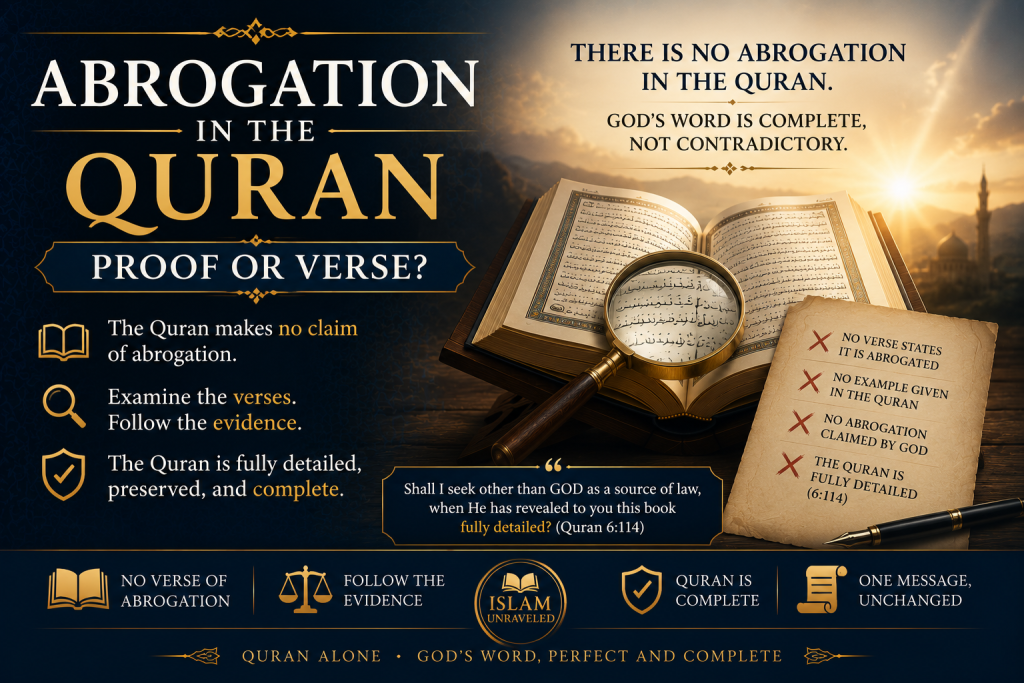
“The Word of your Lord is complete, in truth and justice. Nothing shall abrogate His words.” (6:115)
And:
“Nothing shall abrogate His words…” (18:27)
The Quran also repeatedly presents itself as internally free from contradiction:
“Had it been from other than GOD, they would have found in it numerous contradictions.” (4:82)
If Quranic verses genuinely cancel one another:
- legal contradiction becomes institutionalized within revelation itself.
This creates an interpretive tension that classical scholarship attempted to manage but never fully resolved.
Abrogation and the Fully Detailed Quran
The Quran repeatedly describes itself as:
- fully detailed,
- clarified,
- complete,
- and sufficient.
“Shall I seek other than GOD as a source of law, when He has revealed to you this book fully detailed?” (6:114)
The doctrine of abrogation raises an important question:
How can a fully detailed and perfected revelation contain permanently canceled rulings that remain recited as scripture?
The issue becomes even more difficult when some scholars claimed that:
- certain verses were canceled in ruling but not recitation,
- others in recitation but not ruling,
- and others in both.
Such distinctions increasingly complicated the interpretive system itself.
2:106 in Context
The broader context of Surah 2 is highly significant.
The surrounding passages discuss:
- previous communities,
- divine signs,
- miracles,
- revelation,
- and reactions to God’s evidences.
Within this context, interpreting ayah as:
sign or miracle
fits naturally with the Quran’s broader usage.
The verse may therefore refer not to:
- cancellation of Quranic legislation,
but rather to:
- replacement of previous divine signs,
- supersession of earlier miracles,
- or transition between revelatory proofs.
Under this interpretation:
- God replaces one sign with another,
- one miracle with another,
- or one revelatory proof with another,
while revelation itself remains internally consistent.
The Quranic Proof and 74:30–31
The Quran explicitly introduces the number nineteen in Surah 74:
“Over it is nineteen.” (74:30)
The following verse states that this number functions:
- as a test,
- a source of certainty,
- and a proof for believers and skeptics alike.
Within the Quranic proof framework, 2:106 acquires additional significance.
The verse may refer to:
- divine signs,
- proofs,
- or miracles
being superseded or renewed through later manifestations of revelation and evidence.
Under this perspective, abrogation concerns:
divine proof
rather than
cancellation of Quranic legislation.
This interpretation preserves:
- Quranic coherence,
- textual integrity,
- and the perfection of God’s words.
The Historical Consequences of Abrogation
The doctrine of abrogation profoundly shaped later Islamic thought.
In some cases, it became a mechanism for:
- overriding clear Quranic principles,
- marginalizing peaceful verses,
- and subordinating direct Quranic statements to later jurisprudence.
Because of this, abrogation often functioned not merely as interpretation, but as theological control over the Quran itself.
The doctrine allowed scholars to determine:
- which verses remained operative,
- which did not,
- and how apparent tensions should be resolved.
This effectively transferred interpretive authority from:
- the Quran itself
to: - later scholarly systems.
The Quran’s Internal Consistency
The Quran repeatedly emphasizes:
- harmony,
- coherence,
- and precision.
Its internal presentation is not one of evolving contradiction, but of:
- progressive clarification,
- consistent monotheism,
- and unified revelation.
The Quran repeatedly invites reflection upon:
- its signs,
- consistency,
- and completeness.
Under this framework, 2:106 is better understood as referring to:
- divine signs,
- miracles,
- and proofs
rather than cancellation of Quranic verses by other Quranic verses.
The Limits of Traditional Interpretation
The traditional doctrine of abrogation emerged largely within:
- legal,
- political,
- and sectarian developments
of early Islamic history.
As jurisprudence expanded, increasingly complex mechanisms were required to reconcile:
- differing rulings,
- sectarian positions,
- and inherited traditions.
Abrogation became one such mechanism.
However, the Quran itself repeatedly emphasizes:
- clarity,
- completeness,
- and consistency.
This raises the possibility that the doctrine reflects later interpretive construction more than the Quran’s own self-presentation.
Part of a Larger Series
This article is part of the series:
Can Modern Scholarship Explain the Quran Without the Quranic Proof?
which examines unresolved Quranic questions in modern scholarship in light of the Quran’s internally coherent structure and the Quranic proof centered upon the number nineteen.
Articles in This Series
- The Quranic Initials and the Mathematical Structure of the Quran
- Why “Becca” Instead of “Mecca”?
- Abrogation in the Quran — Proof or Verse?
- Why Is the Basmalah Missing from Surah 9?
- Did Prophet Muhammad Write the Quran?
- Surah 74 and the Hidden Secret of the Quran
- Purified Sheets and the Messenger After the Prophets
Conclusion
Verse 2:106 has historically served as the primary foundation for the doctrine of Quranic abrogation.
Yet the doctrine depends heavily upon interpreting the word ayah exclusively as:
Quranic verse.
The Quran itself, however, uses ayah in a much broader sense:
- sign,
- miracle,
- proof,
- evidence,
- and revelation.
When interpreted in light of:
- the Quran’s internal consistency,
- its repeated claims of perfection,
- and its emphasis on divine signs,
2:106 appears more naturally connected to:
- divine proofs,
- miracles,
- and revelatory signs
rather than cancellation of Quranic verses.
The broader issue ultimately concerns the nature of revelation itself.
Is the Quran:
- internally coherent,
- complete,
- and protected,
or does it contain institutionalized contradiction requiring later scholars to determine which verses remain valid?
The Quran repeatedly presents itself as:
- perfected,
- clarified,
- and fully detailed.
Any interpretation of 2:106 must ultimately be measured against that broader Quranic self-presentation.