Introduction
The Quran repeatedly describes itself as:
- complete
- fully detailed
- sufficient for guidance
“Shall I seek other than GOD as a source of law, when He has revealed to you this book fully detailed?” (6:114)
“We have revealed to you this book, fully detailed, guidance, mercy, and good news for the submitters.” (16:89)
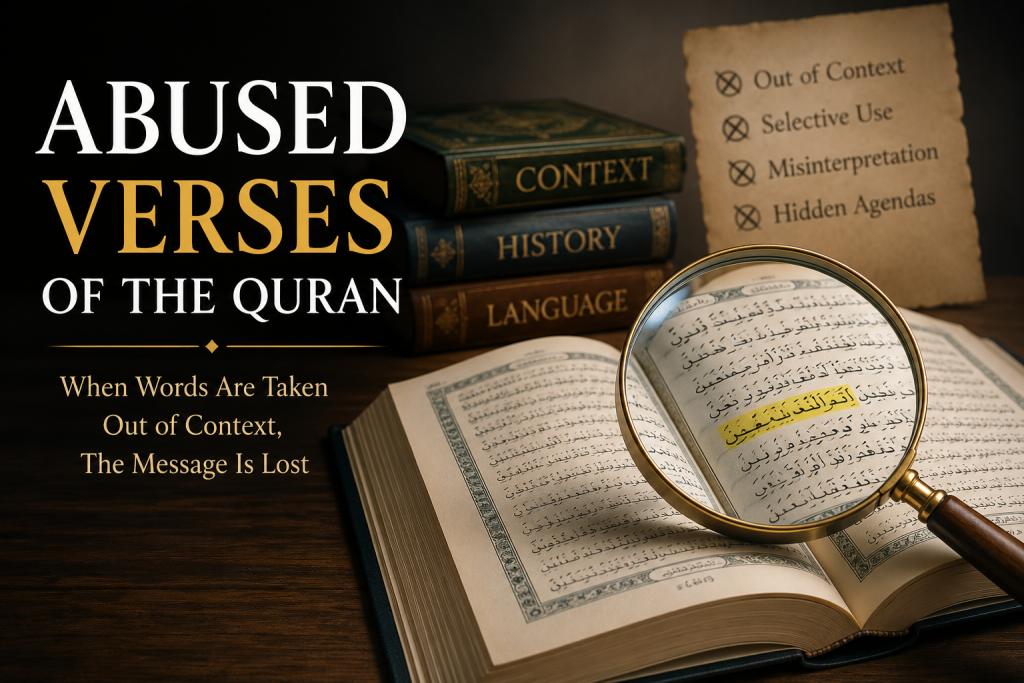
Despite these declarations, much of traditional Islam rests not directly upon the Quran as a whole, but upon abused verses of the Quran with expansive interpretations of a relatively small number of verses.
Among the most frequently invoked are:
- 33:56
- 33:21
- 59:7
These verses are often detached from their immediate context and transformed into foundations for:
- ritualized praise of Muhammad
- imitation of personal habits as religious law
- external legislative authority alongside the Quran
A careful reading of the Quran presents a very different picture.
The Quran’s Framework: God Alone as Religious Authority
Before examining the verses individually, the Quran establishes several overarching principles:
“The Most Gracious. Teacher of the Quran.” (55:1–2)
“Then it is upon Us to explain it.” (75:19)
“In which Hadith other than GOD and His revelations do they believe?” (45:6)
The Quran consistently attributes:
- revelation to God
- explanation to God
- legislation to God
The messenger’s role is delivery of revelation, not the establishment of an independent religious system.
Verse 33:56 — Support or Ritualized Devotion?
The Traditional Interpretation
Verse 33:56 is commonly used to justify perpetual devotional praise directed toward Muhammad:
“GOD and His angels help and support the prophet. O you who believe, you shall help and support him, and regard him as he should be regarded.” (33:56)
Over time, this verse became the basis for ritual formulas repeatedly directed toward the Prophet.
The Context of the Verse
Only a few verses earlier, the Quran states:
“O you who believe, you shall remember GOD frequently. You shall glorify Him day and night.” (33:41–42)
Then:
“He is the One who helps you, together with His angels…” (33:43)
The same root used in 33:56 is used here for God and the angels supporting believers.
The meaning is clearly not ritual praise.
The Meaning of “Salat”
The root associated with “salat” carries meanings related to:
- connection
- support
- encouragement
This becomes even clearer in 9:103:
“…and support them; your support reassures them.” (9:103)
The Prophet himself performs “salat” upon believers.
Obviously this does not mean ritual worship directed toward believers. It means support and encouragement.
Thus, in 33:56, believers are instructed to:
- support the Prophet
- stand with his mission
- respect him appropriately during his lifetime
The verse does not establish ritualized devotional formulas directed toward him after his death.
The Theological Consequence
The Quran repeatedly warns against redirecting devotion away from God:
“When GOD alone is mentioned, the hearts of those who do not believe in the Hereafter shrink with aversion. But when others are mentioned beside Him, they become satisfied.” (39:45)
The Quran’s devotional focus remains consistently centered on God alone.
Verse 33:21 — What Does “Good Example” Mean?
“Indeed, you have in the messenger of GOD a good example…” (33:21)
This verse is frequently expanded to mean that every recorded habit, preference, or behavior attributed to Muhammad becomes religiously binding.
But the context tells a different story.
The Context of Battle and Hardship
The surrounding verses discuss:
- fear
- battle
- perseverance
- trust in God
The “good example” refers to Muhammad’s:
- steadfastness
- patience
- devotion to God
- commitment during crisis
The verse praises moral and spiritual conduct in a battle situation—not the transformation of personal lifestyle details into a secondary legal system.
Muhammad Followed Revelation
The Quran repeatedly emphasizes that Muhammad himself followed revelation:
“I only follow what is revealed to me.” (46:9)
“I possess no power to benefit myself or harm myself…” (7:188)
He was not presented as an independent source of religious legislation separate from the Quran.
Verse 59:7 — What the Messenger Gives You
Perhaps no verse has been used more broadly to justify extra-Quranic authority than 59:7:
“Whatever the messenger gives you, take it; and whatever he forbids you from, refrain from it.”
Traditionally, this verse, which deals with spoils of war when the Prophet was alive, is used as unrestricted authorization for Hadith and Sunnah literature.
But once again, context matters.
The Actual Subject of the Passage
The passage concerns:
- war gains
- distribution of resources
- economic administration after conflict
The messenger is functioning as:
- leader
- administrator
- executor of Quranic law
The verse addresses obedience within that immediate context.
It does not establish unlimited legislative authority independent of revelation.
The Quran Defines the Messenger’s Limits
The Quran repeatedly defines Muhammad’s duty:
“The sole duty of the messenger is delivery.” (5:99)
“Had he uttered any other teachings…” (69:44–47)
The Quran presents the messenger as:
- transmitter of revelation
- implementer of revelation
- warner
Not a parallel source of religious law beside God’s scripture.
How Context Was Replaced by Expansion
A broader pattern emerges:
- contextual verses become generalized
- situational commands become permanent institutions
- moral examples become detailed legal systems
This process gradually transformed a Quran-centered religion into one heavily dependent upon:
- narrations
- inherited traditions
- secondary authorities
The Quran’s Consistent Position
The Quran repeatedly returns to the same foundational principles:
“Shall I seek other than GOD as a source of law…?” (6:114)
“Then it is upon Us to explain it.” (75:19)
“The Most Gracious. Teacher of the Quran.” (55:1–2)
The authority structure of the Quran is remarkably consistent:
- God reveals
- God explains
- the messenger delivers
The Human Messenger
The Quran consistently portrays Muhammad as:
- human
- mortal
- servant of God
“I am no more than a human like you…” (18:110)
“You will surely die, just as they will die.” (39:30)
Respect for the messenger is unquestionably commanded. But the Quran does not transform Muhammad into:
- an object of devotional focus
- an independent legislator
- a source of religion beside revelation
Conclusion
The issue is not respect for Muhammad. The Quran commands believers to respect him, support him, and follow the revelation delivered through him.
The issue is what happened afterward.
A small number of verses were progressively expanded beyond their context to justify:
- ritualized praise directed toward Muhammad
- imitation of personal habits as religion
- legislative authority outside the Quran
When examined in context, verses such as:
- 33:56
- 33:21
- 59:7
do not establish these systems.
The Quran consistently maintains a different framework:
- worship belongs to God alone
- legislation belongs to God alone
- explanation belongs to God alone
The messenger’s role was to faithfully deliver revelation—not become the center of a secondary religious structure after his death.