Quran 98:2, Revelation, and the Continuity of Divine Confirmation
Introduction
Among the more debated questions in Quranic interpretation is the relationship between and specifically the messenger after the prophets:
- prophets,
- messengers,
- scripture,
- and divine confirmation after the final prophet Muhammad.
The Quran explicitly declares Muhammad to be:
“the final prophet” (33:40)
Yet the Quran also repeatedly discusses:
- messengers,
- divine confirmation,
- purified scripture,
- and covenantal continuity.
Particularly significant are:
- 3:81,
- 98:2–3,
- and 74:30–31.
Traditional Islamic theology generally collapsed the distinction between:
- prophet (nabi)
and - messenger (rasool),
effectively treating them as interchangeable.
However, the Quran itself consistently distinguishes between the two categories.
Within the Quranic framework:
- every prophet is a messenger,
but - not every messenger is necessarily a prophet.
This distinction becomes highly significant in understanding:
- 3:81,
- the concept of divine confirmation,
- and the role of “purified sheets” in 98:2.
This article examines:
- the Quranic distinction between prophets and messengers,
- the meaning of “purified sheets,”
- the continuity of divine confirmation,
- and the relationship between these concepts and the Quranic proof centered upon the number nineteen.
The Covenant of 3:81
One of the most important verses in this discussion is 3:81:
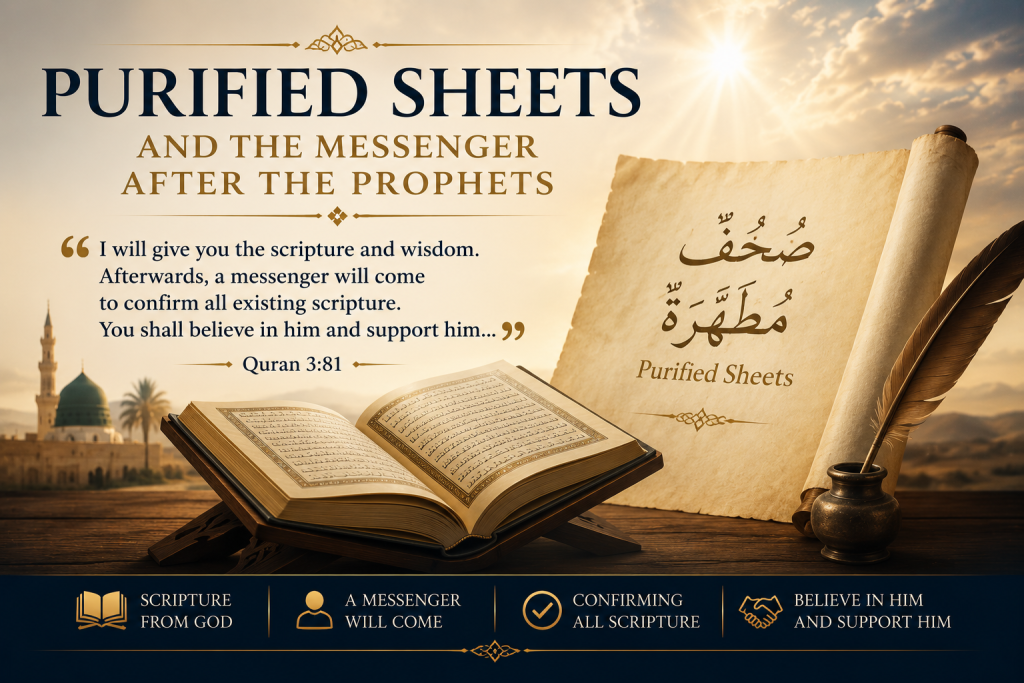
“GOD took a covenant from the prophets, saying, ‘I will give you the scripture and wisdom. Afterwards, a messenger will come to confirm all existing scripture. You shall believe in him and support him…’ ” (3:81)
Several features are immediately significant.
The verse distinguishes between:
- prophets,
and - a messenger who comes afterward.
The prophets are described as recipients of:
- scripture,
- and wisdom.
The messenger, however, is specifically described as:
confirming existing scripture.
This distinction is critical.
The verse does not describe the messenger as:
- bringing a new scripture,
- replacing previous revelation,
- or functioning as a new prophet.
Rather, the messenger’s role is:
confirmation.
Prophets and Messengers in the Quran
The Quran consistently distinguishes between:
- prophet (nabi)
and - messenger (rasool).
A prophet is associated with:
- scripture,
- revelation,
- and divine law.
A messenger, meanwhile, functions more broadly as:
- one commissioned with a divine message,
- warning,
- or confirmation.
The Quran also applies the term messenger to:
- angels,
- Gabriel,
- and human envoys.
Thus, the categories are related but not identical.
The widespread traditional assumption that:
prophet = messenger in every case
does not fully align with the Quran’s own terminology.
This distinction becomes especially important after 33:40:
“Muhammad was not the father of any man among you. He was a messenger of GOD and the final prophet.”
The verse explicitly closes:
prophethood,
while simultaneously affirming:
messengership.
The wording itself is highly significant.
The Meaning of Confirmation
The messenger in 3:81 is described as:
“confirming”
existing scripture.
This Quranic concept of confirmation is deeply important.
The Quran repeatedly describes itself as:
- confirming previous scripture,
- clarifying truth,
- and restoring forgotten understanding.
Similarly, a messenger after the prophets would not:
- introduce new revelation,
- alter scripture,
- or establish independent authority.
Rather, the role would involve:
- confirmation,
- clarification,
- restoration,
- and proof.
This distinction preserves:
- the finality of prophethood,
while allowing: - continued confirmation of revelation.
Purified Sheets in 98:2–3
Another significant passage states:
“A messenger from GOD is reciting purified sheets. In it are valuable teachings.” (98:2–3)
The passage is striking because it connects:
- a messenger,
- purified sheets,
- and authoritative teachings.
Traditional interpretation generally applies the verses retrospectively to Muhammad and the Quran.
However, the Quranic language itself remains broader.
The phrase:
“purified sheets”
suggests:
- preservation,
- purification,
- and textual integrity.
Within the Quranic proof framework, these verses acquire additional significance because the mathematical structure centered upon nineteen is understood as preserving and purifying the Quranic text itself.
The “purified sheets” therefore become connected not merely to physical manuscript, but to:
- divinely protected structure,
- textual integrity,
- and internally verifiable preservation.
Purified Sheets and the Question of Textual Integrity
The expression:
“purified sheets” (98:2)
acquires additional significance in relation to questions of Quranic textual preservation and integrity.
Within the Quranic proof framework centered upon the number nineteen, particular attention is given to verses 9:128–129 because their inclusion disrupts several structural and numerical relationships embedded within the Quranic text.
Interestingly, modern academic scholarship has also recognized unusual features associated with these verses. Nicolai Sinai, for example, notes that verse 9:128 attributes to Muhammad qualities elsewhere used uniquely for God, creating a degree of theological tension within the broader Quranic discourse.
Historically, Islamic sources themselves record that these verses occupied a unique transmission history during the compilation process.
Within the Quranic proof framework, the concept of:
“purified sheets”
is therefore connected not merely to physical preservation, but to purification of the Quranic text from later intrusion or textual irregularity.
Under this perspective, the internally integrated mathematical structure of the Quran functions as a mechanism of textual verification and preservation.
Whether one accepts this conclusion or not, the relationship between:
- textual integrity,
- structural coherence,
- and internally verifiable preservation
deserves serious analytical consideration.
The Quranic Proof and Confirmation
Surah 74 explicitly introduces the number nineteen:
“Over it is nineteen.” (74:30)
The following verse states that this proof functions:
- to strengthen faith,
- remove doubt,
- and convince believers and People of the Scripture alike.
Within the Quranic proof framework, the nineteen-based structure functions precisely as:
confirmation.
Importantly, the proof does not introduce:
- a new Quran,
- new revelation,
- or new law.
Rather, it points back to:
- the existing Quran,
- its structure,
- and its preservation.
Thus, the role remains entirely consistent with the Quranic definition of:
confirmation of existing scripture.
The Difference Between Revelation and Confirmation
A crucial distinction emerges between:
- revelation,
and - confirmation.
Prophets receive:
- scripture,
- revelation,
- and divine law.
The messenger described in 3:81 functions differently.
The role is:
- confirmatory,
- explanatory,
- and evidentiary.
The Quran itself repeatedly emphasizes:
- confirmation of prior truth,
- restoration of forgotten guidance,
- and clarification of revelation.
Thus, confirmation does not violate the finality of prophethood.
Rather, it operates within the continuing preservation and clarification of revelation already given.
The Historical Phenomenon of Messenger Claims
After the distinction between:
- prophet,
and - messenger
became more widely discussed in modern times, numerous individuals began claiming messengership.
Many such claimants attempted to imitate aspects of the Quranic proof by:
- producing numerical patterns,
- symbolic interpretations,
- or speculative calculations.
However, the Quranic framework established in 74:30–31 presents the proof itself as:
- singular,
- divinely appointed,
- and functioning as a decisive sign.
A central principle therefore emerges:
a genuine Quranic confirmation must arise:
- directly from the Quran,
- through internally coherent structure,
- and through evidentiary consistency
rather than arbitrary numerological speculation.
The Problem of Methodology
Modern academic scholarship generally avoids discussions of:
- revelation,
- divine appointment,
- or internally embedded miraculous structure.
Historical-critical methodology operates within:
- historical reconstruction,
- literary analysis,
- and methodological naturalism.
As a result, concepts such as:
- divinely embedded mathematical confirmation,
- or covenantal messengership after the prophets,
fall largely outside conventional academic categories.
The issue therefore again concerns:
- methodological limits,
rather than merely: - textual analysis.
The Quran’s Internal Coherence
The Quran repeatedly presents itself as:
- protected,
- complete,
- internally coherent,
- and divinely preserved.
“Falsehood cannot enter it, in the past or in the future…” (41:42)
The Quranic proof framework proposes that:
- internally embedded structure,
- mathematical integration,
- and textual precision
constitute part of this divine preservation.
Under this perspective:
- purified sheets,
- confirmation,
- and the proof of nineteen
become interconnected concepts within the Quran’s own internal architecture.
Part of a Larger Series
This article is part of the series:
Can Modern Scholarship Explain the Quran Without the Quranic Proof?
which examines unresolved Quranic questions in modern scholarship in light of the Quran’s internally coherent structure and the Quranic proof centered upon the number nineteen.
Articles in This Series
- The Quranic Initials and the Mathematical Structure of the Quran
- Why “Becca” Instead of “Mecca”?
- Abrogation in the Quran — Proof or Verse?
- Why Is the Basmalah Missing from Surah 9?
- Did Prophet Muhammad Write the Quran?
- Surah 74 and the Hidden Secret of the Quran
- Purified Sheets and the Messenger After the Prophets
Conclusion
The Quran consistently distinguishes between:
- prophets,
and - messengers.
Prophets receive:
- revelation,
- scripture,
- and divine law.
The messenger described in 3:81, however, is specifically associated with:
confirmation of existing scripture.
Similarly, 98:2–3 describes:
- a messenger,
- purified sheets,
- and authoritative teachings.
Within the Quranic proof framework centered upon the number nineteen, these passages acquire renewed coherence.
The proof functions not as:
- new revelation,
- or replacement scripture,
but as:
- confirmation,
- preservation,
- and internally verifiable evidence of the Quran itself.
The broader issue therefore concerns the Quran’s own self-presentation.
The Quran repeatedly invites examination of:
- its signs,
- structure,
- coherence,
- and preservation.
Whether one ultimately accepts the Quranic proof framework or not, the relationship between:
- confirmation,
- purified sheets,
- and internally embedded Quranic structure
deserves serious analytical consideration.