A Quranic and Historical Examination of One of the Quran’s Most Discussed Place Names
Introduction
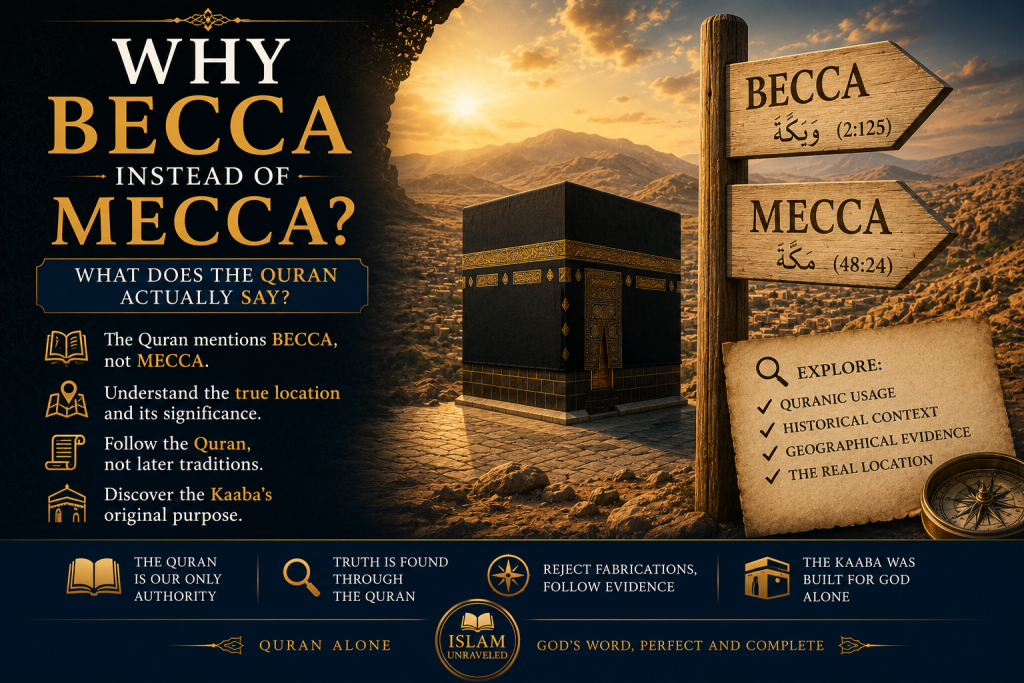
One of the more intriguing textual features of the Quran appears in 3:96 with the word ‘Becca’ instead of Mecca.
“The first house established for the people was the one in Becca, blessed and a guidance for all people.”
The verse is striking because the Quran uses the name:
Becca (Bakkah)
rather than the expected and historically familiar:
Mecca (Makkah)
The issue has attracted attention from:
- traditional Muslim commentators,
- philologists,
- historians,
- and modern academic Quranic scholarship.
Why does the Quran use “Becca” in this verse while “Mecca” became the standard historical and geographical name?
The question is significant because the Quran otherwise demonstrates extraordinary linguistic precision and consistency. Consequently, scholars have attempted to explain the variation through:
- dialectal development,
- alternate ancient place names,
- linguistic interchange,
- or historical geography.
Yet the question remains unresolved.
From the perspective of the Quranic proof centered upon the number nineteen, however, the spelling “Becca” may represent neither historical accident nor linguistic irregularity, but a deliberate structural component within the Quran’s internally integrated mathematical design.
This article examines the issue from:
- traditional scholarship,
- modern academic perspectives,
- and the Quranic proof framework.
The Quranic Verse
The relevant verse states:
“The first house established for the people was the one in Becca, blessed and a guidance for all people.” (3:96)
The Quran elsewhere refers to:
- the Sacred Masjid,
- the Sacred House,
- and the sanctuary,
but only this verse uses the term:
Bakkah (Becca)
The uniqueness of the spelling has naturally generated scholarly discussion.
Traditional Explanations
Classical Muslim commentators generally proposed that:
- Becca and Mecca refer to the same city,
- with “Becca” representing either:
- an older form,
- a sacred precinct within Mecca,
- or a linguistic variation.
Some linked the word to Arabic roots associated with:
- crowding,
- gathering,
- or humility before God.
Others suggested distinctions between:
- the city itself,
- and the sanctuary area surrounding the Ka‘bah.
While these explanations preserved traditional understanding, they did not fully explain why the Quran specifically employed this spelling in this verse alone.
Modern Academic Approaches
Modern scholarship has approached the issue primarily through:
- philology,
- historical linguistics,
- Semitic language comparison,
- and ancient Arabian geography.
Some scholars view “Bakkah” as:
- an alternate early name,
- a dialectal form,
- or evidence of linguistic fluidity between consonants such as:
- B,
- M,
- and related phonetic structures.
Others interpret the variation within broader discussions regarding:
- the historical development of Mecca,
- pilgrimage traditions,
- and the religious geography of western Arabia.
Yet despite extensive discussion, no universally accepted explanation has emerged.
The problem remains noteworthy precisely because the Quran is otherwise highly deliberate in its textual formulation.
The Quranic Proof Perspective
Within the Quranic proof framework centered upon the number nineteen, the spelling “Becca” acquires a different significance.
Under this framework, the Quran is viewed not merely as literary discourse, but as an internally integrated mathematical structure in which:
- letters,
- placement,
- spelling,
- and arrangement
may serve structural functions.
Specifically, the spelling:
Bakkah
rather than
Makkah
preserves precise letter frequencies and numerical relationships within Surah 3.
Under this perspective, the spelling is deliberate and structurally necessary.
What appears historically irregular may therefore function mathematically within the larger architecture of the Quran.
The Larger Question of Quranic Precision
The issue ultimately touches upon a broader question:
Does the Quran contain internally integrated structural features extending beyond ordinary literary composition?
The Quran repeatedly presents itself as:
- precise,
- protected,
- and internally coherent.
“The Word of your Lord is complete, in truth and justice.” (6:115)
“Had it been from other than GOD, they would have found in it numerous contradictions.” (4:82)
If the Quran contains deliberate mathematical relationships spanning:
- surahs,
- letter frequencies,
- initials,
- and structural placement,
then spelling variation itself may become part of that integrated design.
Textual Irregularity or Deliberate Structure?
Historical-critical scholarship typically approaches irregularities through:
- historical development,
- editorial history,
- scribal transmission,
- or linguistic variation.
The Quranic proof framework approaches the same phenomena differently.
Under this perspective, certain features commonly treated as anomalies may instead represent:
- intentional structural markers,
- mathematically constrained spellings,
- or internally coordinated textual features.
Thus, the issue becomes methodological as much as philological.
The Role of Internal Coherence
One of the strengths of the Quranic proof framework is that it attempts to explain multiple textual phenomena through a unified internal model.
Within this broader structure:
- the Quranic initials,
- the missing Basmalah in Surah 9,
- the placement of 74:31,
- and the spelling “Becca”
are not isolated irregularities.
They become interconnected components of a larger internally coherent system.
Whether one ultimately accepts the framework or not, the attempt at unified explanation possesses analytical significance.
The Quran and Deliberate Language
The Quran repeatedly emphasizes:
- precision of language,
- measured composition,
- and intentional revelation.
Even subtle textual choices may therefore possess significance beyond immediate historical explanation.
This does not eliminate the value of:
- philology,
- linguistics,
- or historical analysis.
Rather, it raises the possibility that some Quranic phenomena may require explanatory models extending beyond conventional literary assumptions.
Methodological Boundaries
The broader issue again concerns methodology.
Conventional academic scholarship generally excludes:
- revelation,
- divine intentionality,
- or internally embedded mathematical structure
as explanatory categories.
As a result, features such as “Becca” are interpreted within:
- historical,
- linguistic,
- or editorial frameworks alone.
The Quranic proof perspective proposes that such frameworks may be insufficient to account fully for certain textual phenomena.
Part of a Larger Series
This article is part of the series:
Can Modern Scholarship Explain the Quran Without the Quranic Proof?
which examines unresolved Quranic questions in modern scholarship in light of the Quran’s internally coherent structure and the Quranic proof centered upon the number nineteen.
Articles in This Series
- The Quranic Initials and the Mathematical Structure of the Quran
- Why “Becca” Instead of “Mecca”?
- Abrogation in the Quran — Proof or Verse?
- Why Is the Basmalah Missing from Surah 9?
- Did Prophet Muhammad Write the Quran?
- Surah 74 and the Hidden Secret of the Quran
- Purified Sheets and the Messenger After the Prophets
Conclusion
The Quran’s use of “Becca” instead of “Mecca” remains one of the more intriguing textual questions in Quranic studies.
Traditional scholarship preserved the identification of the location while offering various linguistic explanations. Modern academic approaches have explored:
- philology,
- dialect,
- and historical geography,
yet the issue remains unresolved.
The Quranic proof centered upon the number nineteen proposes a different possibility:
that the spelling serves a deliberate structural function within the Quran’s internally integrated mathematical design.
Under this framework, what appears to be textual irregularity may instead reflect textual precision.
The larger question therefore extends beyond one place name.
It concerns whether the Quran contains dimensions of internally coordinated structure that conventional historical-critical methodology is not presently designed to recognize.
The Quran itself repeatedly calls readers to examine:
- its signs,
- coherence,
- and precision.
The spelling “Becca” may represent one small but significant element within that broader Quranic architecture.