Historical-Critical Inquiry and the Internal Coherence of the Quran
Introduction
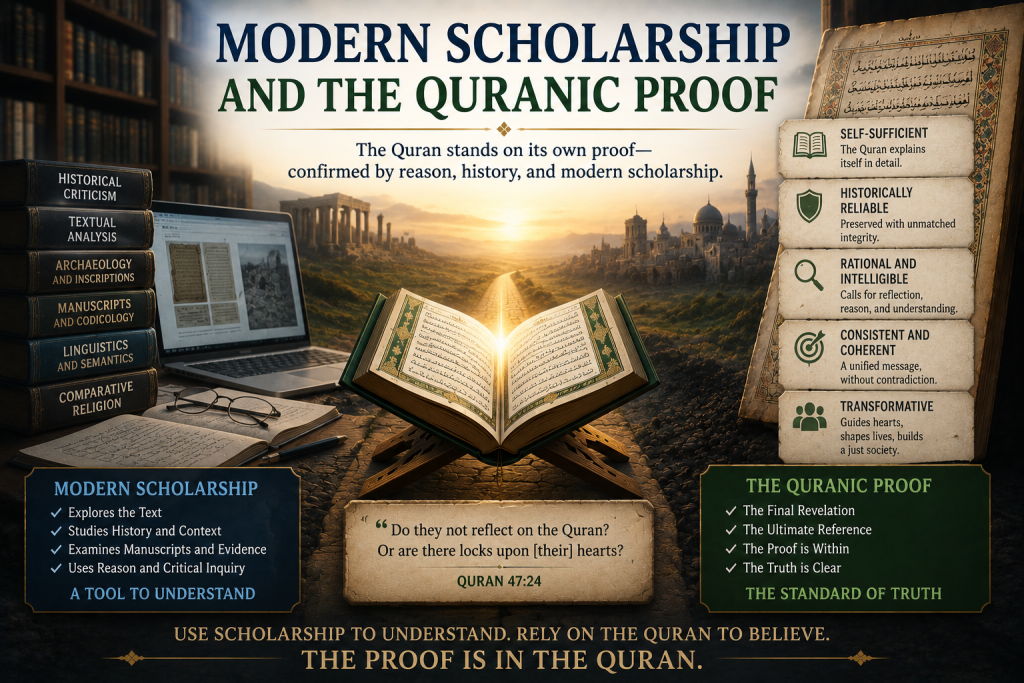
In this context, we will explore the role of Modern Scholarship and the Quranic Proof in understanding the text and its implications.
Modern academic scholarship on the Quran has developed significantly over the last several decades. Contemporary scholars increasingly analyze the Quran through:
- literary criticism,
- historical reconstruction,
- manuscript studies,
- intertextual analysis,
- and the broader context of Late Antiquity.
Among contemporary scholars, Professor Nicolai Sinai of the University of Oxford represents a serious and methodologically rigorous academic approach to Quranic studies. His work frequently emphasizes close textual reading combined with historical-critical analysis of the Quran within its Late Antique environment.
Such scholarship has produced important insights into:
- the literary structure of the Quran,
- its engagement with Biblical and post-Biblical traditions,
- the chronology of revelation,
- and the development of the early Islamic community.
At the same time, modern scholarship continues to encounter a number of unresolved textual, structural, and historical questions regarding the Quran itself. These include:
- the enigmatic Quranic initials,
- the spelling “Becca” instead of “Mecca” in 3:96,
- the meaning of abrogation in 2:106,
- the omission of the Basmalah from Surah 9,
- the placement and role of 74:31,
- the final arrangement of the Quran,
- and the meaning of “purified sheets” in 98:2.
From the perspective of mainstream academic methodology, these questions are generally approached through:
- source criticism,
- redaction history,
- manuscript development,
- literary convention,
- or historical contingency.
However, a Quran-centered perspective rooted in the internal mathematical structure of the Quran proposes a different possibility:
that many of these unresolved issues are not random textual irregularities, but interconnected elements of an internally embedded Quranic proof centered upon the number nineteen, explicitly referenced in 74:30–31.
This article does not seek to dismiss historical-critical scholarship. Rather, it proposes that certain longstanding textual and structural questions surrounding the Quran may possess internally Quranic resolutions that conventional academic methodology, by definition, does not consider.
The Historical-Critical Method and Its Limits
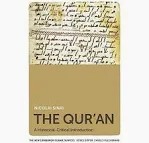
Modern academic scholarship approaches the Quran as a historical text emerging within a particular religious and cultural environment.
This methodology has yielded valuable contributions:
- analysis of Quranic language,
- recognition of Late Antique theological debates,
- manuscript comparison,
- literary structure,
- and historical contextualization.
Yet the historical-critical method necessarily operates within methodological constraints.
By design, it does not generally consider:
- divine authorship,
- revelation,
- or internally embedded supernatural structure
as explanatory categories.
As a result, phenomena within the Quran that appear anomalous or unresolved are often interpreted through:
- editorial development,
- textual layering,
- scribal variation,
- or historical evolution.
The question, however, is whether certain features of the Quran may instead point toward a deliberate internal structure operating beyond ordinary literary composition.
The Quran’s Self-Presentation
The Quran repeatedly presents itself not merely as inspired literature, but as:
- fully detailed,
- internally consistent,
- divinely protected,
- and mathematically precise.
“We have neglected nothing in the Book.” (6:38)
“Shall I seek other than GOD as a source of law, when He has revealed to you this book fully detailed?” (6:114)
“The Word of your Lord is complete, in truth and justice.” (6:115)
The Quran repeatedly challenges the reader to examine:
- its structure,
- consistency,
- and signs.
Particularly significant is Surah 74:
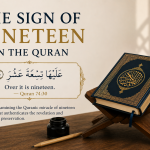
“Over it is nineteen.” (74:30)
followed immediately by:
“We appointed angels to be guardians of Hell, and we assigned their number only to disturb the disbelievers, to convince the Christians and Jews, to strengthen the faith of the faithful, to remove all traces of doubt from the hearts of Christians, Jews, as well as the believers…” (74:31)
The verse itself explicitly presents the number nineteen as:
- a test,
- a sign,
- and a source of certainty.
The question then becomes whether certain unresolved Quranic phenomena may relate to this internally embedded structure.
The Enigmatic Initials
One of the most discussed unresolved questions in Quranic studies concerns the disconnected or enigmatic letters appearing at the beginning of twenty-nine surahs.
Traditional exegesis generally acknowledges uncertainty regarding their meaning.
Modern scholarship often approaches them through:
- scribal hypotheses,
- liturgical symbols,
- abbreviation theories,
- or literary convention.
However, within the Quranic mathematical structure centered upon nineteen, these initials exhibit intricate numerical relationships that extend throughout the text.
Under this framework, the initials function not as isolated anomalies, but as components of a larger structural system embedded within the Quran.
This possibility fundamentally alters the nature of the question itself.
“Becca” Instead of “Mecca”
Another longstanding question concerns 3:96:
“The first house established for the people was the one in Becca…”
Why “Becca” rather than the expected “Mecca”?
Historical-critical scholarship generally approaches this issue through:
- linguistic variation,
- alternate place names,
- dialectal history,
- or geographical tradition.
Within the nineteen-based mathematical structure, however, the spelling preserves precise letter counts within the surah itself.
Thus, what appears historically irregular may instead function structurally within the Quran’s internal design.
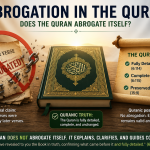
Abrogation in 2:106
Verse 2:106 has historically become one of the central prooftexts for the doctrine of Quranic abrogation:
“When we abrogate any ayah…”
Yet the Arabic word ayah possesses multiple meanings:
- sign,
- miracle,
- proof,
- revelation,
- verse.
Traditional scholarship overwhelmingly interpreted the verse as referring to the cancellation of Quranic verses by later Quranic verses.
However, this interpretation creates tension with verses such as:
- 6:115,
- 18:27,
- and 41:42,
which repeatedly emphasize the perfection and inviolability of God’s words.
Within the Quranic proof framework, 2:106 may instead refer to the replacement or supersession of divine signs or miracles rather than cancellation of Quranic legislation.
Again, the issue becomes one of internal Quranic coherence.
The Missing Basmalah in Surah 9
The omission of the Basmalah from Surah 9 remains one of the most discussed structural anomalies in the Quran.
Academic approaches typically interpret the omission through:
- redaction history,
- liturgical convention,
- or textual development.
Within the Quranic mathematical structure, however, the omission functions as part of a larger numerical balance connected to the overall structure of the Quran and the status of 9:128–129.
Interestingly, Nicolai Sinai himself notes that 9:128 attributes to Muhammad qualities elsewhere used uniquely for God.
This observation illustrates how historical-critical scholarship may identify textual tension while remaining unable, methodologically, to pursue internally mathematical explanations.
The Final Arrangement of the Quran
Modern scholarship continues to debate:
- the arrangement of the Quran,
- chronology,
- codification,
- and recension history.
Yet the mathematical structure associated with the Quranic proof presupposes:
- a finalized arrangement,
- deliberate placement,
- and internally integrated structural relationships.
If valid, such a structure would strongly support the essential integrity of the Quranic arrangement as transmitted.
Surah 74 and the “Hidden Secret”
Particularly striking is the role of Surah 74 itself.
Professor Sinai raises questions regarding the placement and literary role of 74:31 within the surrounding text.
Yet under the Quranic proof framework, Surah 74 functions precisely as the central disclosure of the proof:
- “Over it is nineteen” (74:30)
- followed by five explicit functions of the proof in 74:31.
The surah’s title itself:
Al-Muddaththir
(“The Hidden Secret” or “The Cloaked One”)
takes on additional significance within this interpretive framework.
The Limits of Methodological Naturalism
The central issue underlying these discussions is methodological.
Historical-critical scholarship operates within what may be termed methodological naturalism:
- explanations must remain historically and materially reconstructable.
An internally embedded mathematical structure spanning the entire Quran over fourteen centuries naturally falls outside such methodology.
Thus, the issue is not necessarily lack of intelligence or rigor within academic scholarship, but the boundaries imposed by its own methodological assumptions.
The Quran as an Internally Coherent System
The Quran repeatedly calls readers to examine:
- its consistency,
- signs,
- precision,
- and internal harmony.
“Had it been from other than GOD, they would have found in it numerous contradictions.” (4:82)
The Quranic proof framework proposes that several longstanding textual and structural questions may not represent:
- editorial residue,
- accidental irregularity,
- or unresolved literary tension,
but rather components of a deliberate internally integrated system.
Whether one accepts this conclusion or not, the framework deserves serious analytical consideration because it attempts to explain multiple unresolved questions simultaneously through a unified internal model.
Articles in This Series
- The Quranic Initials and the Mathematical Structure of the Quran
- Why “Becca” Instead of “Mecca”?
- Abrogation in the Quran — Proof or Verse?
- Why Is the Basmalah Missing from Surah 9?
- Did Prophet Muhammad Write the Quran?
- Surah 74 and the Hidden Secret of the Quran
- Purified Sheets and the Messenger After the Prophets
Conclusion
Modern Quranic scholarship has contributed substantially to the academic study of the Quran through:
- literary analysis,
- manuscript studies,
- historical contextualization,
- and philological rigor.
Scholars such as Nicolai Sinai represent serious and thoughtful engagement with the Quranic text.
At the same time, a number of textual and structural questions remain unresolved within conventional historical-critical methodology.
The Quranic proof centered upon the number nineteen proposes that several of these questions may possess internally Quranic resolutions grounded in the Quran’s own self-presentation as:
- complete,
- precise,
- protected,
- and internally coherent.
The broader question therefore is not whether modern scholarship possesses intellectual rigor.
Rather, the question is whether methodological assumptions excluding internally embedded revelatory structure may themselves limit the range of possible explanations available to scholarship.
In that sense, the discussion is not ultimately about conflict between faith and scholarship.
It is about whether the Quran may contain dimensions of internal structure that conventional academic methodology is not presently equipped to recognize.
Continue Your Study
These related studies examine different ways the Quran can become secondary to inherited tradition, simplified religious teaching, academic assumptions, or political ideology – and why religious claims should ultimately be tested against the Quran itself.
The Quran Hijacked Twice – By Critics and Traditionalists
Examine how critics of Islam and traditional Muslim authorities can arrive from opposite directions yet rely on the same post-Quranic traditions, leaving the Quran itself secondary.
When “Islam for Beginners” Is Not the Quran
Explore how introductory presentations of Islam can begin with inherited beliefs and practices rather than allowing newcomers to encounter the Quran and evaluate its message directly.
When the Quran Becomes Secondary
Examine how additional religious sources, authorities, and inherited assumptions can gradually move the Quran from the center of religious guidance to a secondary position.
When Religion Becomes Ideology – A Quranic Critique of Sayyid Qutb’s Milestones
Examine how religion can be transformed into a political ideology, and evaluate the influential ideas of Sayyid Qutb’s Milestones against the Quran itself.