Introduction
The Quran describes itself as:
“fully detailed” (6:114)
“a clear scripture” (5:15)
“a criterion between truth and falsehood” (25:1)
The Arabic Quran is infallible. Every translation, however, is a human effort and therefore limited. Yet not all translations are the same. Some aim to convey meaning linguistically, while others attempt to draw attention to what is already present within the Quran itself.
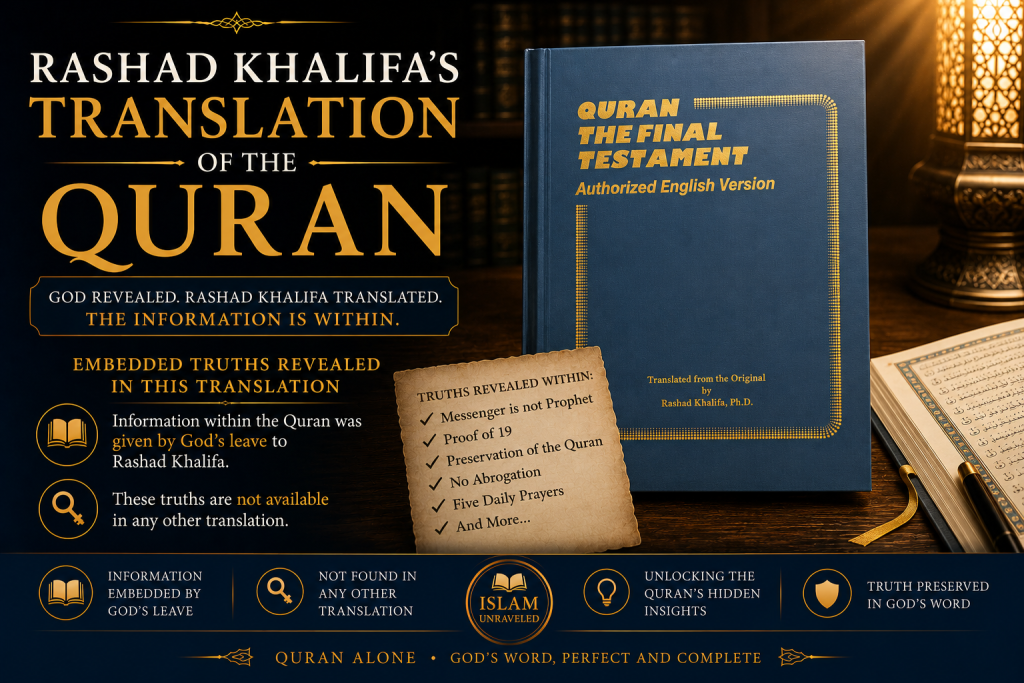
Rashad Khalifa’s translation of the Quran belongs to the latter category. It does not present new information, it highlights embedded information already contained within the Quran.
The Quran Explains Itself
A fundamental principle of the Quran is:
“Then it is upon Us to explain it.” (75:19)
This establishes that:
The Quran is self-explanatory
Its meanings are clarified within the text itself
This principle is explored further in our discussion on the Quran as the sole source of guidance.
Rashad Khalifa’s translation consistently approaches the Quran:
- verse by verse
- in light of other verses
- allowing the Quran to define its own terms
Without this approach, readers often rely on:
- inherited interpretations
- external sources
- fragmented understanding
Embedded Information Within the Quran
The Quran contains layers of meaning that are:
- internally connected
- structurally consistent
- self-reinforcing
Two major examples illustrate this clearly.
1. The Proof Within the Quran (74:30–35)
For centuries, readers encountered:
“Over it is nineteen.” (74:30)
The meaning remained unclear. Attempts were made to assign significance externally—even entire systems were constructed around the number nineteen.
However, the Quran itself explains:
“…a proof… to remove all doubt…” (74:31–35)
The number is not symbolic in isolation
It is part of a verifiable internal structure
This is discussed in detail here
Rashad Khalifa’s work brought attention to this internal proof as part of the Quran’s own framework.
2. The Distinction Between Messenger and Prophet (3:81, 33:40)
The Quran distinguishes clearly between:
- prophet (nabi)
- messenger (rasool)
It also states:
“Muhammad… is the final prophet.” (33:40)
This distinction is explored here
Without understanding this distinction, confusion arises. Throughout history, individuals have claimed prophethood, establishing movements and doctrines that contradict the Quran’s framework.
The Quran already resolves this issue:
- roles are defined
- boundaries are set
- continuity is explained
Rashad Khalifa’s translation brings this distinction into focus by allowing the Quran to explain itself.
What Is at Stake
The critical point is not about preference between translations.
It is this:
The Quran contains embedded information
This information is not always visible through conventional translation approaches
As a result:
A reader who does not engage with a translation that highlights these elements risks:
- missing internal connections
- overlooking structural consistency
- failing to recognize how the Quran verifies itself
This is not about adding to the Quran. It is about seeing what is already there.
Mission: Delivery and Return
The mission of Prophet Muhammad can be summarized simply:
Deliver the Quran
The natural continuation of that mission is:
Return to the Quran
This is not a new message, it is the Quran’s own call:
“My Lord, my people have deserted this Quran.” (25:30)
This theme is discussed further here
Returning to the Quran includes:
- reading it carefully
- allowing it to define its own terms
- recognizing its internal coherence
A Necessary Clarification
It must be emphasized:
- The Arabic Quran alone is infallible
- Any translation is:
- human
- limited
- subject to error
Rashad Khalifa’s translation does not replace the Quran. It serves as:
a tool that highlights the Quran’s internal structure
Conclusion
The Quran presents itself as:
- complete
- detailed
- self-explanatory
Yet engaging with that depth requires more than surface reading.
Rashad Khalifa’s translation draws attention to:
- internal proof
- structural consistency
- precise distinctions
These are not additions, they are part of the Quran itself.
For broader context on how the Quran distinguishes truth from falsehood
The essential point is this:
Some translations convey meaning
Others help reveal how the Quran explains itself
And when that dimension is overlooked, the reader does not lose the Quran—but may miss how the Quran verifies, clarifies, and reinforces its own message.