Introduction
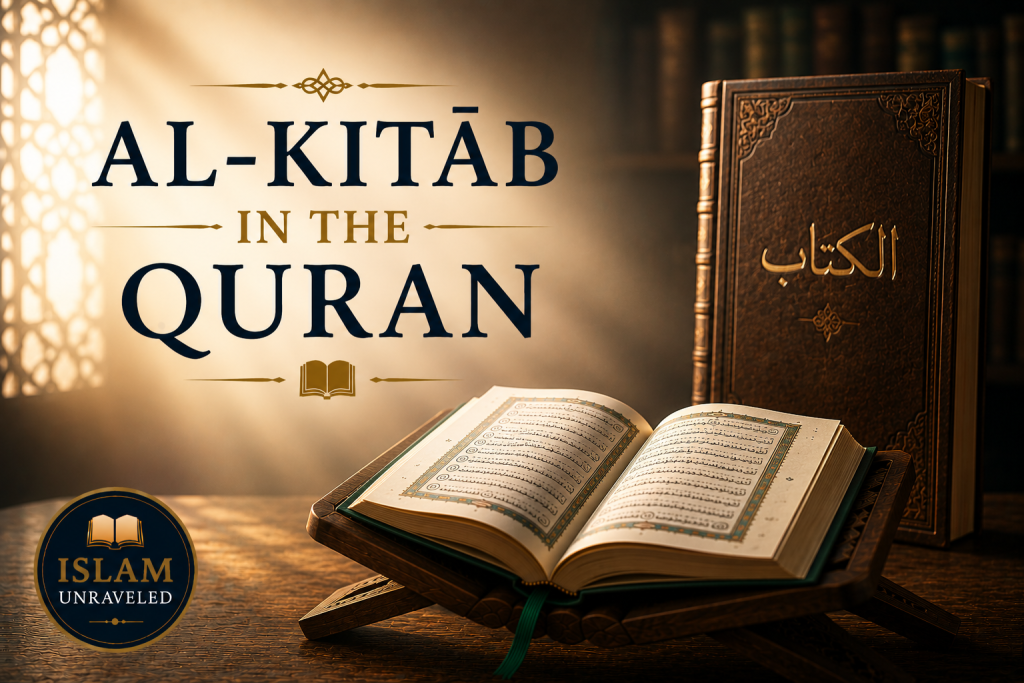
Among the most frequently used and often misunderstood terms is “Al-Kitab” in the Quran. Commonly translated as “the Book,” the term is sometimes treated as having a single, fixed meaning throughout the Quran. This approach, however, leads to confusion and misinterpretation.
The Quran presents itself as:
As discussed in our article on the Quran as the sole source of guidance, the Quran defines itself as complete and sufficient in matters of law and belief. A careful reading shows that Al-Kitab is a contextual term, its meaning is determined by how it is used within a given passage.
Language and Context: A Necessary Principle
In all languages, meaning is shaped by context.
Consider the English word “light”:
- It can mean physical illumination
- Or understanding (“to shed light on a matter”)
The word remains the same, but its meaning shifts depending on usage.
The Quran operates with the same linguistic precision. As emphasized in our discussion on truth and falsehood in the Quran, clarity emerges when verses are understood within their proper context rather than in isolation.
The Error of a Fixed Meaning
A common claim is that “Al-Kitab” must always carry one rigid meaning, often assumed to refer exclusively to the Quran.
This approach creates difficulties:
- It blurs distinctions between different revelations
- It forces meanings that do not fit the context
- It obscures the Quran’s explanation of earlier scriptures
The Quran does not support such rigidity. Instead, it uses the term in a way that reflects both continuity and distinction within revelation, a theme also reflected in our analysis of how the Quran distinguishes truth from falsehood.
The Core Meaning of Al-Kitab
The root of “Kitab” conveys the idea of:
: something written, prescribed, or decreed
From this root, the term can refer to:
- a specific revealed scripture
- divine law or decree
- a written record
The precise meaning is determined by context, a principle central to understanding the Quran on its own terms.
Al-Kitab as Revealed Scriptures
The Quran explicitly identifies multiple revelations as “Kitab”:
The Torah
“We have sent down the Torah, containing guidance and light…” (5:44)
The Gospel
“We sent Jesus… and we gave him the Gospel, containing guidance and light…” (5:46)
The Quran
“…We revealed to you this scripture, truthfully, confirming previous scriptures, and superseding them…” (5:48)
The Psalms (Zabur)
“…We gave David the Psalms.” (4:163)
These are not isolated texts but part of a unified system of revelation, as further explored in our article on messengers and their role in delivering divine guidance.
The Central Passage: 5:43–48
Verses 5:43–48 provide one of the clearest presentations of how Al-Kitab functions across different revelations.
1. The Torah (5:44)
- Sent down by God
- Contains guidance and light
- Prophets judged according to it
: The focus is functional:
- judgment based on revealed law
2. The Gospel (5:46)
- Given to Jesus
- Confirms the Torah
- Contains guidance and light
: This demonstrates:
- continuity
- reinforcement
- augmentation
3. The Quran (5:48)
- Confirms previous scripture
- Acts as a criterion (muhaymin)
- Establishes final authority
: This aligns with the Quran’s role as described in our article on the Quran as the ultimate criterion between truth and falsehood.
Unity of Revelation
The Quran presents revelation as a continuous and unified process:
- Torah to Gospel to Quran
These are not separate religions in origin, but stages in:
: a single divine message
This unity is essential to understanding why the Quran serves as the final authority, a concept also explored in our discussion on returning to the Quran as the primary source of guidance.
Why Context Matters in Translation
The debate over translating “Al-Kitab” as:
- “the Book”
- “scripture”
- “previous scripture”
is not merely linguistic, it is conceptual.
To insist on one rigid translation ignores the Quran’s own distinctions:
- between different revelations
- between past and present scripture
- between confirmation and supersession
Contextual translation is not distortion, it is clarification, much like how understanding the Quran requires reading it in light of its own explanations.
Supporting Example: Places of Worship (22:40)
The Quran states:
“…monasteries, churches, synagogues, and masjids…” (22:40)
This verse recognizes:
- multiple communities
- multiple forms of worship
It reinforces the same principle:
; The Quran speaks to a real and diverse human context, not a simplified or isolated one.
The Quran’s Method
The Quran consistently:
- explains itself
- clarifies through repetition
- distinguishes through context
This method is central to understanding how the Quran maintains internal consistency and coherence, a theme also reflected in multiple articles across this site.
Why This Matters
Misunderstanding “Al-Kitab” leads to:
- confusion about revelation
- misunderstanding of prophetic roles
- incorrect conclusions about religious identity
Recognizing its contextual meaning allows the reader to see:
- the unity of divine guidance
- the progression of revelation
- the role of the Quran as final criterion
Conclusion
“Al-Kitab” is not a rigid label with a single fixed meaning. It is a contextual term within a unified system of revelation.
The Quran is precise, but its precision requires:
- attention to context
- recognition of distinctions
- understanding of continuity
The essential principle is simple:
Words in the Quran are consistent in purpose, but contextual in meaning
And understanding that context is key to understanding the message itself