Part of the Series: The Quran, Idolatry, and the Emergence of Sectarian Religion
Introduction
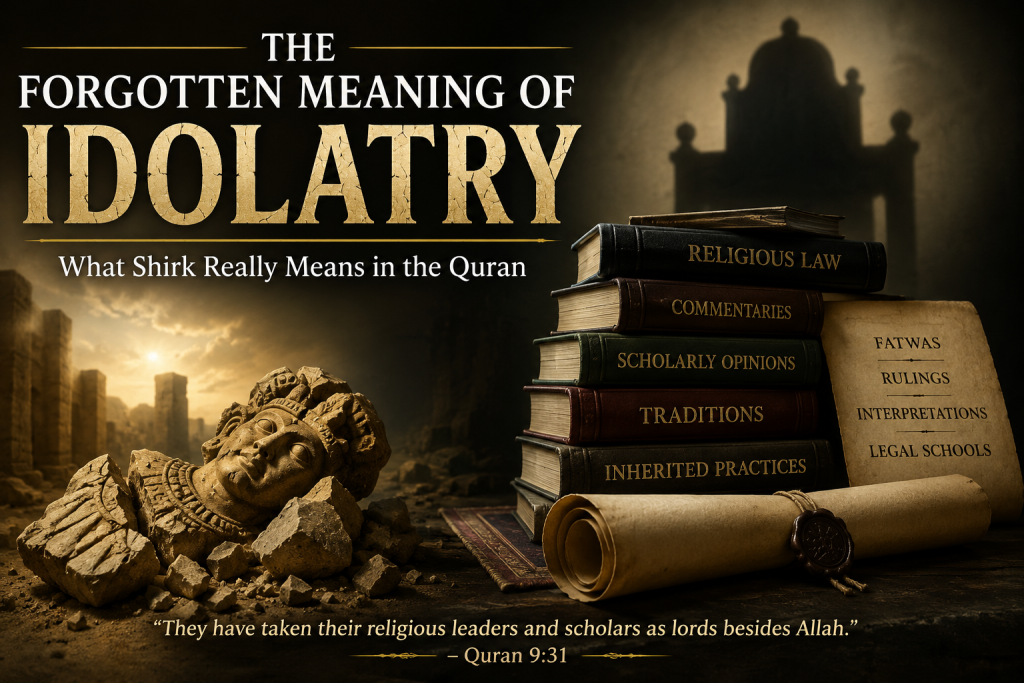
When people hear the word “idolatry,” they often think of statues, carved images, and pagan temples; having forgotten the meaning of idolatry in the Quran.
This understanding is not without basis. The Quran recounts how Abraham challenged his father’s idols, how the Israelites worshipped the golden calf, and how various prophets confronted physical objects of worship.
Yet a careful reading of the Quran reveals something surprising.
While physical idols are certainly condemned, the Quran’s primary concern is often not statues at all. Instead, the revelation repeatedly warns against a more subtle and enduring form of idolatry: assigning authority, devotion, or religious legitimacy to others alongside God.
If this observation is correct, then idolatry did not disappear with the destruction of ancient statues. It remains a danger wherever human beings elevate individuals, traditions, institutions, or religious authorities to a position that belongs to God alone.
Physical Idols in the Quran
The Quran does refer to physical idols in several historical narratives.
Abraham questioned his father:
“Do you take idols as gods?” (6:74)
Later, he challenged his people:
“What are these statues to which you are devoted?” (21:52)
The Israelites encountered people devoted to idols:
“O Moses, make for us a god just as they have gods.” (7:138)
The prophet Elias confronted the worship of Baal:
“Do you call upon Baal and abandon the Best Creator?” (37:125)
These examples demonstrate that physical idols existed in earlier communities and that God’s messengers opposed them.
However, something remarkable occurs when the Quran addresses Muhammad’s contemporaries.
The Quran’s Opponents Believed in God
The Quran repeatedly states that Muhammad’s opponents acknowledged God.
If you ask them who created the heavens and the earth, they will say, “God.” (29:61)
If you ask them who created the heavens and the earth, they will say, “God.” (39:38)
They were not atheists.
Nor were they people completely ignorant of God.
The Quran also tells us that they called upon God sincerely when facing danger:
When they ride aboard a ship, they implore God sincerely, devoting the religion entirely to Him. (29:65)
The puzzle becomes obvious.
If these people already believed in God, what made them mushrikeen?
The Real Meaning of Shirk
The Quran’s answer is association.
The mushrikeen did not necessarily reject God. Rather, they associated others with Him.
Traditionally, this concept is often reduced to worshipping statues.
The Quran, however, presents a much broader picture.
Shirk occurs whenever something is elevated into a position that belongs exclusively to God.
This includes authority, legislation, devotion, and religious guidance.
Who Has the Right to Legislate Religion?
One of the Quran’s strongest themes concerns religious authority.
God asks:
Shall I seek other than God as a source of law when He has revealed to you this Book fully detailed? (6:114)
The Quran repeatedly presents itself as complete, sufficient, and fully detailed for religious guidance.
Yet people continually sought additional authorities.
The Quran warns:
Or do they have partners who legislate for them religious laws never authorized by God? (42:21)
Notice the language.
The issue is not statues.
The issue is legislation.
Those who establish religious laws without divine authorization are described as partners.
This is the language of shirk.
Religious Leaders as Lords Besides God
The Quran goes further:
They have taken their religious leaders and scholars as lords besides God. (9:31)
Many readers assume idolatry requires bowing before an object.
Yet this verse presents another form of elevation.
When people grant religious authority that properly belongs to God alone, they create rivals in religion.
The object of worship may not be stone.
It may be human.
Following Forefathers
Another recurring Quranic theme is blind adherence to inherited tradition.
Whenever they are told:
“Follow what God has revealed,”
they respond:
“We follow what we found our parents following.” (2:170)
The Quran repeatedly condemns this mentality.
The problem is not respect for previous generations.
The problem is allowing inherited traditions to override revelation.
Once tradition becomes the final authority, it effectively competes with God.
Abraham’s Struggle Was Larger Than Statues
Abraham is often remembered for breaking idols.
Yet the Quran presents his mission as much larger than the destruction of physical objects.
Abraham challenged the entire religious structure of his society.
He questioned inherited beliefs.
He rejected the authority of his forefathers.
He called people to direct devotion to God alone.
The broken statues symbolized a deeper truth.
False authority must be broken before pure monotheism can emerge.
The Corruption of Religion
The Quran presents a recurring historical pattern:
- God reveals guidance.
- People accept it.
- Human additions accumulate.
- Religious authorities emerge.
- Traditions become sacred.
- God’s message becomes obscured.
This pattern occurred before Noah.
It occurred before Abraham.
It occurred before Moses.
It occurred before Jesus.
And according to the Quran, it had already occurred before Muhammad.
The role of revelation is not merely to oppose paganism.
It is to restore God’s exclusive authority.
Modern Idolatry
Modern people rarely bow before statues.
Yet the Quran’s warnings remain relevant.
Whenever religious laws are attributed to sources God did not authorize, the danger of association appears.
Whenever human authority becomes unquestionable, the danger of association appears.
Whenever tradition overrides revelation, the danger of association appears.
The form may change.
The principle remains the same.
Conclusion
The Quran certainly condemns physical idols.
But its message goes much deeper.
The greatest danger identified by the Quran is not stone idols but rival authority.
The central question is not:
“Do you worship a statue?”
The central question is:
“Who has the right to define religion?”
The Quran’s answer is clear.
Religious authority belongs to God alone.
Anything elevated alongside Him becomes a partner.
And that is the forgotten meaning of idolatry.
Related Reading
If you found this article helpful, you may also enjoy:
- Who Were the Mushrikeen in the Quran? – Examining whether the Quran’s opponents were merely idol worshippers or something more complex.
- The Forgotten Meaning of Idolatry – How the Quran’s concept of shirk extends beyond statues and physical idols.
- Did the Quran Confront Pagans or Corrupted Monotheists? – Exploring the religious landscape addressed by the Quran.
- From Believers to Sectarian Islam – How a movement centered on believers and submitters became associated with sectarian identities.
- The Kaaba Before Muhammad: What Does the Quran Actually Say? – Investigating Abraham’s sanctuary through the Quran’s own testimony.
- How Did the Traditional Story of Pagan Arabia Arise? – Comparing the traditional narrative with the Quran’s emphasis.
- The Idols of Noah and the Idols of Arabia: What Does the Quran Say? – Examining what the Quran actually reveals about ancient idols and religious corruption.