Part of the Series: The Quran, Idolatry, and the Emergence of Sectarian Religion
Introduction
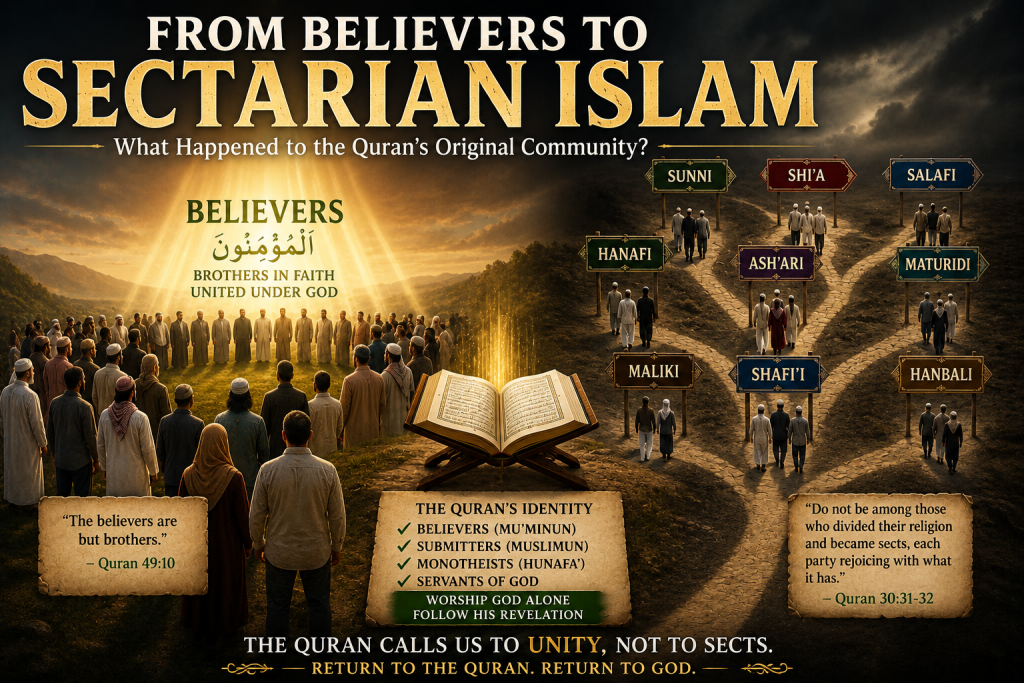
Open the Quran and a striking fact from Believers to Sectarian Islam becomes immediately apparent.
The Quran repeatedly speaks of:
- believers (mu’minun),
- submitters (muslimun),
- monotheists (hunafa’),
- servants of God,
- people of the scripture.
Yet it never describes God’s approved community as:
- Sunni,
- Shi’i,
- Salafi,
- Ash’ari,
- Maturidi,
- Hanafi,
- Maliki,
- Shafi’i,
- Hanbali.
These labels dominate religious discussions today, but they are absent from the Quran.
This raises an important question:
How did a revelation centered on believers and submitters become identified with competing sects, schools, and institutions?
The Quran itself offers important clues.
The Quran’s Preferred Identity
The Quran consistently uses simple and universal descriptions.
Believers
The believers are but brothers. (49:10)
Submitters
Abraham was neither a Jew nor a Christian; he was a monotheist submitter. (3:67)
Monotheists
Follow the religion of Abraham, the monotheist. (16:123)
The emphasis is always on one’s relationship with God rather than affiliation with a religious institution.
The Quran’s focus is faith, submission, and righteousness.
The Quran Warns Against Sectarianism
Far from encouraging sectarian labels, the Quran repeatedly warns against division.
Do not be among those who divided their religion and became sects, each party rejoicing with what it has. (30:31-32)
And:
Those who divide their religion and become sects, you have nothing to do with them. (6:159)
These are powerful warnings.
The Quran does not merely discourage sectarianism.
It presents it as a departure from the unity intended by revelation.
A Pattern Found Throughout Scripture
The Quran repeatedly describes a recurring historical pattern.
First
God sends guidance.
Then
A believing community emerges.
Later
Differences appear.
Eventually
Groups divide into competing factions.
This pattern is described regarding earlier communities.
The people were one community; then God sent the prophets. (2:213)
The Quran repeatedly portrays division as something that develops after revelation, not something created by revelation itself.
The Rise of Religious Authority
As discussed in the previous article, one of the Quran’s central concerns is authority.
The Quran repeatedly asks:
Shall I seek other than God as a source of law when He has revealed to you this Book fully detailed? (6:114)
Over time, however, religious communities tend to develop layers of authority.
Interpretations accumulate.
Traditions expand.
Institutions emerge.
Human opinions gradually acquire sacred status.
This process is not unique to Islam.
The Quran describes similar developments among previous religious communities.
The Transformation of Identity
The earliest believers were united by common submission to God.
The Quran’s emphasis was simple:
- worship God alone,
- establish prayer,
- give charity,
- uphold justice,
- prepare for the Hereafter.
As institutions developed, identity increasingly became tied to:
- schools,
- sects,
- scholars,
- doctrines,
- inherited traditions.
Gradually, belonging to a group became as important as devotion to God.
The Quran repeatedly warns against precisely this tendency.
The Example of Abraham
Abraham occupies a central place in the Quran.
Why?
Because Abraham existed before later religious divisions.
He was:
- not Jewish,
- not Christian,
- not Sunni,
- not Shi’i.
The Quran presents him simply as a monotheist submitter.
Abraham was neither a Jew nor a Christian, but a monotheist submitter. (3:67)
His example reminds believers that devotion to God precedes every later religious label.
What Happened After Muhammad?
The Quran does not provide a detailed political history after Muhammad’s death.
However, it repeatedly warns believers about the dangers that affected previous communities:
- division,
- innovation,
- religious authority,
- inherited traditions,
- sectarianism.
History shows that Muslim communities eventually developed:
- legal schools,
- theological schools,
- sectarian identities,
- institutional authority structures.
These developments may have been understandable responses to historical circumstances.
The important question is whether they became substitutes for the simple Quranic identity of believer and submitter.
Believers Versus Sects
One of the most striking contrasts in the Quran is the difference between divine and human classifications.
Human beings tend to ask:
“Which group do you belong to?”
The Quran asks:
“Do you believe?”
Human beings ask:
“What school do you follow?”
The Quran asks:
“Do you submit to God?”
Human beings ask:
“Which scholars do you accept?”
The Quran asks:
“What has God revealed?”
This difference lies at the heart of the Quran’s message.
The Danger of Sectarian Pride
The Quran describes a common characteristic of sectarianism:
Each faction rejoicing with what it has. (30:32)
The danger is not merely division.
The danger is becoming satisfied with one’s group rather than remaining devoted to God’s guidance.
Once group identity becomes primary, truth often becomes secondary.
The Quran repeatedly redirects attention away from parties and back to revelation.
Returning to the Quran’s Identity
The solution offered by the Quran is remarkably simple.
Return to the identity God Himself uses.
Be:
- believers,
- submitters,
- monotheists,
- servants of God.
The Quran never commands believers to identify themselves through later sectarian labels.
Instead, it repeatedly calls them to unity under God’s revelation.
Conclusion
The Quran presents a community united by faith, submission, and devotion to God alone.
History, however, shows a recurring tendency for religious communities to divide into competing sects and institutions.
This pattern occurred before Muhammad.
The Quran warns that it can occur again.
The challenge for believers is therefore not merely to inherit a religious identity but to return continually to the Quran’s simple and universal description:
Believers who submit to God alone.
That identity existed before every sect.
And according to the Quran, it remains the identity that matters most.
Related Reading
If you found this article helpful, you may also enjoy:
- Who Were the Mushrikeen in the Quran? – Examining whether the Quran’s opponents were merely idol worshippers or something more complex.
- The Forgotten Meaning of Idolatry – How the Quran’s concept of shirk extends beyond statues and physical idols.
- Did the Quran Confront Pagans or Corrupted Monotheists? – Exploring the religious landscape addressed by the Quran.
- From Believers to Sectarian Islam – How a movement centered on believers and submitters became associated with sectarian identities.
- The Kaaba Before Muhammad: What Does the Quran Actually Say? – Investigating Abraham’s sanctuary through the Quran’s own testimony.
- How Did the Traditional Story of Pagan Arabia Arise? – Comparing the traditional narrative with the Quran’s emphasis.
- The Idols of Noah and the Idols of Arabia: What Does the Quran Say? – Examining what the Quran actually reveals about ancient idols and religious corruption.