Part of the Series: The Quran, Idolatry, and the Emergence of Sectarian Religion
Introduction
Many Muslims grow up with a familiar picture of Pagan Arabia before Muhammad.
The story is well known.
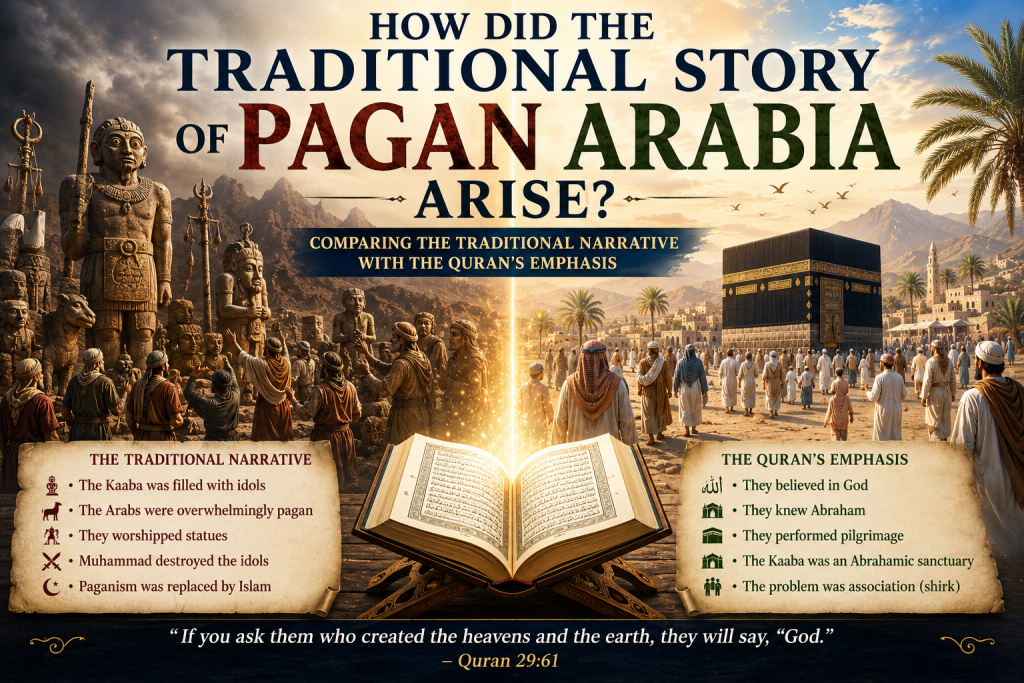
The Kaaba was filled with idols. The Arabs were overwhelmingly pagan. They worshipped statues, abandoned Abraham’s religion, and lived in a state of religious darkness known as jahiliyyah. Muhammad then appeared, destroyed the idols, and replaced paganism with monotheism.
This narrative is deeply rooted in Islamic tradition and is widely accepted across the Muslim world.
Yet when we turn to the Quran itself, a question emerges:
Why does the Quran spend so little time describing the world that later narratives place at the center of the story?
Instead of focusing on statues and pagan rituals, the Quran repeatedly emphasizes association (shirk), inherited traditions, fabricated religious laws, and devotion directed toward intermediaries besides God.
This raises an important question:
How did the familiar picture of pagan Arabia become the dominant way of understanding Muhammad’s mission?
The Quran’s Description of Muhammad’s Opponents
The Quran’s opponents are not portrayed as atheists.
Repeatedly, the Quran states:
If you ask them who created the heavens and the earth, they will say, “God.” (29:61)
If you ask them who created the heavens and the earth, they will say, “God.” (39:38)
The Quran also says:
When they ride aboard a ship, they implore God sincerely. (29:65)
These statements reveal something important.
Muhammad’s opponents already believed in God.
The central issue was not God’s existence.
The issue was association.
They Knew Abraham
The Quran repeatedly connects Muhammad’s message to Abraham.
Follow the religion of Abraham, the monotheist. (16:123)
The Kaaba is linked to Abraham and Ishmael.
Pilgrimage is linked to Abraham.
The sacred sanctuary is linked to Abraham.
This suggests that Abraham’s legacy was already known.
Muhammad was not introducing Abraham to an unfamiliar people.
He was calling them back to Abraham’s original monotheism.
The Quran’s Main Criticism
When the Quran criticizes its opponents, the emphasis is remarkably consistent.
The recurring themes include:
- associating partners with God,
- following forefathers blindly,
- fabricated religious laws,
- intercessors,
- religious authority besides God.
The Quran repeatedly asks:
Or do they have partners who legislate for them religious laws never authorized by God? (42:21)
And:
Shall I seek other than God as a source of law when He has revealed to you this Book fully detailed? (6:114)
The conflict described by the Quran is fundamentally theological.
The issue is authority and worship.
Where Are the Idols?
This observation becomes even more interesting when we examine the Quran’s treatment of physical idols.
The Quran clearly discusses idols in earlier historical narratives.
Abraham
Do you take idols as gods? (6:74)
Abraham’s People
What are these statues to which you are devoted? (21:52)
Moses
Make for us a god just as they have gods. (7:138)
The Golden Calf
The Quran clearly knows how to discuss physical idols when it wishes.
Yet when speaking about Muhammad’s contemporaries, the emphasis shifts dramatically toward religious corruption and association.
The Development of Historical Narratives
Every religious community develops historical traditions.
Stories are transmitted.
Details are expanded.
Events are explained.
Generations seek to understand the past.
This process is natural.
Over time, however, complex realities often become simplified into memorable narratives.
A struggle against religious corruption may gradually become remembered primarily as a struggle against idols.
A battle over authority may become remembered primarily as a battle against statues.
The simpler story is often easier to transmit.
The Appeal of the Pagan Arabia Narrative
The image of a completely pagan Arabia offers a powerful contrast.
It creates a dramatic transformation:
Before Muhammad:
- darkness,
- idolatry,
- paganism.
After Muhammad:
- monotheism,
- revelation,
- truth.
This contrast is easy to understand and easy to teach.
Yet the Quran itself presents a more nuanced picture.
The people already believed in God.
They already knew Abraham.
They already performed pilgrimage.
Their problem was not the absence of monotheistic concepts.
Their problem was corruption of those concepts.
The Pattern Found Throughout the Quran
The Quran repeatedly presents the same historical pattern.
Noah
People corrupted God’s guidance.
Abraham
People inherited corrupted beliefs.
Moses
People introduced innovations and deviations.
Jesus
His message was altered after him.
Muhammad
People inherited Abraham’s religion but no longer practiced it in its original form.
The recurring theme is corruption of revelation.
The Quran’s pattern is remarkably consistent.
The Role of Sectarian History
Another factor may be the tendency of later religious communities to define themselves against what came before.
The sharper the contrast between the old and the new, the stronger the community’s identity becomes.
As centuries passed, it became natural to emphasize the difference between Muhammad’s message and the society around him.
The result may have been an increasing focus on paganism while the Quran itself remained focused on association and corruption.
A Lesson for Today
Perhaps the most important lesson is not historical but contemporary.
The Quran repeatedly warns believers that religious corruption is not confined to ancient societies.
Communities often assume that idolatry belongs to the distant past.
The Quran’s message is different.
The danger lies not merely in statues.
The danger lies in:
- association,
- religious authority besides God,
- inherited traditions,
- fabricated religious laws.
These dangers can appear in any generation.
Conclusion
The traditional picture of pagan Arabia remains deeply influential.
Yet the Quran itself paints a more complex portrait.
Muhammad’s opponents believed in God.
They recognized the sacred sanctuary.
Their error was not complete ignorance of monotheism but its corruption.
This observation may help explain why the Quran spends so much time discussing association, authority, and religious corruption while giving comparatively little attention to the details that later became central to popular narratives.
The Quran’s focus is clear.
The greatest struggle is not merely against physical idols.
It is against anything that competes with God for authority, devotion, and worship.
Related Reading
If you found this article helpful, you may also enjoy:
- Who Were the Mushrikeen in the Quran? – Examining whether the Quran’s opponents were merely idol worshippers or something more complex.
- The Forgotten Meaning of Idolatry – How the Quran’s concept of shirk extends beyond statues and physical idols.
- Did the Quran Confront Pagans or Corrupted Monotheists? – Exploring the religious landscape addressed by the Quran.
- From Believers to Sectarian Islam – How a movement centered on believers and submitters became associated with sectarian identities.
- The Kaaba Before Muhammad: What Does the Quran Actually Say? – Investigating Abraham’s sanctuary through the Quran’s own testimony.
- How Did the Traditional Story of Pagan Arabia Arise? – Comparing the traditional narrative with the Quran’s emphasis.
- The Idols of Noah and the Idols of Arabia: What Does the Quran Say? – Examining what the Quran actually reveals about ancient idols and religious corruption.