Introduction
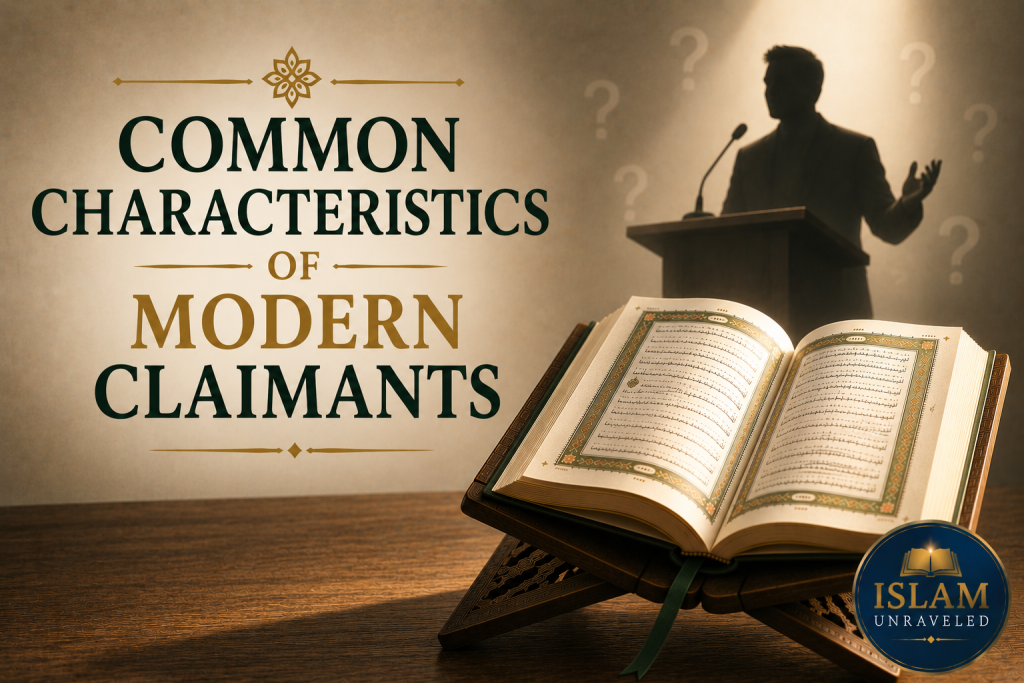
Throughout history, individuals have claimed divine appointment, special revelation, messengership, spiritual authority, or a unique status before God. Since the announcement of the Messenger after the Prophets, Rashad Khalifa, numerous additional claimants have appeared. While their claims differ, many of them exhibit remarkably similar common characteristics of modern claimants.
This article does not evaluate any specific individual. Rather, it identifies recurring patterns that have appeared among modern claimants and compares those patterns to the principles established in the Quran.
The Primary Mission Is Often Lost
The Quran presents a simple and consistent mission for God’s messengers:
Worship God alone.
Every messenger called people to devote their religion entirely to God and to abandon all forms of idolatry.
A recurring problem among many modern claimants is that attention gradually shifts away from worshiping God alone and toward the claimant himself. Explicitly or implicitly, “obey the messenger” becomes transformed into “obey me.”
The Quran never authorizes a messenger to become a source of religious law independent of God’s revelation.
Human Interpretations Replace the Quran
One of the distinguishing characteristics of Rashad Khalifa’s work was his repeated insistence that believers return directly to the Quran.
He repeatedly emphasized:
Many modern claimants move in the opposite direction. Their teachings increasingly depend upon their own interpretations, explanations, private understandings, and personal conclusions.
As a result, followers become dependent upon the claimant’s interpretations rather than upon the Quran itself.
Claims Without Quranic Evidence
The Quran repeatedly demands evidence:
“Produce your proof if you are truthful.” (2:111)
Many claimants make extraordinary assertions but fail to demonstrate clear Quranic support.
Claims are often presented as facts while the supporting evidence cannot be shown directly from the Quran.
The burden of proof always rests upon the claimant.
Repackaging Existing Evidence
Some claimants attempt to establish legitimacy through numerical calculations involving the number 19.
However, the mathematical structure of the Quran was already delivered and documented before these later claims appeared.
Repeating numerical calculations, modifying them, or constructing new theories does not constitute independent evidence of divine appointment.
A messenger’s proof must stand on its own merits.
New Religious Teachings Not Found in the Quran
A common pattern is the introduction of teachings that cannot be clearly demonstrated from the Quran.
Examples include:
- Multiple future messengers.
- New religious obligations.
- Special geographic locations.
- Alternative Qiblah directions.
- Unique doctrinal requirements.
- Exclusive paths to salvation.
The Quran repeatedly warns against introducing religious teachings that God did not authorize.
“Or do they have partners who legislate for them in religion what God has not authorized?” (42:21)
Exploiting Human Fear
One of the most effective tools available to false religious leaders is fear.
Human beings naturally fear:
- uncertainty,
- disasters,
- economic collapse,
- illness,
- social rejection,
- punishment,
- and the future.
Rather than helping people develop trust in God, some claimants knowingly or unknowingly exploit these fears.
Followers are often encouraged to fear:
- imminent catastrophes,
- secret enemies,
- coming destruction,
- divine punishment,
- rejection of the claimant,
- or exclusion from a supposedly chosen group.
In some cases this takes the form of repeated predictions regarding disasters, earthquakes, wars, societal collapse, or other future events. In other cases the fear is more subtle. Followers are led to believe that questioning the claimant places them in danger with God.
The Quran presents a very different message.
God repeatedly calls believers to place their trust in Him rather than live in fear of people or events.
“It is only Satan who frightens his supporters. So do not fear them, but fear Me, if you are believers.” (3:175)
The role of a messenger is to guide people toward God, confidence in His promises, and trust in His guidance—not to create dependence through fear.
When fear becomes the primary mechanism for attracting or retaining followers, believers should exercise caution and return to the Quran as their criterion.
Predicting Future Events
Another recurring characteristic is the prediction of specific future events.
Dates are suggested.
Disasters are anticipated.
Geographic regions are singled out.
Historical timelines are proposed.
The Quran consistently portrays knowledge of the unseen as belonging to God.
When predictions repeatedly fail, the credibility of the claimant should be carefully reexamined.
Criticism Is Not Allowed
A healthy claim welcomes examination.
The Quran repeatedly invites investigation, reflection, and verification.
Many claimants react differently.
Questions are discouraged.
Critics are attacked and labeled enemies of God.
Disagreement is treated as rebellion.
Such behavior is inconsistent with the Quranic spirit of evidence-based inquiry.
Truth does not fear examination.
Limited Quranic Knowledge
Perhaps the most striking characteristic is that many claimants display a surprisingly shallow understanding of the Quran itself.
They may focus extensively on:
- calculations,
- signs,
- dreams,
- predictions,
- symbolism,
- personal experiences,
while demonstrating limited understanding of the Quran’s central themes:
- worship of God alone,
- religious authority,
- accountability,
- righteousness,
- justice,
- mercy,
- guidance,
- and the Hereafter.
The Quran’s primary purpose is guidance, not speculation.
The Quranic Standard
The safest approach is not to begin with the claimant.
Begin with the Quran.
Every claim should be measured against God’s revelation.
The question is not:
“How impressive is the claimant?”
The question is:
“Does the claim agree with the Quran?”
The Quran remains the criterion.
The claimant is the one being tested.
Not the other way around.
Additional Common Characteristics of Modern Messenger Claimants
Reinterpreting Earlier Messengers to Validate Themselves
A recurring pattern among modern claimants is the attempt to establish legitimacy by creating a special connection with a previously accepted messenger.
Rather than presenting an independent proof from God, they frequently:
- Claim to be a successor of an earlier messenger.
- Claim that the earlier messenger predicted them.
- Claim exclusive understanding of the earlier messenger’s mission.
- Reinterpret the earlier messenger’s teachings to support their own claims.
This pattern is particularly common among claimants who emerged after Rashad Khalifa. They often devote significant effort to proving their connection to Rashad before presenting evidence for their own claims.
Yet the Quran never teaches that a messenger’s legitimacy comes through proximity to a previous messenger. Every messenger must stand on the proof granted by God.
Rewriting the Messenger’s Story
Closely related to the above is the tendency to redefine how previous messengers received their authority.
For example, a claimant may describe a messenger as having gradually “become aware” of his mission rather than being directly informed by God.
Such reinterpretations are often useful because they create a pathway through which the claimant’s own experience appears similar to that of a messenger.
The Quran, however, consistently portrays messengership as a divine appointment rather than a personal realization.
Future Predictions Presented as Proof
Many claimants place heavy emphasis on future predictions.
These predictions may involve:
- Wars.
- Natural disasters.
- Economic collapse.
- End-time events.
- Dates for major prophecies.
- Timelines leading to the Day of Judgment.
The Quran states that God may reveal certain unseen matters to chosen messengers.
However, the Quran does not teach the reverse proposition:
“Whoever predicts the future is therefore a messenger.”
A prediction, even if correct, is not itself proof of messengership.
The burden remains on the claimant to demonstrate a clear Quranic basis for the claim.
Personal Identification Throughout Scripture
Modern claimants frequently discover themselves throughout scripture.
They may identify themselves in:
- Quranic verses.
- Initials.
- Numerical patterns.
- Prophecies.
- Symbolic imagery.
- Historical narratives.
Over time, more and more passages become centered around the claimant.
The Quran becomes interpreted through the claimant rather than the claimant being evaluated through the Quran.
A useful question is:
“Does the verse naturally point to the claimant, or does the claimant first assume it refers to him and then interpret it accordingly?”
Claiming Exclusive Understanding
Another recurring characteristic is the assertion that the claimant alone understands certain truths.
Examples include claims such as:
- Only I understand the Quranic initials.
- Only I understand the hidden meanings of the Quran.
- Only I can explain certain prophecies.
- Previous generations were unable to understand these matters.
Such claims often elevate the claimant into a position where disagreement with him becomes equivalent to disagreement with God’s revelation.
The Quran repeatedly directs believers back to the scripture itself rather than to any individual interpreter.
Creating New Religious Requirements
Many claimants begin by offering interpretations but gradually introduce obligations not explicitly found in the Quran.
These may include:
- Additional financial obligations.
- Reporting requirements.
- Membership requirements.
- Administrative procedures.
- Approval processes.
- Special conditions for community participation.
Over time, these systems can become difficult to distinguish from religious law.
The Quran repeatedly warns against attributing religious requirements to God without clear authority from revelation.
Administrative Authority Replacing Direct Accountability
The Quran emphasizes the direct relationship between the believer and God.
Modern claimants often introduce intermediary structures:
- Inner circles.
- Regional representatives.
- Directors.
- Authorized coordinators.
- Financial administrators.
These structures may eventually become necessary for participation in the claimant’s movement.
The focus gradually shifts from:
God ↔ Believer
to:
God ↔ Claimant ↔ Believer
The greater the dependence upon the claimant’s authority, the further the system moves from the Quran’s emphasis on personal accountability before God.
Building Proofs Around Themselves
One of the strongest recurring patterns is that the claimant becomes the center of the proof.
Names, dates, events, personal experiences, family relationships, occupations, educational history, and numerical calculations are all interpreted as evidence.
The Quran’s signs become increasingly connected to the claimant’s life story.
Yet genuine proof should exist independently of the claimant.
A proof that requires prior belief in the claimant in order to function is not an independent proof.
Speaking About God Beyond What Is Revealed
The Quran repeatedly warns against speaking about God without knowledge.
Modern claimants frequently make highly specific statements regarding:
- God’s intentions.
- God’s future plans.
- The meaning of symbolic passages.
- Future world events.
- The role of future individuals.
Often these conclusions are presented with certainty even though the Quran does not explicitly state them.
The more detailed the claim, the greater the need for clear evidence.
The Claimant Becomes the Primary Sign
Perhaps the most significant characteristic is that the claimant gradually becomes the center of the narrative.
The discussion increasingly revolves around:
- The claimant’s discoveries.
- The claimant’s interpretations.
- The claimant’s experiences.
- The claimant’s predictions.
- The claimant’s role in prophecy.
The Quran’s purpose, however, is to direct people toward God and His signs.
A useful test is this:
Does the message point primarily toward God and the Quran, or does it increasingly point toward the claimant himself?
The answer often reveals far more than the claimant’s arguments.
Conclusion
Modern claimants often differ in personality, style, and presentation. Yet many exhibit the same recurring patterns: lack of clear Quranic evidence, introduction of new teachings, reliance on fear, failed predictions, resistance to scrutiny, and an excessive focus on themselves rather than on worshiping God alone.
The believer’s protection is not found in following personalities. It is found in adhering to God’s revelation.
The Quran remains fully sufficient as the criterion by which all religious claims must be judged.