Introduction
In recent years, several individuals have claimed to be messengers of God following the proclamation of Rashad Khalifa as the messenger of the covenant described in Quran 3:81.
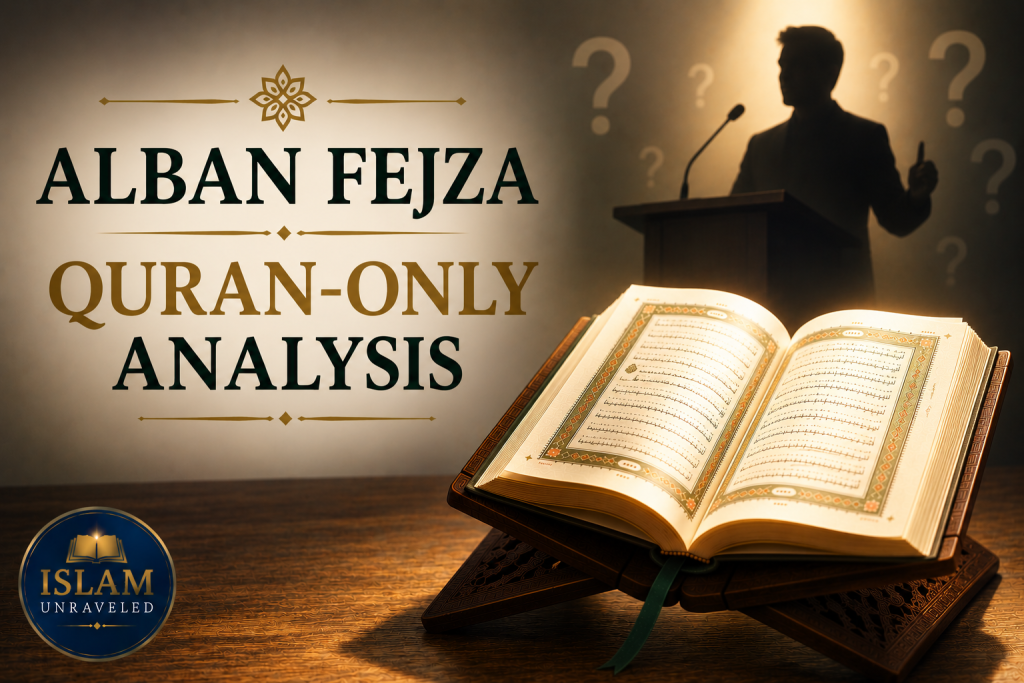
One such claimant is Alban Fejza, who maintains that he is the “Clarifying Messenger” referenced in Quran 44:13 and that his mission is to explain the Quran, reveal future events, and clarify matters that previous generations did not understand.
This article is not an examination of Alban Fejza as a person, nor does it attempt to judge his sincerity. Sincerity alone does not establish truth. The purpose of this article is simply to compare his claims with the Quran and determine whether those claims are supported by clear Quranic evidence.
The Quran repeatedly directs believers to verify religious claims through evidence rather than personalities:
“Do not accept any information, unless you verify it for yourself. I have given you the hearing, the eyesight, and the brain, and you are responsible for using them.” (17:36)
The question before us is therefore straightforward:
Does the Quran support the claims being made?
The Quranic Standard for Messengership
The burden of proof always rests upon the claimant.
Throughout history, genuine messengers were supported by evidence granted by God. The evidence was not based upon personal feelings, private experiences, or self-identification with scripture.
The Quran repeatedly teaches that God chooses His messengers:
“God knows exactly who is best qualified to deliver His message.” (6:124)
A messenger therefore requires more than conviction. He requires clear evidence from God.
The greater the claim, the greater the proof required.
Reinterpreting Rashad Khalifa
A recurring pattern among modern messenger claimants is the effort to establish legitimacy through Rashad Khalifa.
Alban Fejza frequently presents himself as the continuation of Rashad’s mission and repeatedly attempts to connect his own claims to Rashad’s work.
However, several important distinctions emerge.
Rashad Did Not Claim Self-Discovery
Alban describes Rashad as gradually becoming aware of his messengership after making certain discoveries.
Yet Rashad repeatedly stated that Gabriel informed him of his role.
The difference is significant.
One model is divine appointment.
The other is personal realization.
The Quran consistently presents messengership as a divine appointment.
Rashad Rejected Hadith Because of the Quran
Alban often presents the mathematical code as the primary reason Rashad rejected Hadith.
Historically, Rashad repeatedly cited Quranic verses regarding the completeness, perfection, and sufficiency of the Quran itself.
The mathematical proof reinforced the Quran’s authority but did not replace the Quran’s own testimony regarding itself.
The Clarifying Messenger of Quran 44:13
One of Alban Fejza’s central claims is that he is the “Clarifying Messenger” mentioned in Quran 44:13.
The passage states:
“Watch for the day when the sky brings a profound smoke.
It will envelope the people; this is a painful retribution.
‘Our Lord, relieve this retribution for us, we are believers.’ Now that it is too late, they remember! An enlightening messenger had come to them.
But they turned away from him, saying, ‘Well taught, crazy!’
We will relieve the retribution for awhile; then you will revert.
The day we strike the great stroke, we will avenge.” (44:10-16)
The sequence is noteworthy.
The smoke occurs.
The people plead.
The messenger had already come.
The messenger had already been rejected.
The punishment follows.
The messenger is mentioned in the past tense relative to the smoke.
Alban’s interpretation requires the smoke to remain in the future and requires himself to be the messenger in the passage.
Yet neither conclusion is explicitly stated in the text.
The burden therefore remains upon the claimant to demonstrate why the passage refers to him.
The Smoke and the Year 2052
Alban further claims that the smoke of Quran 44 will occur in the year 2052.
The Quran, however, never mentions:
- 2052
- Alban Fejza.
- A future smoke date.
- A future clarifying messenger.
The date is derived from a series of calculations and assumptions external to the text itself.
A useful question is:
Where does the Quran authorize the method used to derive the date?
Without a Quranic basis for the method, the conclusion remains an interpretation rather than a Quranic fact.
Who Explains the Quran? (75:17-19)
Another central claim is that Alban’s mission is described in Quran 75:19.
The passage states:
“It is we who will collect it into Quran. Then it is we who will explain it.”
The speaker throughout the passage is God.
The subject remains God.
The verse does not identify:
- Alban Fejza.
- A future messenger.
- A future clarifier.
Yet Alban repeatedly applies the verse to himself.
The Quran attributes the explanation of the Quran to God.
The verse does not explicitly attribute that role to Alban.
The Future Prediction Argument
A recurring theme throughout Alban’s writings is that his ability to identify future events proves his messengership.
This argument is often based on Quran 72:26-27.
However, the verse states that God may reveal certain unseen matters to messengers He chooses.
The verse does not teach the reverse proposition:
Whoever predicts future events is therefore a messenger.
The distinction is crucial.
A future prediction, even if correct, is not itself proof of messengership.
The claimant must first establish that he is a messenger.
The Seven Meanings Doctrine
Alban teaches that the Quran possesses seven meanings and that he is the first person to understand all seven.
The difficulty is that the Quran never explicitly teaches:
- that every verse has seven meanings,
- that a future messenger would understand all seven,
- that previous generations lacked access to those meanings.
These claims therefore require independent Quranic support.
Without such support, they remain assertions rather than established Quranic teachings.
The Quranic Initials
A substantial portion of Alban’s theology is built upon his interpretation of the Quranic initials.
According to his explanations, the initials:
- represent sectors of civilization,
- predict future crises,
- reveal future world events,
- identify future messengers.
The Quran itself never states these things.
The methodology relies heavily upon:
- symbolic assignments,
- reconstructed ancient alphabets,
- numerical calculations,
- historical assumptions.
The problem is not that such ideas are impossible.
The problem is that the Quran never presents them as the intended meaning of the initials.
The Zakat System
Perhaps the most significant practical issue concerns Alban’s teachings regarding Zakat.
His system introduces:
- mandatory reporting,
- verification requirements,
- congregation directors,
- messenger-supervised arrangements,
- consultation payments,
- additional financial categories.
The Quran certainly commands believers to give Zakat.
However, the Quran does not explicitly require:
- reporting one’s Zakat,
- obtaining approval before spending certain portions,
- participation in a messenger-centered administrative structure,
- proving community membership through a reporting system.
The distinction between Quranic obligations and administrative preferences becomes increasingly important.
Believers must be careful not to transform administrative systems into religious law.
Self-Identification Throughout Scripture
A recurring pattern in Alban’s writings is the identification of himself in numerous verses.
These include:
- 44:13.
- 75:19.
- 15:87.
- 36:3.
- Various references to future messengers.
The same pattern appears repeatedly:
The verse is first assumed to refer to Alban.
The interpretation is then built around that assumption.
The Quranic question is whether the verse naturally points to Alban or whether Alban is first inserted into the verse.
The difference is significant.
Objective Proof Versus Personal Interpretation
Perhaps the most important distinction concerns the nature of proof itself.
Rashad Khalifa pointed to an objective phenomenon: the mathematical structure of the Quran.
Whether one accepted Rashad’s conclusions or not, the underlying data existed independently of Rashad.
Alban’s arguments increasingly depend upon:
- personal interpretations,
- personal discoveries,
- personal identifications,
- personal calculations,
- personal experiences.
The center of gravity shifts from an external proof toward the claimant himself.
A proof that requires prior acceptance of the claimant in order to function is not an independent proof.
Conclusion
The primary issue is not Alban Fejza’s sincerity.
The primary issue is whether the Quran supports the claims being made.
A consistent pattern emerges throughout his writings:
Conclusions are often assumed first and verses are then interpreted around those conclusions.
The Quran repeatedly directs believers toward clear evidence, careful verification, and avoidance of speculation regarding God.
For this reason, the burden remains upon any claimant to demonstrate his claims directly from the Quran itself rather than through assumptions, symbolic systems, personal experiences, or self-identification with scripture.
As always, the final criterion remains the same:
The Quran alone.