Introduction
Among the many verses that address revelation and guidance, few have generated as much discussion as Quran 75:19 which brings up the proposition of God explains the Quran:
“Then it is We who will explain it.”
Who is the “We” in this verse?
Does the verse refer exclusively to God?
Do angels participate in the process?
Can human beings be included within the divine “We”?
And what does it mean for God to explain the Quran?
These questions are important because they touch upon the nature of revelation, the role of messengers, the function of scripture, and the source of religious understanding.
Rather than approaching the verse through historical traditions or theological assumptions, this study examines the verse in light of the Quran itself.
The goal is to allow the Quran to explain the Quran.
The Context of 75:16-19
The passage reads:
“Do not move your tongue to hasten it.
It is We who will collect it into Quran.
Once We recite it, you shall follow such a Quran.
Then it is We who will explain it.” (75:16-19)
The sequence is straightforward:
- Collection.
- Recitation.
- Explanation.
The same speaker performs all three actions.
There is no indication that the actor changes between verses 17, 18, and 19.
The natural reading is that the same “We” who collects the Quran is also the “We” who recites it and explains it.
The Meaning of Bayan
The Arabic word translated as “explain” in 75:19 is:
بَيَانَهُ (bayānahu)
It comes from the root:
ب ي ن (B-Y-N)
The root carries meanings such as:
- to make clear,
- to clarify,
- to distinguish,
- to make evident,
- to explain,
- to manifest.
Related Quranic words include:
- bayan (clarification),
- yubayyinu (He explains),
- mubin (clear, manifest, clarifying).
Thus the verse literally means:
“Then it is We who will provide its clarification.”
The verse attributes the clarification of the Quran to the same speaker who collected and recited it.
The First Teacher of the Quran
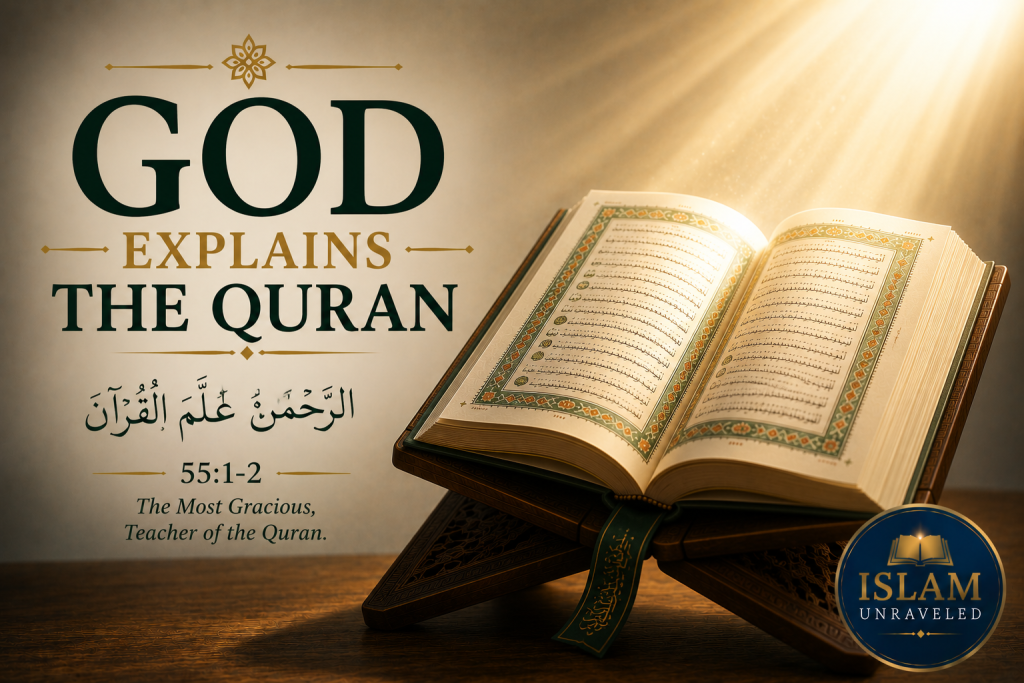
Perhaps the clearest statement in the Quran regarding the source of understanding appears in Surah 55:
“The Most Gracious.
Teacher of the Quran.
Creator of the human being.
Taught him how to distinguish.” (55:1-4)
The order is remarkable.
Before mentioning the creation of the human being, God identifies Himself as:
“Teacher of the Quran.”
The Quran therefore establishes a foundational principle:
The ultimate teacher of the Quran is God.
All human understanding begins with this reality.
God Repeatedly Explains the Revelations
The Quran consistently attributes explanation to God.
For example:
“Thus God explains His revelations for the people.” (2:187)
“God thus explains His revelations for you, that you may understand.” (2:242)
“We thus clarify the revelations for you.” (3:118)
“We thus explain the revelations.” (6:55)
“He explains the revelations for people who know.” (10:5)
“We thus explain the revelations for people who reflect.” (10:24)
The pattern is unmistakable.
Again and again, the Quran attributes the explanation of revelation to God.
The Quran never presents explanation as originating independently from human beings.
God Fully Detailed the Scripture
The Quran repeatedly describes itself as fully detailed.
“Shall I seek other than God as a source of law, when He has revealed to you this book fully detailed?” (6:114)
“We have given them a scripture that we detailed with knowledge.” (7:52)
“A scripture whose verses have been perfected, then detailed.” (11:1)
These verses reinforce the idea that explanation and detailing originate with God.
The Quran is not presented as an incomplete revelation waiting for completion by future interpreters.
The Role of the Messenger
The Quran repeatedly defines the role of God’s messengers.
Among their responsibilities are:
Recitation
“A messenger from among them who recites Your revelations to them.” (2:129)
Teaching
“He teaches them the scripture and wisdom.” (2:129)
Purification
“He purifies them.” (3:164)
Delivery
“The sole duty of the messenger is delivery.” (5:99)
These functions are explicitly stated.
The Quran repeatedly describes the messenger as one who recites, teaches, purifies, and delivers.
The Quran never explicitly describes the messenger as the ultimate source of the Quran’s explanation.
That role is consistently attributed to God.
How Does God Communicate Knowledge?
The Quran provides an important framework in 42:51:
“No human being can communicate with God except through inspiration, or from behind a barrier, or through sending a messenger through whom He reveals what He wills.”
This verse identifies three methods through which God communicates:
- Inspiration.
- From behind a barrier.
- Through a messenger carrying revelation.
All three methods originate with God.
The source remains divine even when intermediaries are involved.
The Role of Gabriel in Revelation
The Quran specifically identifies Gabriel as the bearer of revelation.
“Say, ‘Anyone who opposes Gabriel should know that he has brought it down to your heart, in accordance with God’s will.'” (2:97)
“The Holy Spirit has brought it down from your Lord.” (16:102)
“The trustworthy Spirit came down with it.” (26:193)
Gabriel participates in delivering revelation.
Yet the revelation remains God’s revelation.
The existence of an intermediary does not alter the ultimate source.
Understanding the Divine “We”
Throughout the Quran, God refers to Himself using:
- “I”
- “He”
- “We”
For example, when speaking directly to Moses:
“Indeed, I am your Lord.” (20:12)
“Indeed, I am God; there is no god except Me.” (20:14)
Elsewhere the Quran uses:
“We created.”
“We revealed.”
“We explained.”
The Quran therefore moves freely between singular and plural forms while referring to the same divine authority.
When Does “We” Include Angelic Participation?
Several Quranic examples suggest that angels may participate in actions ultimately attributed to God.
Examples include:
- delivery of revelation,
- taking of souls,
- recording deeds,
- carrying out divine commands.
In every case:
God remains the ultimate actor.
The angels act only by His permission and authority.
The action remains attributed to God.
41:9-12 and the Relationship Between “He” and “We”
An important example appears in Surah 41.
The passage repeatedly says:
“He created…”
“He placed…”
“He completed…”
Yet the same passage later states:
“We adorned the lowest universe with lamps.” (41:12)
The narrative moves between singular and plural references while describing a single divine process.
The shift does not indicate multiple gods.
Rather, it demonstrates that the Quran can attribute actions to God while acknowledging the participation of His authorized agents.
Applying These Principles to 75:17-19
Returning to 75:17-19:
“It is We who will collect it into Quran.”
“Once We recite it.”
“Then it is We who will explain it.”
Gabriel’s participation in revelation and recitation is well established elsewhere in the Quran.
Thus angelic participation within this process is entirely possible.
However, whether angels participate or not, the action remains attributed to God.
The subject throughout the passage remains unchanged.
The explanation belongs to God.
Does Human Participation Create Divine Partnership?
One objection sometimes raised concerns the historical preservation of the Quran.
The argument is often presented as follows:
- Human beings participated in preserving and transmitting the Quran.
- Therefore humans must be included within the divine “We.”
The conclusion does not follow from the premise.
Human participation in a process does not make human beings part of God’s “We.”
Consider the preservation of the Quran.
Believers memorized it.
Scribes copied it.
Teachers transmitted it.
Students learned it.
Yet the Quran still says:
“Absolutely, We have revealed the Reminder, and absolutely, We will preserve it.” (15:9)
The preservation remains attributed to God.
Human participation does not transform human beings into part of the divine speaker.
They remain servants carrying out functions permitted by God.
The same principle applies to 75:17.
Even if God employed means in collecting and preserving the Quran, the collection remains attributed to Him.
Does the Divine “We” Include Human Beings?
The Quran repeatedly presents angels as carrying out God’s commands.
However, the Quran never explicitly includes human beings within God’s “We.”
No verse states that prophets, messengers, scholars, teachers, or believers become part of the divine plural.
This is an important distinction.
The Quran provides evidence for angelic participation in certain divine actions.
It does not provide evidence for human inclusion within God’s “We.”
How Does God Explain the Quran Today?
The Quran suggests several ways through which God continues to explain His revelation.
Through the Quran Itself
Verses clarify other verses.
The Quran functions as its own interpreter.
Through Reflection
“Do they not reflect upon the Quran?” (4:82)
Through Fulfillment
As events unfold, meanings become clearer.
Through Inspiration
God continues to guide sincere believers according to His will.
Through His Signs
Both scripture and creation point toward deeper understanding.
In every case, the source remains God.
The Relationship Between Divine Teaching and Human Learning
Teachers teach.
Students learn.
Scholars study.
Believers reflect.
Messengers recite and teach.
Yet all genuine understanding ultimately originates with God.
The Quran never denies the existence of human teaching.
Rather, it places human teaching beneath divine teaching.
Every true insight is a gift from God.
Every correct understanding originates with Him.
Conclusion
The Quran repeatedly attributes the explanation of revelation to God.
“The Most Gracious. Teacher of the Quran.”
“Then it is We who will explain it.”
“God thus explains His revelations.”
The Quran also demonstrates that God may employ angels and other means in carrying out His purposes.
Yet the source of revelation, preservation, and explanation remains God.
The simplest reading of 75:19 is therefore also the most consistent with the rest of the Quran:
“Then it is We who will explain it.”
God explains His revelation.
He may teach through revelation, signs, reflection, inspiration, and the unfolding of history, but the explanation remains His.