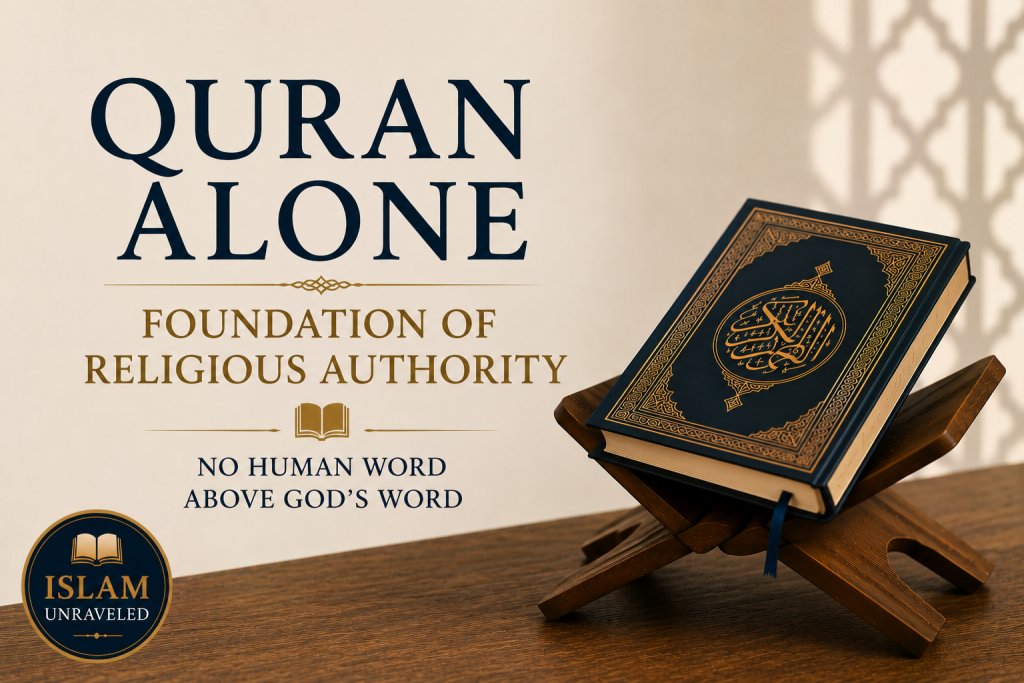
The Quran alone is God’s final revelation to humanity—complete, fully detailed, and sufficient for religious guidance. It presents itself as the sole authority for belief, law, and practice. Yet, over time, additional sources such as Hadith and inherited traditions have been elevated alongside it, often shaping religion in ways not authorized by God.
This article examines the Quran’s own claims about its authority, the role of Abraham in establishing religious duties, and the correct approach to practicing Islam based solely on the Quran.
The Quran as the Sole Source of Religious Law
The Quran explicitly establishes itself as the only legitimate source of religious law:
“Shall I seek other than God as a source of law, when He has revealed to you this Book fully detailed?” (6:114)
This verse leaves no room for secondary authorities. Seeking religious rulings from sources outside the Quran contradicts God’s declaration that the Book is fully detailed.
God further confirms:
“The word of your Lord is complete, in truth and justice. Nothing shall abrogate His words.” (6:115)
The Quran is also described as:
“An explanation of everything” (16:89)
“Guiding to what is most upright” (17:9)
Together, these verses establish that the Quran alone provides complete guidance for the religion.
The Quran Is Fully Detailed — What That Means
The Quran’s completeness applies to religious law, guidance, and principles, not to mechanical or procedural details of rituals.
This distinction is essential.
The Quran provides:
- Beliefs and core doctrines
- Moral and ethical laws
- Commands and prohibitions
- Corrections of distortions
However, it does not function as a step-by-step manual for ritual procedures. This is not a deficiency, but part of a deliberate design tied to the historical continuity of religion.
The Religion of Abraham and Preserved Religious Duties
The Quran repeatedly identifies Islam as the continuation of the religion of Abraham:
“Follow the religion of Abraham, monotheism; he was not an idol worshiper.” (16:123)
Abraham was entrusted with the foundational rites of worship:
“Show us our rites.” (2:128)
“Proclaim the pilgrimage to the people.” (22:27)
The Quran further states:
“The religion of your father Abraham; He named you Muslims before.” (22:78)
Thus, core religious duties—Salat (prayer), Zakat (charity), Sawm (fasting), and Hajj (pilgrimage)—were established through Abraham and preserved through generations.
The Quran came not to introduce new rituals, but to:
- confirm existing practices
- correct distortions
- provide final, universal guidance
For example, ablution is clarified:
“O you who believe, when you rise to observe the prayer, wash your faces and your arms…” (5:6)
This shows correction and refinement—not invention.
The Error of Rejecting Religious Duties
A common misunderstanding arises when individuals conclude that because the Quran does not detail ritual procedures, those practices should be abandoned.
This is a serious error.
The Quran consistently commands the observance of religious duties:
“Establish the prayer and give the zakat.” (2:43)
“Fasting is decreed upon you…” (2:183)
Rejecting these obligations contradicts clear Quranic commands.
At the same time, redefining these duties into abstract or symbolic meanings—such as reducing prayer to meditation or fasting to general restraint—also distorts the religion.
The Quran warns against extremes:
“Do not follow the steps of Satan.” (2:208)
“Do not go to excess in your religion.” (4:171)
True submission lies in upholding the duties as commanded, while ensuring they remain free from distortion.
Hadith and Unauthorized Religious Sources
The Quran explicitly questions reliance on any source other than itself:
“Which hadith other than this do they believe in?” (45:6)
“In which hadith after this will they believe?” (77:50)
These statements challenge the authority of external religious narratives.
While Hadith literature emerged generations after the Prophet, the Quran never authorizes it as a source of law. Instead, it warns against following conjecture and inherited assumptions:
“They follow nothing but conjecture and personal desire.” (53:23)
Religious authority must therefore remain grounded in the Quran alone.
The Quran’s Method: Reflection, Context, and Understanding
The Quran calls upon believers to engage with it thoughtfully:
“Do they not study the Quran carefully? If it were from other than God, they would have found in it many contradictions.” (4:82)
Understanding the Quran requires:
- contextual reading
- reflection across verses
- use of reason and intellect
Language in the Quran is dynamic, and meanings must be derived from context—not rigid or artificial interpretations.
The Way Forward: Returning to Pure Submission
The Quran calls humanity to a straight and unified path:
“This is My path—a straight one. You shall follow it and do not follow other paths.” (6:153)
Returning to the Quran alone requires:
- recognizing it as the sole source of religious authority
- rejecting unauthorized additions
- upholding the religious duties established through Abraham
- avoiding extremes and distortions
God declares:
“Today I have completed your religion for you, perfected My blessing upon you, and chosen submission (Islam) as your religion.” (5:3)
Submission to God is fulfilled through submission to His revealed Book.