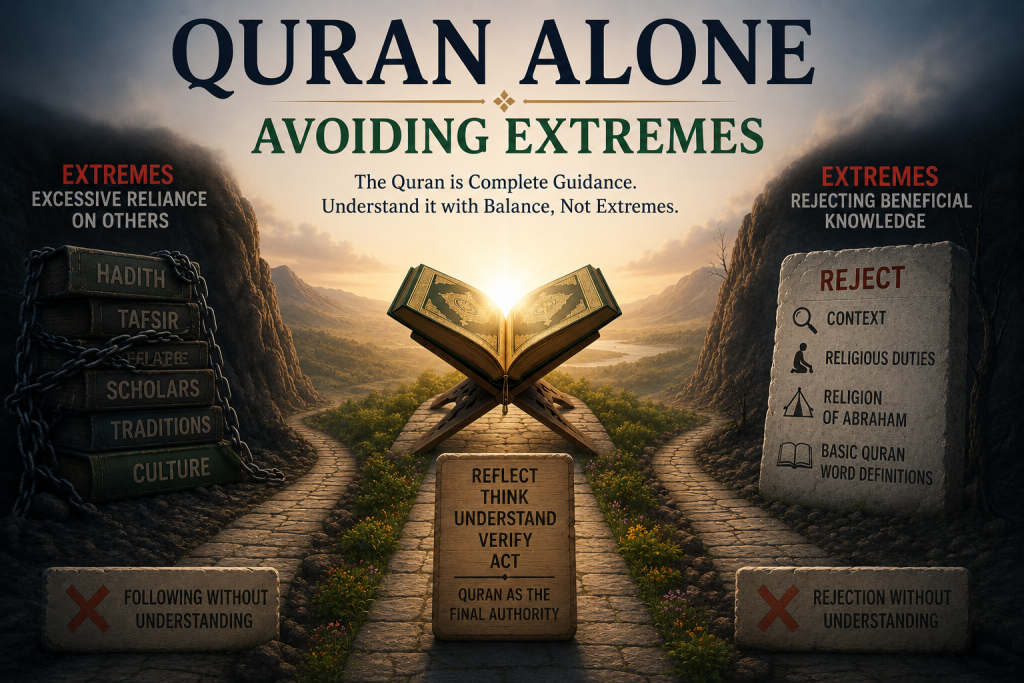
Choosing the Quran alone as the sole source of religious authority is a decisive and serious commitment. It requires not only rejecting unauthorized sources, but also correctly understanding and upholding what the Quran itself commands.
A common error arises when individuals, in rejecting external sources, go to the opposite extreme and begin to question or abandon clearly established religious duties. This reaction does not align with the Quran’s guidance.
This article addresses the importance of avoiding extremes and maintaining the balance required for true submission to God.
The Quran Alone Is a Commitment to Obedience
Accepting the Quran alone is not merely an intellectual position, it is a commitment to obey God’s commands as revealed in the Book.
The Quran repeatedly instructs believers:
“Obey God and obey the messenger…” (4:59)
Obedience to the messenger is obedience to the message he delivered, the Quran. Therefore, choosing the Quran alone requires adherence to its directives, not selective acceptance.
Submission (Islam) means aligning one’s beliefs and actions with what God has revealed, without addition or omission.
The Danger of Reactionary Extremes
When individuals leave behind inherited traditions, there is a risk of swinging to the opposite extreme.
Instead of correcting distortions, some begin to:
- reject established practices
- reinterpret clear commands metaphorically
- dismiss religious duties altogether
The Quran warns against such tendencies:
“Do not go to extremes in your religion…” (4:171)
“And do not follow the steps of Satan…” (2:208)
Satan’s strategy is not only to introduce falsehood, but also to push people away from truth through imbalance.
Religious Duties Are Clearly Commanded
The Quran explicitly commands the core religious duties:
“Establish the prayer and give the zakat…” (2:43)
“O you who believe, fasting is decreed upon you…” (2:183)
“Hajj shall be observed in the specified months…” (2:197)
These commands are clear and repeated. They are not symbolic suggestions, nor are they optional.
Rejecting these duties contradicts the Quran itself.
Distortion Through Redefinition
Another form of deviation is redefining religious duties into abstract concepts.
Examples include:
- interpreting Salat as mere reflection or connection
- redefining fasting as general self-restraint
- treating zakat as voluntary charity only
Such interpretations remove the practical dimension of worship and contradict the Quran’s consistent commands.
The Quran presents these duties as observable, structured acts, not vague or purely internal states.
The Balanced Path of Submission
True submission lies between two extremes:
- Blindly following inherited traditions without verification
- Rejecting or redefining what the Quran clearly commands
The Quran calls believers to a balanced path:
“This is My path, a straight one. You shall follow it…” (6:153)
This path requires:
- accepting the Quran as the sole authority
- maintaining the religious duties it commands
- avoiding additions and distortions
The Role of Abrahamic Transmission
The Quran identifies Islam as the continuation of the religion of Abraham:
“Follow the religion of Abraham…” (16:123)
The practices of worship were established through Abraham and preserved through generations.
The Quran confirms and corrects these practices but does not discard them.
Thus, the absence of procedural detail in the Quran does not negate the existence or obligation of these duties.
Conclusion
Choosing the Quran alone is not a path of reduction, but a path of clarity and discipline.
It requires rejecting unauthorized sources while fully upholding what God has commanded.
Abandoning religious duties or redefining them leads away from submission, not toward it.
True adherence to the Quran is demonstrated through:
- obedience to its commands
- consistency in practice
- avoidance of extremes
In this balance lies the straight path that leads to peace and acceptance with God.