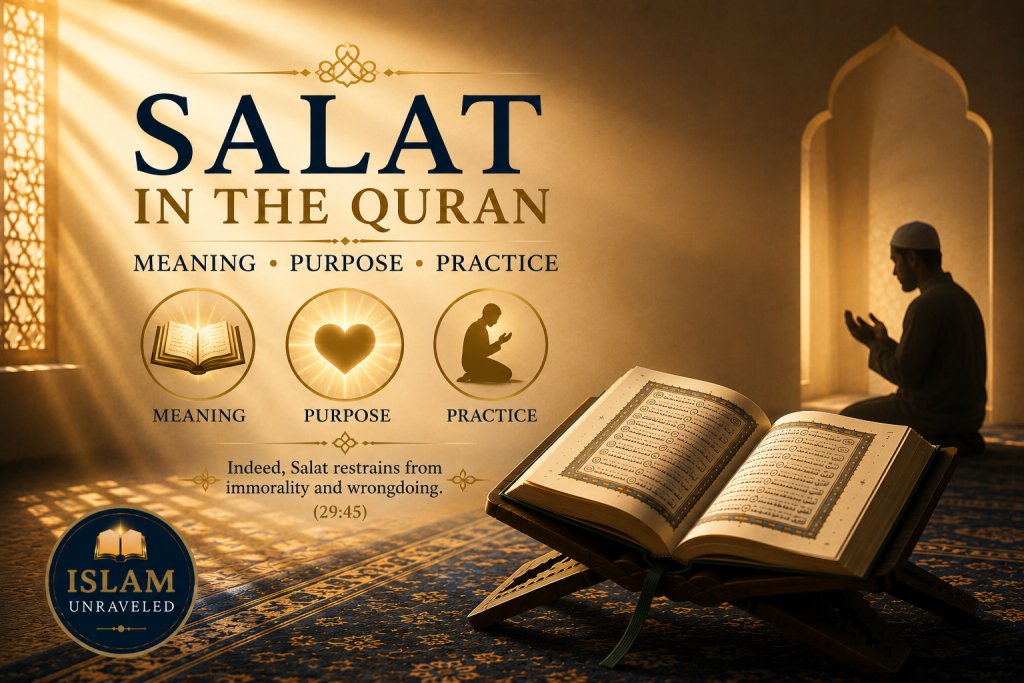
One of the central religious duties (الصلاة) Salat in the Quran, consistently commanded for all believers and practiced by all prophets. While commonly translated as “prayer,” the Quranic concept of Salat encompasses more than supplication, it represents a structured act of worship, a connection with God, and a defining characteristic of submission.
A key question arises: if the Quran is fully detailed, why does it not provide step-by-step instructions for performing Salat? This article examines the meaning of Salat, its origin in the religion of Abraham, its preservation across generations, and the Quran’s role in confirming and correcting this essential practice.
The Meaning of Salat in the Quran
The word Salat in the Quran carries a range of meanings, including:
- supplication
- connection with God
- a formal act of worship
While Salat includes the concept of devotion and remembrance, the Quran consistently presents it as a specific, observable practice, not merely an internal or symbolic state.
This distinction is important. Reducing Salat to a purely mental or abstract concept contradicts the way the Quran commands and describes it.
Salat as a Mandatory Religious Duty
The Quran makes it clear that Salat is not optional:
“This is the book… those who believe in the unseen, observe the Salat…” (2:2–3)
“You shall observe the Salat and give the obligatory charity…” (2:43)
Salat is consistently paired with other obligatory acts such as Zakat, fasting, and Hajj. These duties define submission and are required of all believers.
The Religion of Abraham and the Origin of Salat
The Quran identifies Islam as the continuation of the religion of Abraham:
“Follow the religion of Abraham…” (16:123)
Abraham was not only a monotheist but was also entrusted with establishing religious practices:
“We taught them how to observe the Salat and the obligatory charity…” (21:73)
“My Lord, make me one who observes the Salat…” (14:40)
This demonstrates that Salat did not originate with Prophet Muhammad but was established much earlier as part of Abraham’s religious system.
Continuity Across the Prophets
The same religious duties were upheld by all prophets after Abraham:
- Moses and Aaron (10:87) were commanded to observe Salat
- Jesus (19:31) was enjoined to observe Salat and give charity
- Ismail (19:55) instructed his family to observe Salat
This continuity shows that Salat is a universal practice of submission, not a later innovation.
Transmission Across Generations
The Quran indicates that these practices were passed down through generations:
“They were succeeded by generations who lost the Salat…” (19:59)
This verse confirms two realities:
- Salat existed and was known
- People later neglected or corrupted it
Thus, religious duties were preserved but required correction.
Salat Existed Before Prophet Muhammad
The Quran declares:
“Shall I seek other than God as a source of law, when He has revealed to you this Book fully detailed?” (6:114)
The Quran is fully detailed for:
- law
- guidance
- principles
However, it does not provide procedural details for rituals such as Salat.
This is not a deficiency. It reflects the fact that these practices were already known through the Abrahamic tradition.
The Quran Corrects Corruptions in Practice
The Quran does not introduce new rituals—it corrects distortions.
Examples include:
Ablution
“Wash your faces and your arms… wipe your heads, and wash your feet…” (5:6)
Tone in prayer
“Do not utter your Salat too loudly, nor secretly…” (17:110)
Pure monotheism
“The places of worship belong to God…” (72:18)
These corrections ensure that Salat remains aligned with pure monotheistic worship.
Distortion Through Redefinition
A major modern deviation is redefining Salat into abstract meanings such as:
- general remembrance
- meditation
- spiritual awareness
While remembrance is part of Salat, the Quran clearly describes Salat as an established act:
“Observe the Salat…”
Repeated commands confirm that Salat is a structured practice, not merely a concept.
The Question of Hadith and Ritual Details
The Quran challenges reliance on any hadith other than itself:
“Which hadith after this will they believe?” (77:50)
“Which hadith other than this do they uphold?” (45:6)
At the same time, no external source provides a complete, universally consistent method of Salat.
The preservation of Salat does not depend on hadith literature, but on:
- continuity across generations
- universal practice among believers
- correction by the Quran
The Preservation of Salat
God declares:
“We have revealed the reminder, and we will preserve it.” (15:9)
This preservation includes:
- Scripture (the Quran)
- Practice (religious duties)
Salat has been preserved through:
- transmission from Abraham
- continuity across prophets
- widespread and consistent practice among believers
This universal consistency reflects divine preservation.
The Balanced Understanding of Salat
A correct Quran-based understanding avoids two extremes:
Extreme 1
Blind adherence to inherited traditions without verification
Extreme 2
Rejecting or redefining Salat due to lack of procedural detail
The correct path is:
- accept the Quran as sole authority
- uphold Salat as commanded
- recognize its Abrahamic origin
- avoid distortion or reduction
Conclusion
Salat is a divinely established practice rooted in the religion of Abraham and upheld by all prophets. The Quran confirms its obligation, corrects distortions, and preserves its purpose without reducing it to mere symbolism or overburdening it with unnecessary detail.
True submission requires:
- observing Salat as commanded
- maintaining its physical and structured nature
- preserving its purity and purpose
Through Salat, believers maintain a direct and continuous connection with God, following the same path established for generations of submitters before them.