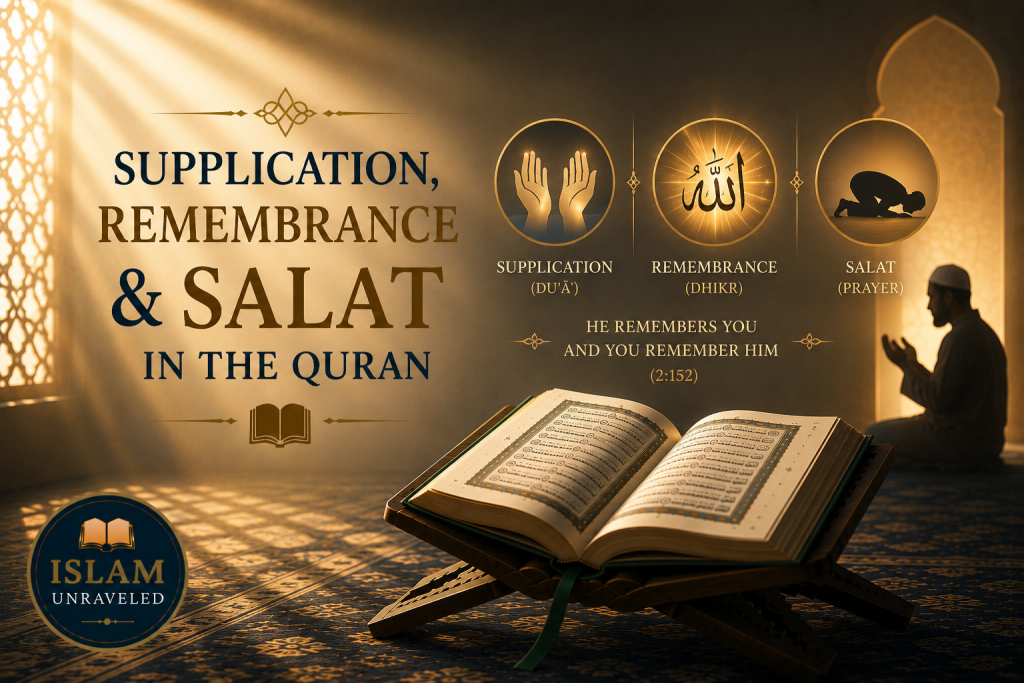
The Quran uses multiple terms related to worship and connection with God, including duʿāʾ (supplication), ṣalāt in the Quran (contact prayer), and dhikr (remembrance). While these concepts are related, they are not interchangeable.
Understanding the distinctions between them is essential for correctly interpreting the Quran and avoiding the common error of reducing Salat to a general concept of remembrance or supplication.
Duʿāʾ (Supplication)
Duʿāʾ refers to calling upon God directly. It is a personal and informal act of worship in which a person expresses needs, seeks help, or communicates with God.
The Quran states:
“When My servants ask you about Me, I am always near. I answer their prayers when they pray to Me…” (2:186)
“Your Lord says, ‘Implore Me and I will respond to you…’” (40:60)
Duʿāʾ is:
- personal and spontaneous
- not restricted to specific times
- not tied to a formal structure
It can occur at any time—while standing, sitting, or lying down.
Salat (Contact Prayer)
Salat in the Quran is a formal, structured act of worship that is observed at specific times.
The Quran commands:
“You shall observe the Contact Prayers at both ends of the day and during the night…” (11:114)
“Observing the Contact Prayers is decreed for the believers at specific times.” (4:103)
Salat is:
- formal and structured
- performed at prescribed times
- obligatory for believers
It includes physical actions and recitations, distinguishing it from general remembrance or supplication.
Dhikr (Remembrance)
Dhikr refers to remembering and mentioning God. It can be verbal or internal and may occur during Salat or independently.
The Quran states:
“By the remembrance of God, the hearts are comforted.” (13:28)
“You shall remember Me, that I may remember you…” (2:152)
Dhikr is:
- continuous
- flexible in form
- both internal and verbal
It is not restricted to a ritual format and can occur at any time.
Key Distinctions Between the Three
These three concepts serve different roles:
Duʿāʾ
- Supplication and personal invocation
- Informal and unrestricted
Salat
- Formal contact prayer
- Structured and time-bound
- Obligatory
Dhikr
- Remembrance of God
- Continuous and flexible
While they overlap in purpose—connecting the believer with God—they are not interchangeable.
The Error of Conflating Salat with Dhikr or Duʿāʾ
A common misunderstanding is to interpret Salat as merely remembrance or supplication.
This leads to conclusions such as:
- Salat is only meditation
- Salat is simply remembering God
- Salat has no physical structure
These interpretations contradict the Quran’s consistent commands to:
“Observe the Salat…”
The Quran clearly distinguishes between structured prayer and general remembrance.
The Unique Qur’anic Usage of Ṣalāt
The Quran uses a distinctive form of the word ṣalāt (صلاة), which differs from other derivatives of the same root.
Other forms such as:
- yuṣallūna
- ṣalli
carry meanings like invoking blessings or support.
However, the specific form ṣalāt is consistently used to refer to the formal religious duty.
This distinction reinforces that Salat is not a general concept but a defined act of worship.
The Significance of Qur’anic Spelling
The Qur’anic spelling of ṣalāt is unique and consistent. It does not fully conform to expected Arabic morphological patterns, which indicates a deliberate distinction.
This special orthography serves to:
- identify ṣalāt as a specific religious duty
- differentiate it from general meanings of the root
- preserve its role as an institutionalized act of worship
This demonstrates that the Quran treats ṣalāt as a clearly defined practice, not an abstract concept.
The Balanced Understanding
A correct understanding of worship in the Quran recognizes that:
- Duʿāʾ is personal and informal
- Dhikr is continuous remembrance
- Salat is structured and obligatory
Each has its place. This balance reflects the principle discussed in “Quran Alone: Avoiding Extremes and Upholding Religious Duties.”
Reducing Salat to duʿāʾ or dhikr removes its defined role and contradicts the Quran’s commands.
Conclusion
The Quran presents a comprehensive system of worship in which supplication, remembrance, and structured prayer all play distinct roles.
Salat stands as a formal, time-bound act of worship that cannot be reduced to general remembrance or personal supplication.
Understanding these distinctions is essential for maintaining the integrity of Quranic guidance and avoiding reinterpretations that depart from the text.