Introduction
The command to “obey the messenger” appears repeatedly in the Quran and is often interpreted as obedience to sources outside the Quran. However, when examined carefully within the Quran itself, a clear and consistent understanding emerges:
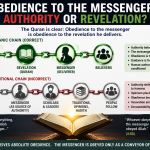
Obeying the messenger means obeying the message he delivered—the Quran.
The Quran establishes that:
- God alone is the source, teacher, and explainer of revelation
- The messenger’s role is to deliver, not to legislate or interpret independently
- Obedience to the messenger is inseparable from obedience to God’s revelation
God Is the Source, Teacher, and Explainer of the Quran
The Quran attributes not only revelation, but also its explanation and teaching, to God alone:
“The Most Gracious. Teacher of the Quran.” (55:1–2)
“Then it is upon Us to explain it.” (75:19)
“A Book whose verses are perfected, then detailed from One who is Wise, Cognizant.” (11:1)
“A scripture whose verses are detailed…” (41:3)
“We have explained the scripture in detail, with knowledge, as guidance and mercy…” (7:52)
These verses establish:
- The Quran is self-explanatory by divine design
- Its explanation is God’s responsibility, not a human function
The messenger does not possess independent authority to explain or add to revelation.
The Messenger’s Role: Delivery, Not Legislation
The Quran repeatedly defines the messenger’s duty:
“The sole duty of the messenger is to deliver the message.” (multiple verses: 16:35, 16:82, 24:54, 29:18, 42:48)
“O messenger, deliver what has been revealed to you from your Lord…” (5:67)
“The messenger’s duty is only to deliver.” (5:99)
This establishes a fundamental boundary:
- The messenger delivers revelation
- He does not create religious law outside it
- He does not act as an independent source of guidance
Even the messenger himself is commanded:
“I only follow what is revealed to me.” (10:15)
“Say: I am not different from other messengers, nor do I know what will happen to me or to you. I only follow what is revealed to me.” (46:9)
Understanding “Obey God and Obey the Messenger”
The Quran frequently states:
“Obey God and obey the messenger…”
This phrase must be understood within the Quran’s own framework.
Another verse clarifies the relationship:
“Whoever obeys the messenger is obeying God.” (4:80)
This shows:
- The messenger does not introduce a separate authority
- Obeying him is identical to obeying God, because he conveys God’s words
Thus:
- Obeying God is obeying revelation
- Obeying the messenger is obeying the same revelation he delivered
There are not two sources—there is one source, conveyed through the messenger.
Context: Obedience During the Messenger’s Lifetime
Some verses commanding obedience relate to practical, community-based situations during the messenger’s life:
“Obey God, and obey the messenger, and those in authority among you…” (4:59)
“O you who believe, obey God and His messenger, and do not turn away…” (8:20)
“Obey God and His messenger, and do not dispute…” (8:46)
These verses involve:
- Community order
- Conflict resolution
- Collective discipline
In these contexts:
- The messenger functioned as a leader and arbiter
- Obedience ensured unity and stability
However, this authority was:
- Operational and situational, not legislative beyond revelation
After the Messenger: What Remains to Be Obeyed?
After the messenger’s death, what remains is what he delivered:
“We have sent down to you a Book containing your message. Do you not understand?” (21:10)
The Quran confirms:
- The message is complete
- The mission is fulfilled
Thus, “obey the messenger” after his lifetime can only mean:
obey the message he conveyed—the Quran
To claim obedience through other sources introduces a contradiction with the Quran’s own statements.
The Quran Rejects Other “Hadith” as Authority
The Quran explicitly warns against accepting other religious authorities:
“In which hadith other than God and His revelations do they believe?” (45:6)
“Which hadith other than this do they uphold?” (77:50)
This makes it clear:
- No secondary source is authorized alongside the Quran
- Religious authority belongs to God’s revelation alone
The Quran’s Self-Sufficiency
The Quran describes itself as:
- Fully detailed (6:114)
- Perfected and complete (6:115)
- Explained by God (75:19)
- Guidance and mercy (7:52)
This leaves no gap requiring external supplementation.
The messenger’s example was:
- To follow the Quran
- To submit to God’s revelation
“My prayer, my worship, my life and my death are all devoted to God…” (6:162)
A Consistent Quranic Principle
Across the Quran, one consistent principle emerges:
- God is the only lawgiver
- The Quran is the only authorized source of guidance
- The messenger is the conveyor of that guidance
Thus, obedience is unified:
- Not divided between multiple authorities
- Not extended to later reports or traditions
Conclusion
The Quranic command to “obey the messenger” is often misunderstood when detached from the Quran’s own explanations.
Within the Quran’s framework:
- The messenger does not speak independently in religion
- His role is to deliver God’s revelation
- Obedience to him is obedience to that revelation
Therefore:
To obey the messenger today is to obey the Quran.
There is no separate body of teachings, no secondary authority, and no parallel source of religious law.
“Whoever obeys the messenger is obeying God.” (4:80)
The messenger’s voice is the voice of revelation—the Quran—through which God continues to guide humanity.