The Quran: How Guidance Works
Introduction
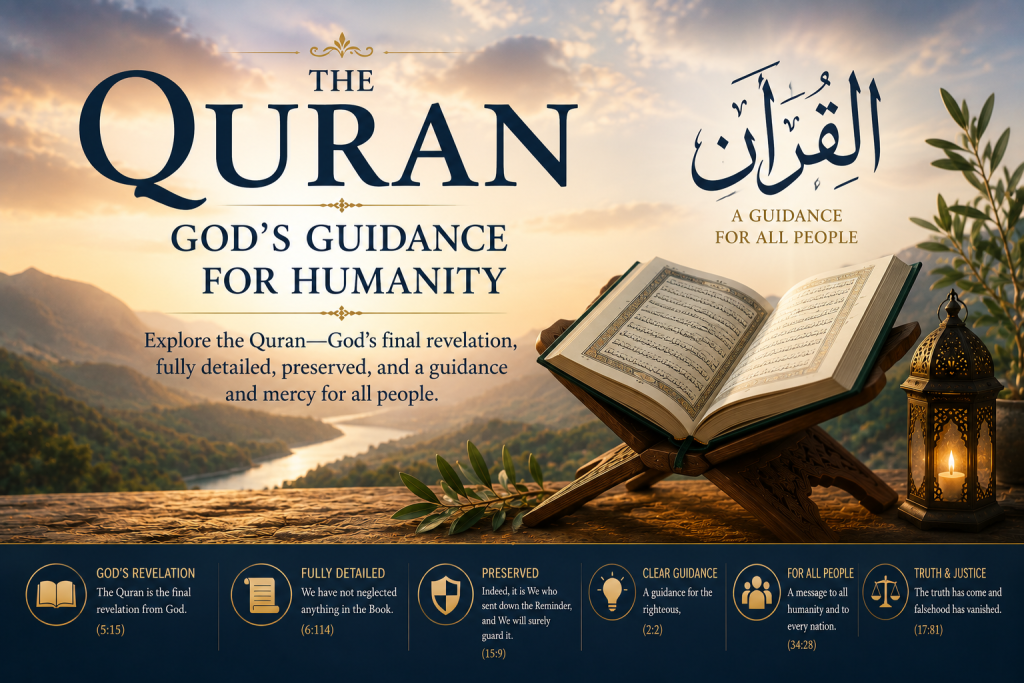
The Quran presents itself as revelation from God – a guidance, reminder, warning, and criterion for humanity.
It does not ask people to surrender their ability to think. It repeatedly calls upon them to reflect, observe, compare, reason, and take responsibility for how they respond to God’s words.
God declares that He teaches the Quran, and that its explanation ultimately rests with Him. The Quran therefore occupies a unique position: it is not merely a book to be interpreted through religious authorities, inherited traditions, or external systems. It is revelation meant to be read, examined, and understood through the guidance God provides within it.
This page is the gateway to IslamUnraveled’s study of the Quran – what the Quran says about itself, how it should be approached, how it has been transmitted, and where its authority and proof ultimately reside.
Begin Here
If you are new to the Quran, two places provide a natural beginning.
The Opening Chapter of the Quran
The Quran begins with only seven verses, yet they introduce many of its foundational themes: God, grace, mercy, judgment, worship, dependence upon God, guidance, and the straight path.
Read: The Opening Chapter of the Quran
Read the Quran
If you prefer to begin directly with the text, visit the Quran Reading Hub and explore the Quran surah by surah.
How the Quran Functions as Guidance
The Quran does not introduce itself as commentary, theology, biography, or a collection of human religious opinions.
It presents itself as revelation from God, sent down to guide, warn, remind, and distinguish truth from falsehood.
Its guidance unfolds through:
- clear commands and prohibitions,
- recurring themes,
- examples from earlier communities,
- accounts of God’s messengers,
- comparison and contrast,
- internal explanation,
- signs and evidence,
- and repeated reminders of human accountability.
The Quran repeatedly calls readers to think, reflect, and consider what they are reading.
Guidance therefore involves more than receiving information.
It requires a response.
Complete Guidance Without Unnecessary Burden
The Quran presents God’s revelation as complete for religious guidance and law, defining what God requires and what He forbids.
Completeness, however, does not mean that the Quran functions as an exhaustive procedural manual for every action in human life.
Where religious practices already existed – particularly those associated with Abraham – the Quran confirms what remains valid, corrects corruption where necessary, and establishes the purpose, limits, and accountability surrounding those practices.
God determines religious obligation.
Human beings are not authorized to create additional religious laws and attribute them to Him.
Reading the Quran on Its Own Terms
The Quran should be approached as a complete and internally connected revelation.
A verse should not be isolated from its immediate context or from other passages addressing the same subject.
The Quran distinguishes between clear and allegorical verses and warns against pursuing ambiguity in order to create division or predetermined conclusions.
Understanding therefore requires readers to:
Read the verses.
Consider their context.
Compare related passages.
Recognize recurring themes.
Distinguish clear statements from allegorical ones.
Allow the Quran to explain the Quran.
This approach does not eliminate thought or interpretation. It establishes the Quran itself as the controlling framework within which interpretation takes place.
Language, Preservation, and Access
The Quran was revealed in Arabic to an Arabic-speaking messenger and his immediate audience.
Language therefore matters.
Words have meanings, roots, grammatical relationships, and contexts that can help clarify a passage. At the same time, knowledge of Arabic does not give any individual exclusive authority over God’s revelation.
Translations make the Quran accessible across languages, while examination of Arabic vocabulary and context can help resolve questions where translations differ.
The Quran also attributes its preservation ultimately to God rather than to any human institution.
Preservation ensures that the revelation remains available.
Understanding requires that people engage with it.
Authority Without Mediation
The Quran assigns ultimate religious authority to God.
Messengers deliver God’s revelation. Human beings read it, discuss it, study it, translate it, and seek to understand it.
But no scholar, clergy, institution, tradition, or religious community becomes a second source of divine law.
This distinction is fundamental.
Human knowledge can help us understand history, language, context, and the world in which revelation was delivered.
But human knowledge does not become revelation.
The Quran remains the criterion against which religious claims are measured.
Explore the Quran
The studies in this section are organized into four areas. Together they provide a structured way to examine what the Quran says about itself and how its guidance is understood.
1. The Quran Itself
What does the Quran say about its own purpose and authority?
Begin by examining how the Quran describes itself – as revelation, guidance, clarification, criterion, and the source through which God communicates His religious requirements.
2. Reading & Understanding
How should the Quran be approached?
The Quran has structure, recurring themes, clear and allegorical passages, deliberate repetition, and internal relationships between verses and surahs.
These studies examine how those features help readers understand the revelation as a coherent whole rather than as disconnected individual statements.
3. Transmission & Language
How did the Quran reach us, and what role does language play in understanding it?
The Quran was revealed in Arabic and has been transmitted across generations and languages.
These studies examine preservation, Arabic vocabulary, Quranic roots, context, and the distinction between translating God’s words and interpreting their meaning.
Translation versus Interpretation
4. Authorization & Proof
Where does the Quran locate the proof of its authority?
The Quran does not ask people merely to accept claims of divine origin.
It points to signs, evidence, internal confirmation, and ultimately a proof contained within the revelation itself.
These studies examine the Quran’s presentation of that proof, the significance of 74:30–35, the covenant of 3:81, and the messenger associated with delivering and confirming the proof.
The Proof Is Contained Within the Quran
Over It Is Nineteen (74:30–35)
A Sign for Believers, Doubters, and Rejecters
What This Quran Section Is - and Is Not
The purpose of this section is not to replace the Quran with another body of commentary.
Nor is it intended to establish another religious authority between the reader and God.
Its purpose is to help readers investigate questions such as:
What does the Quran say about itself?
How does it describe its purpose?
How does it explain guidance?
What does it mean when it describes itself as complete and fully detailed?
How should context, language, and related passages be considered?
What authority does the Quran give to human beings in matters of religion?
And where does the Quran say its proof ultimately resides?
The studies throughout this section examine these questions by continually returning to the Quran itself.
The Reader Remains Responsible
No website, scholar, teacher, translator, or religious community can assume responsibility for another person’s beliefs.
The Quran places that responsibility upon the individual.
That principle applies equally to IslamUnraveled.
Do not accept a conclusion simply because you read it here.
Examine the verses.
Consider the evidence.
Compare related passages.
Question assumptions.
And verify conclusions for yourself.
The objective is not to lead readers toward dependence upon IslamUnraveled.
It is to lead them continually back to God’s words.
Continue Your Study
The Quran connects its guidance to every aspect of faith and life. From here, you can continue through the site’s other major areas of study.
God
Explore what the Quran teaches about God, His attributes, His authority, and humanity’s relationship with Him.
Abraham
Explore Abraham’s life, pure monotheism, the religion of Abraham, and the religious duties associated with him.
Religious Duties
Study Salat, Zakat, fasting, pilgrimage, and the Quranic principles governing religious practice.
Messengers
Explore what the Quran teaches about God’s messengers, prophets, scripture, and the delivery and confirmation of revelation.
Major Quranic Themes
Continue into worship, freedom, idolatry, women, Satan, jihad, and other recurring themes throughout the Quran.
Explore Additional Articles on the Quran
Beyond these structured studies, IslamUnraveled contains many individual articles examining specific Quranic verses, words, questions, and concepts.