The Original Qibla in the Quran
Was the Sacred House the Original Direction of Salat?
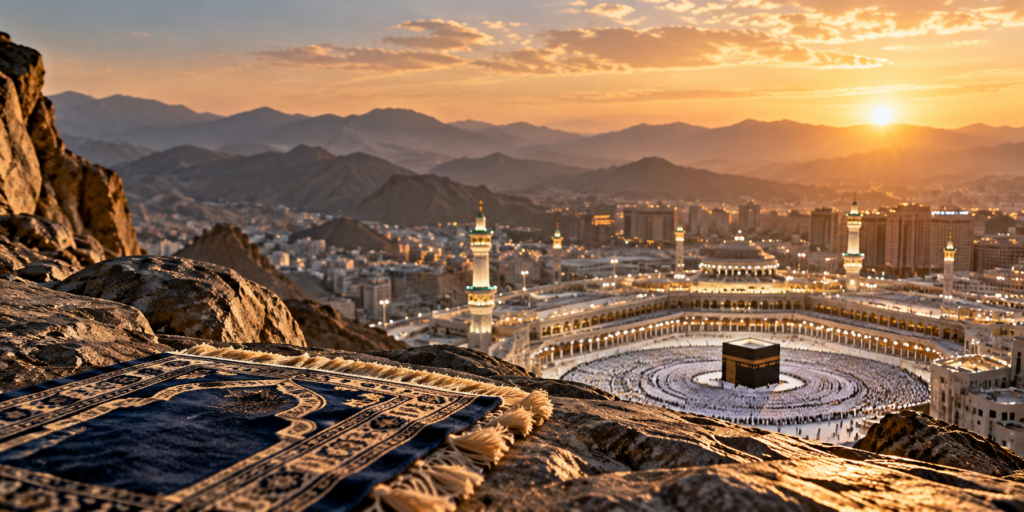
Introduction
What was the original Qibla—the direction faced during Salat?
The commonly accepted account is that Muhammad and the believers originally faced Jerusalem and were later commanded to change their direction toward the Sacred Masjid in Mecca. This understanding is repeated so frequently in both traditional Muslim sources and modern scholarship that it is often treated as though the Quran itself states it.
It does not.
The Quran certainly describes a change of Qibla in 2:142–150. However, it never identifies the previous direction as Jerusalem. More importantly, the discussion of the Qibla does not begin with Muhammad. Earlier in the same sura, the Quran takes us back to Abraham and Ishmael and the Sacred House.
When these verses are examined together, a different picture emerges: the Sacred House was established as a center of worship in the religion of Abraham; an intervening Qibla was later instituted as a test of who would follow the messenger; and the believers were subsequently directed back toward the Sacred Masjid.
The purpose of this page is to examine that evidence from the Quran itself.
The Sacred House Begins With Abraham
The Quran establishes the significance of the House long before the time of Muhammad:
We made the House a focal point for the people, and a safe sanctuary. You may use Abraham’s shrine as a prayer house. We commissioned Abraham and Ismail: “You shall purify My house for those who visit, those who live there, and those who bow and prostrate.”
2:125
The verse connects several important elements:
the House — Abraham and Ishmael — prayer — bowing — prostration.
The following verses continue the account. Abraham asks God to make the place secure (2:126), and then:
Abraham raised the foundations of the House, together with Ismail…
2:127
Thus, the Sacred House was not a religious center introduced by Muhammad. Its Quranic history reaches back to Abraham and Ishmael.
This becomes particularly important when examining the Qibla passage later in the same sura.
The First House Was at Bakkah
The Quran provides an additional identification:
The most important shrine established for the people is the one in Becca; a blessed beacon for all the people.
3:96
The Arabic describes it as the first House established for the people (awwalu baytin wuḍiʿa lil-nās).
The following verse again connects it with Abraham:
In it are clear signs: the station of Abraham…
3:97
Whatever historical traditions may subsequently say about other sacred locations, the Quran itself identifies the House at Bakkah as the first House established for humanity and associates it with Abraham.
Abraham Connects the Sacred House With Salat
Another passage makes the relationship even clearer. Abraham says:
“Our Lord, I have settled part of my family in this plantless valley, at Your Sacred House. Our Lord, they are to observe the Contact Prayers (Salat)…”
14:37
This verse is particularly significant for understanding the Qibla.
It directly connects:
Abraham → his descendants → the Sacred House → Salat.
The Quran therefore establishes an Abrahamic relationship between the Sacred House and the observance of Salat long before Muhammad.
This fits the Quran’s broader teaching that Muhammad was not introducing a new religion. He was commanded:
Then we inspired you to follow the religion of Abraham, the monotheist…
16:123
See also 3:95 and 22:78.
The religious framework is therefore one of continuity with Abraham.
The Change of Qibla
“What Made Them Change Their Qibla?” — 2:142
The passage begins:The fools among the people would say, “Why did they change the direction of their Qiblah?” Say, “To GOD belongs the east and the west; He guides whoever wills in a straight path.” 2:142Several things are immediately apparent. There was a Qibla that the believers had been following, and a change in direction generated objections. But the verse does not identify that previous direction. It does not say Jerusalem. It does not name another city or sanctuary. Instead, God immediately establishes the underlying principle:
“To God belongs the east and the west.”The authority does not belong to a geographical direction. It belongs to God. The significance of this becomes clearer in the next verse.
Why Was the Changed Qibla Established?
Verse 2:143 provides something extremely important that is sometimes overshadowed by discussions about geography.
God tells us why the Qibla they had been following was instituted:
“…We changed the direction of your original Qiblah only to distinguish those among you who readily follow the messenger from those who would turn back on their heels…”
2:143
The purpose was a test.
The issue was therefore much greater than facing east, west, north, or south. The believers were being tested as to whether they would follow God’s instruction delivered through His messenger.
The Quran elsewhere states:
“Whoever obeys the messenger is obeying God.”
4:80
The messenger did not independently create religious law. During his lifetime, however, the believers were required to follow him in carrying out God’s instructions and in matters concerning the believing community.
The Qibla therefore provided a practical test:
Would believers follow God’s direction when instructed through His messenger, or would attachment to a previous practice cause them to turn back?
An “Impartial Community”
The beginning of 2:143 states:
“We thus made you an impartial community, that you may serve as witnesses among the people, and the messenger serves as a witness among you…”
The Arabic expression is ummatan wasaṭan. Wasaṭ fundamentally conveys the idea of being in the middle or center and can carry implications of balance or impartiality.
The important point for the present discussion is what follows: the community was being tested by a change that required allegiance to God’s instruction rather than attachment to a particular direction.
The Sacred Masjid Becomes the Qibla
The next verse gives the explicit direction:
“…You shall turn your face towards the Sacred Masjid. Wherever you may be, all of you shall turn your faces towards it…”
2:144
Now compare what the Quran has already established:
2:125–127 — Abraham and Ishmael are associated with the House and its worship.
3:96–97 — the first House established for humanity is at Bakkah and contains Abraham’s station.
14:37 — Abraham settles his descendants at God’s Sacred House so that they may establish Salat.
16:123 — Muhammad is commanded to follow the religion of Abraham.
And now:
2:144 — Muhammad and the believers are commanded to face the Sacred Masjid.
Read together, these verses provide a coherent Quranic picture.
The direction specified in 2:144 is not toward a newly created religious center. It is toward the Sacred House already firmly rooted in the religion of Abraham.
The Command Is Repeated
The Quran does not leave the new instruction uncertain.
In 2:149:
“Wherever you go, you shall turn your face towards the Sacred Masjid…”
And again:
“Wherever you may be, you shall turn your faces towards it…”
2:150
The repetition establishes the Sacred Masjid as the Qibla of the believing community wherever they may be.
Original Qibla, Temporary Qibla, Restored Qibla
When the relevant Quranic passages are placed together, the sequence can reasonably be reconstructed as follows:
| Stage | Quranic Evidence |
|---|---|
| Abrahamic foundation | The House is associated with Abraham, Ishmael, prayer, bowing and prostration — 2:125–127 |
| First House | The first House established for humanity is at Bakkah — 3:96–97 |
| Sacred House and Salat | Abraham settles his descendants at the Sacred House so that they may establish Salat — 14:37 |
| Abrahamic continuity | Muhammad is commanded to follow Abraham’s religion — 16:123 |
| Intervening Qibla | A Qibla is instituted as a test of who will follow the messenger — 2:142–143 |
| Sacred Masjid commanded | Muhammad and the believers are directed toward the Sacred Masjid — 2:144 |
| Universal instruction | Wherever believers are, they face the Sacred Masjid — 2:149–150 |
This leads to a straightforward Quran-based understanding:
The Sacred House represents the Abrahamic direction of worship; an intervening Qibla was instituted as a test during Muhammad’s time; and the believers were subsequently directed back to the Sacred Masjid.
There is an important distinction, however.
The Quran explicitly states that there was a previous Qibla and explicitly states that it served as a test. It explicitly commands facing the Sacred Masjid.
The word “restored” is our conclusion from bringing these passages together. The Quran does not say in 2:144, “We are restoring your original Qibla.”
That distinction is important because the same standard should be applied to every interpretation.
Does the Quran Say the Previous Qibla Was Jerusalem?
No verse in 2:142–150 identifies the previous Qibla as Jerusalem.
In fact, Jerusalem is not named anywhere in the Quran.
The identification of Jerusalem as Muhammad’s earlier Qibla comes from sources outside the Quran and became part of the conventional historical account. The traditional identification of al-Masjid al-Aqsa in 17:1 with Jerusalem further reinforced Jerusalem’s place in that narrative.
That understanding has also entered Western academic scholarship.
For example, Stephen J. Shoemaker’s reconstruction of early Islam gives Jerusalem considerable importance. A scholarly review of his work summarizes one element of his argument by saying that the early believers’ orientation toward the Holy Land was reinforced by the supposed fact that “the qibla was originally oriented towards Jerusalem.”
The point here is not to examine Shoemaker’s larger theory. It is simply to illustrate how deeply the Jerusalem assumption has become embedded in discussions of early Islam—even when scholars approach Islamic tradition critically or claim to uphold Quran alone.
But when the question is limited to:
What does the Quran itself identify as the original Qibla?
Jerusalem cannot simply be inserted into 2:142–143. The Quran does not put it there.
Let the Quran Complete the Picture
Perhaps the most important methodological point is that 2:142 should not be read in isolation from 2:125–127.
Only seventeen verses before the Qibla discussion, the Quran has already taken the reader back to Abraham, Ishmael, the House, prayer, bowing and prostration.
Other Quranic passages then tell us:
- the House at Bakkah was the first House established for humanity (3:96);
- Abraham settled his descendants beside God’s Sacred House so that they might establish Salat (14:37);
- Muhammad was commanded to follow the religion of Abraham (16:123);
- the unnamed intervening Qibla served specifically as a test of following the messenger (2:143);
- and the believers were then commanded to face the Sacred Masjid (2:144, 149–150).
The Quran therefore provides its own framework for understanding the change of Qibla without requiring Jerusalem to complete the account.
Conclusion
The conventional description of Muhammad changing the Qibla from Jerusalem to Mecca contains an identification that the Quran itself never makes.
What the Quran actually gives us is more revealing.
It establishes the Sacred House within the religion of Abraham. It identifies the House at Bakkah as the first House established for humanity. Abraham connects the Sacred House with the establishment of Salat. Muhammad is commanded to follow Abraham’s religion. The Quran then tells us that an intervening Qibla served as a test of who would follow the messenger, after which the believers were commanded to face the Sacred Masjid.
The Quranic sequence therefore points to:
The Abrahamic Sacred House → a temporary Qibla as a test → restoration of the Sacred Masjid as the Qibla.
The central lesson extends beyond the direction of Salat. When examining any religious teaching, we should first distinguish what the Quran actually says from what later sources have supplied.