The Messenger After the Prophets (Quran 3:81)
INTRODUCTION
The Quran distinguishes between prophets and messengers and explicitly identifies Muhammad as the final prophet (33:40).
Quran 3:81 then describes a covenant taken from the prophets concerning a messenger who comes after scripture and wisdom have been given.
This page examines that verse and related passages to determine what the Quran itself indicates about messengership after the prophets.
THE COVENANT IN QURAN 3:81
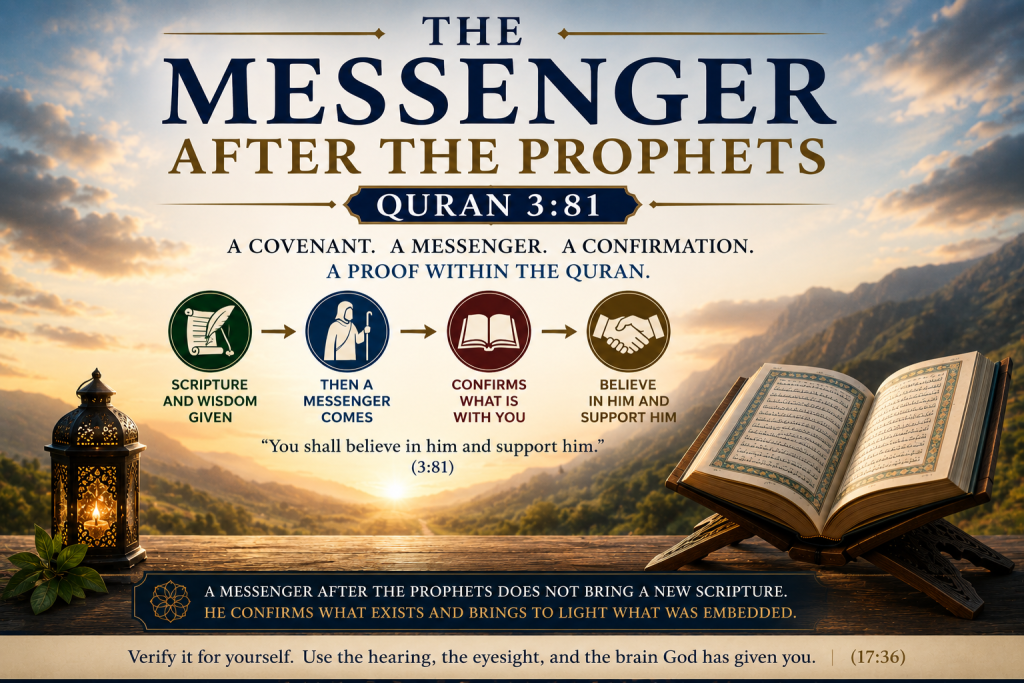
“And God took a covenant from the prophets: ‘I will give you the scripture and wisdom. Afterwards, a messenger will come to confirm what is with you. You shall believe in him and support him.’ He said, ‘Do you agree to this and accept this obligation?’ They said, ‘We agree.’ He said, ‘Then bear witness, and I am with you among the witnesses.’”
(Quran 3:81 – Rashad Khalifa translation)
KEY OBSERVATIONS FROM THE VERSE
1. The covenant is taken from all prophets
The verse is not limited to a specific prophet or time. It establishes a universal agreement across prophetic history.
2. A messenger comes after the prophets
The sequence is explicit:
- Scripture and wisdom are given
- Then a messenger comes
The sequence places the coming messenger after the giving of scripture and wisdom to the prophets. Read together with 33:40, this raises the Quranic question of messengership after the completion of prophethood.
3. The term used is “messenger,” not “prophet”
The Quran is precise in its language.
- The verse does not say prophet
- It specifically says messenger
This distinction aligns with the Quran’s confirmation that:
“Muhammad was not the father of any man among you. He was a messenger of God and the final prophet.” (33:40)
Muhammad is identified as the final prophet.
Quran 3:81 separately speaks of a messenger who comes afterward to confirm existing scripture.
4. The messenger confirms existing scripture
The role of this messenger is not to bring a new scripture, but to:
- Confirm what already exists
- Reinforce what was revealed before
This is consistent with a role of confirmation rather than the introduction of a new scripture. The messenger described in 3:81 confirms what already exists.
5. Belief in this messenger is required
The covenant is not optional:
“You shall believe in him and support him.”
This establishes accountability for recognizing and accepting such a messenger.
CONNECTION TO OTHER QURANIC PRINCIPLES
A. Finality of Prophethood (33:40)
The Quran explicitly declares Muhammad as the final prophet, not the final messenger.
This leaves open the continuation of messengers without prophethood.
B. The Quran is Fully Detailed (6:114)
“Shall I seek other than God as a source of law, when He has revealed to you this book fully detailed?”
Since the Quran is fully detailed for religious guidance and law:
- No additional scripture or independent source of religious law is required.
- A messenger after the prophets does not establish another body of religion beside the Quran.
- His role is one of confirmation and bringing to light what is already present in God’s revelation.
C. God Alone Explains the Quran (75:19)
“Then it is upon Us to explain it.”
The messenger does not become an independent interpreter or religious authority alongside the Quran. He directs people back to God’s revelation, while the Quran states that its explanation ultimately belongs to God.
THE MESSENGER AFTER THE PROPHETS
Based on Quran 3:81, the following framework emerges:
- A messenger comes after the prophets
- He does not bring new scripture
- He confirms the existing revelation
- Belief in him is required
The question naturally arises:
Has such a messenger appeared?
IDENTIFICATION: RASHAD KHALIFA
Within this Quranic framework, Rashad Khalifa claimed to be the messenger described in 3:81.
His claim therefore has to be evaluated by the Quranic criteria already established: confirmation of existing scripture, no new scripture or religious law, and evidence that can be examined.
- Directing people to the Quran alone
- Emphasizing its completeness and sufficiency
- Presenting a mathematical structure within the Quran based on the number 19
This structure is linked to the verses:
“Over it is nineteen.” (74:30)
“…a sign for the believers… and to remove doubt from the hearts of the people of the scripture…” (74:31)
THE PROOF AND THE MESSENGER
The claim concerning the messenger after the prophets is connected to a proof presented as being within the Quran itself.
Quran 74:30 states:
“Over it is nineteen.”
The following verse assigns specific functions to the number, including strengthening faith, removing doubt, and testing different responses (74:31).
The claimed relationship is therefore:
The messenger does not create the proof.
The proof is contained within the Quran.
The messenger brings that proof to light and directs people to examine it.
This distinction is important because the evidence should not depend merely upon accepting the person who presents it.
The sequence should remain:
Quranic claim – evidence – verification – evaluation of the messenger.
VERIFY THE CLAIM
The Quran does not ask people to accept religious claims merely because someone makes them.
It places responsibility upon the individual to examine evidence and use the faculties God has given.
Quran 17:36 states:
“You shall not accept any information, unless you verify it for yourself. I have given you the hearing, the eyesight, and the brain, and you are responsible for using them.”
The claim that a messenger came after the prophets should therefore be approached in the same way.
The relevant questions are:
- Does Quran 3:81 actually describe such a messenger?
- Does 33:40 end prophethood rather than all messengership?
- Does the messenger confirm existing scripture rather than bring a new scripture?
- Is the claimed proof actually present within the Quran?
- Does the claimant’s message remain subordinate to God’s revelation?
- Does the evidence satisfy the Quranic criteria being presented?
The objective is not to replace one religious authority with another.
It is to examine whether the claim can be established from the Quran itself.
CONCLUSION
Quran 3:81 establishes a clear and binding covenant:
- A messenger will come after the prophets
- He will confirm the existing scripture
- People are required to believe and support him
This is not presented as history, but as an ongoing reality tied to accountability.
The responsibility therefore remains with each individual to examine the Quranic framework, investigate the evidence, and determine whether the claim is supported by God’s revelation.
CONTINUE EXPLORING THE MESENGER AFTER THE PROPHETS
These studies move from the Quranic covenant itself to confirmation, proof, manifestations, and the specific claim associated with Rashad Khalifa.
The Quranic Framework
The Covenant Taken from the Prophets (3:81)
Examine the covenant in greater detail and the sequence of scripture, prophets, and the confirming messenger.
Finality of Prophethood
Study Quran 33:40 and the distinction between Muhammad as the final prophet and the Quranic use of the term messenger.
Messenger vs. Prophet
Examine how the Quran uses the two terms and why the distinction matters.
Confirmation After the Prophets
The Messenger Who Confirms What Exists
Explore why the messenger in 3:81 confirms existing scripture rather than bringing another scripture.
Bringing to Light What Was Embedded
Examine the distinction between introducing new revelation and revealing evidence already present within the Quran.
Completion of Accountability
Explore how confirmation and evidence increase individual responsibility before God.
The Proof
The Proof Is Contained Within the Quran
Begin with the Quranic declaration concerning nineteen and the claim that the authentication is embedded within the Quran itself.
Appendix 1 — One of the Great Miracles
Examine the detailed mathematical evidence associated with the number nineteen.
Appendix 24 — Quran 9:128–129
Examine the claimed use of the mathematical structure in identifying two later additions to the Quranic text.
A Sign for Believers, Doubters, and Rejecters
Study the responses to the proof anticipated in Quran 74:31.
Proof Does Not Compel Belief
Explore why evidence does not eliminate human choice.
Manifestations After the Prophets
Quranic Manifestations After the Prophets
Examine the manifestations presented as confirmation of the messenger after the prophets.
The Smoke in Sura 44
Study the Smoke and its role as a warning and manifestation connected with accountability.
Rashad Khalifa – Messenger of the Covenant
Rashad Khalifa — Messenger of the Covenant
Explore his identification as the Messenger of the Covenant, the mathematical proof, the purpose of life, the Quran-alone message, religious practices, and other information brought to light from within the Quran.
Appendix 2 — The Messenger of the Covenant
Read Rashad Khalifa’s detailed presentation of the claim and the Quranic evidence he associated with it.